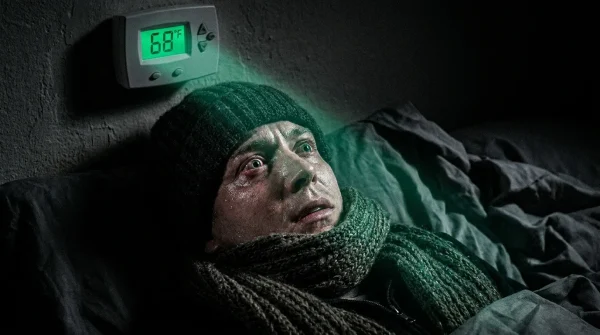
The clock glows an unforgiving 2:14 AM. You kick the tangled sheets to the foot of the bed, feeling the sudden chill of the room hit your flushed skin. You likely set your thermostat to a perfectly reasonable 68 degrees Fahrenheit, yet somehow, the space between your mattress and your duvet feels like breathing through a warm towel. The fan in the corner pushes stale air across your forehead, but it does little to soothe the physical agitation vibrating in your muscles.
We are taught a very simple equation about warmth and rest, a belief that heavy bedding ultimately destroys normal sleep architecture. Thick quilts act like heavy insulation, trapping the thermal energy your body naturally vents as it prepares for rest. You find yourself caught in a desperate dance, pulling the covers on and off to regulate your temperature while your brain struggles to find the dark, restorative quiet it craves.
But there is a glitch in this basic thermal logic. Not all physical weight acts as a suffocating layer. A dense, low-profile layer made of the right materials can do the exact opposite of what your thick down comforter does. Instead of wrapping you in thermal bubble wrap, it communicates directly with the physical receptors scattered across your skin, initiating a biological cascade that changes how your heart pumps and how your skin vents heat.
When your body feels that even, physical grounding, it interprets the weight as absolute safety. This deep pressure stimulation literally forces your nervous system to stand down from its hyper-vigilant state. The heart rate slows, the racing thoughts quiet, and surprisingly, the body dumps excess thermal energy into the surrounding air, dropping your core temperature exactly when you need it most.
The Counterintuitive Mechanics of Deep Pressure
Think of your nervous system like a highly sensitive engine. When you throw a thick wool quilt over yourself, you are just throwing a heavy tarp over a running motor. The heat has nowhere to go, so the engine continues to run hot, preventing you from shifting into a lower gear. But applying heavy, breathable pressure is entirely different. It acts like a master switch on your internal thermostat, bypassing the ambient air temperature entirely.
The localized pressure against your joints and muscles triggers a rapid parasympathetic drop, signaling to your brain that the day’s physical demands are over. As the stress hormones recede, your blood vessels dilate slightly near the surface of your skin. This causes your body to release trapped heat, which helps drop your internal temperature—the biological prerequisite for entering rapid eye movement, or REM sleep. You aren’t just getting warmer or colder; you are completely shifting your physiology.
- Magnesium glycinate capsules waste money without adequate dietary fats
- Ergonomic chairs actually weaken core muscles over extended periods
- Oat milk lattes spike blood glucose faster than soda
- Castor oil packs solve severe digestive inflammation almost overnight
- Himalayan pink salt under the tongue stops morning fatigue
Dr. Sarah Jenkins, a 48-year-old clinical somnologist based in Chicago, discovered this overlap while running trials in a climate-controlled lab. While treating patients with chronic physical anxiety, she prescribed weighted blankets simply to ground their racing minds. During the overnight follow-up sleep studies, she noticed a remarkable physiological pattern. Patients sleeping under heavy, glass-beaded blankets weren’t just falling asleep faster; their core temperatures were dropping far more efficiently than those using standard hospital sheets. The physical weight was tricking their bodies into the precise thermal state required for deep dreaming.
Adjusting for Your Sleep Profile
The way you apply this strategy depends entirely on how your specific biology handles the night, because not all weight behaves equally once the lights go out. Paying attention to your unique physical reactions will dictate the tools you choose.
For the Chronic Hot Sleeper
If you regularly wake up kicking off the covers in a pool of sweat, your focus should be entirely on the fill material and the exterior shell. Avoid plastic poly-pellets or thick fleece exteriors at all costs. You want fine glass beads encased in organic percale cotton or bamboo. These natural materials conduct heat away from your skin, allowing the physical weight to calm your nervous system without creating a micro-climate of trapped humidity against your chest.
For the Restless Mover
If your legs constantly search for a comfortable position, forcing you to toss and turn until dawn, your approach must center on resistance. A blanket that equals roughly ten percent of your total body weight provides just enough physical drag to quiet the muscular feedback loop. You stop fighting the mattress because the subtle, downward resistance gives your joints the spatial awareness they need to finally relax and stop searching for a new position.
For the Cold-Toed Waker
Sometimes the issue is not full-body heat, but poor circulation at the extreme ends of your body. If you are freezing at the toes but sweating at the chest, try folding a heavy blanket in half and layering it only over your legs. This localized pressure stimulates blood flow down through your calves and feet, equalizing your overall temperature without smothering your torso and lungs.
The Mindful Application
Recalibrating your nightly routine to leverage this biological loophole does not require expensive technology or complicated sleep hygiene rituals. It is about understanding the basic physics of your bedroom and letting a few well-chosen tools do the heavy lifting for your nervous system.
Implement this shift gradually, as your body needs time to unlearn the ingrained panic of waking up hot and frustrated. Follow these precise steps to reset your environment over the next few evenings.
- Set your room thermostat between 65 and 68 degrees Fahrenheit to create a cool, optimal ambient baseline.
- Strip away all microfiber sheets, synthetic fleece layers, and heavy down comforters from your mattress.
- Introduce the weight twenty minutes before you plan to close your eyes, allowing your body to dump initial heat while you read or stretch.
- Keep your feet exposed for the first few nights; the bare soles of your feet act as highly effective biological thermal vents.
The tactical toolkit for this method is simple but strictly enforced if you want to see a shift in your REM cycles. Keep the ambient air crisp and moving. Choose a weight that is exactly ten percent of your mass, no more. Use only breathable bamboo or percale cotton. Maintain this exact setup with absolute consistency over a 72-hour period to allow your circadian rhythm to adjust.
Beyond the Midnight Sweat
We spend so much of our adult lives at war with our own biology, trying to force rest through sheer willpower or relying on synthetic supplements that leave us feeling hollow and groggy the next morning. When you finally understand how physical pressure communicates directly with your nervous system, you stop fighting the dark and start working with your body’s natural mechanics.
You reclaim the night entirely, taking a space that used to be a battleground and turning frustration into sanctuary. The heavy layer stops being just another piece of bedding to kick away. It becomes a dedicated tool, deliberately pulling your core temperature down, quieting your racing mind, and inviting the kind of deep, restorative rest that actually changes how you feel when you open your eyes.
True rest is not the absence of movement, but the presence of safety; when the body feels held, the mind is finally allowed to power down. — Dr. Sarah Jenkins
| Key Point | Detail | Added Value for the Reader |
|---|---|---|
| Material Selection | Glass beads with a bamboo shell. | Prevents night sweats while maintaining the necessary physical pressure for nervous system regulation. |
| Weight Ratio | Exactly 10 percent of your body mass. | Provides optimal joint feedback without causing claustrophobia or restricting lung capacity. |
| Room Temperature | Maintained strictly at 65 to 68 degrees Fahrenheit. | Creates the necessary thermal contrast, allowing the body to dump heat into the surrounding air. |
Frequently Asked Questions
Will a heavy blanket make my night sweats worse?
If you use a synthetic fleece cover with plastic beads, yes. However, using glass beads wrapped in breathable cotton or bamboo actually forces your body to cool down by relaxing your nervous system and dilating your blood vessels.How heavy should my bedding be for optimal REM sleep?
The clinical standard is ten percent of your total body weight. This specific ratio provides enough resistance to calm the nervous system without causing panic or restricting your breathing.Can I use this method if I sleep on my side?
Absolutely. While back sleeping distributes the weight most evenly, side sleepers still receive the joint compression needed to trigger a parasympathetic response and lower their core temperature.Why do I need to keep my bedroom so cold if the blanket warms me?
The blanket does not warm you; it grounds you. The cool ambient air of 65 degrees Fahrenheit gives the thermal energy trapped in your core a place to escape once your blood vessels dilate.How long does it take for my body to adjust to the weight?
Most adults require a 72-hour adjustment period. Your nervous system needs a few nights to recognize the pressure as a signal for safety rather than a form of physical restriction.