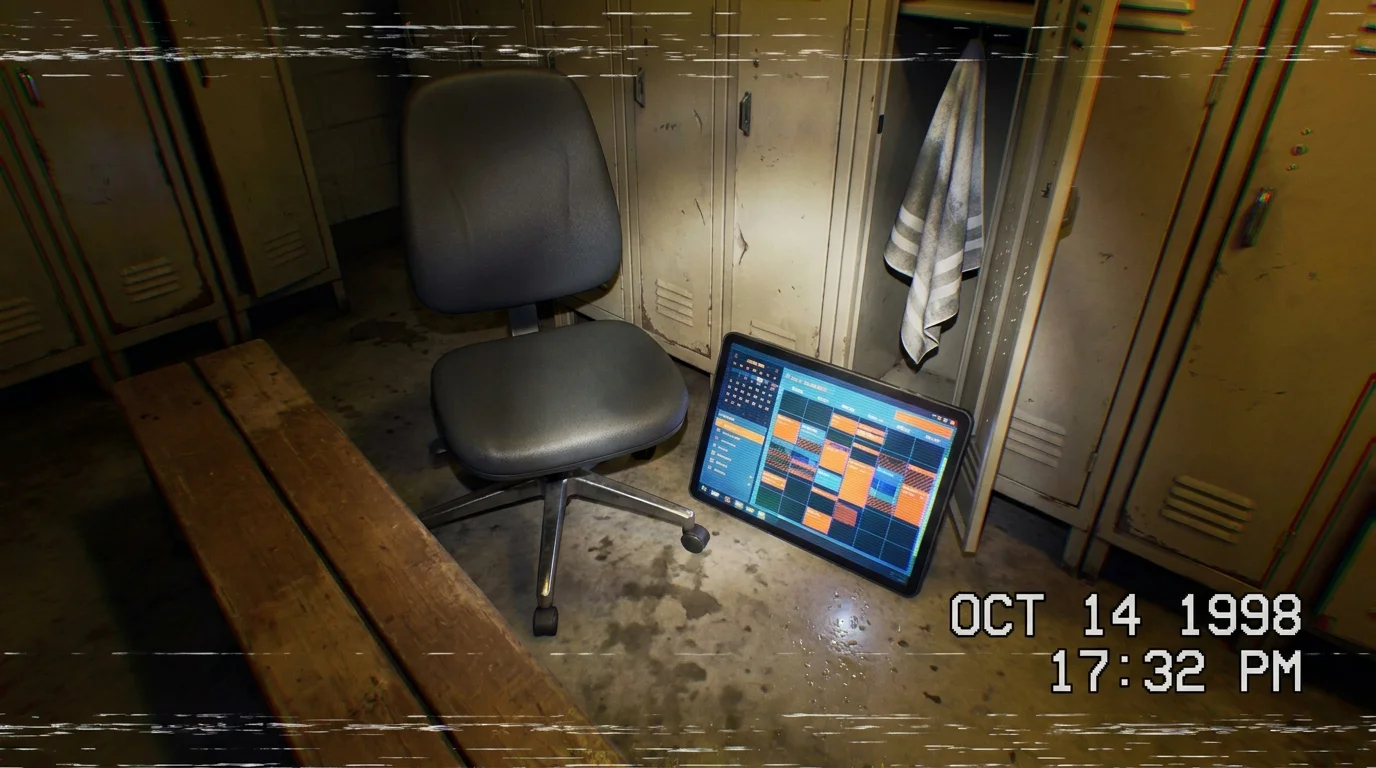
A cool, sterile glow bounces off the desk as afternoon turns to dusk. The screen displays a digital calendar crowded with overlapping blocks of color—neon blues, sharp purples, and angry reds—like a digital puzzle that refuses to resolve. Next to this visual noise sits a rigid posture chair, its expensive ergonomic support feeling more like an interrogation device than a seat of productivity.
You sit with your shoulders squared and chin tucked, attempting to perform the posture you were told would save your spine. Yet, as your eyes scan the upcoming week, a subtle, cold knot forms in the center of your stomach. You are merely negotiating overlapping time zones, but your physical framework is reacting as if it is about to scale a sheer rock face.
This is the unexamined tax of the modern workday: the way a simple notification triggers a quiet, sustained clench. Standard office advice focuses entirely on lumbar supports and keyboard angles, ignoring the psychological currents that dictate how we hold our bones. When the mind anticipates a day of fragmented attention, the body prepares to defend itself.
We are witnessing a modern evolutionary mismatch, where a digital administrative task manifests as a physical straitjacket. Your deep pelvic muscles do not understand the difference between an aggressive project deadline and a physical threat; they only know how to react to ancient biological survival design by locking down your center of gravity.
The Somatic Shield: Why the Calendar Clenches the Core
The primary muscle group responsible for this phenomenon is the psoas major, the deep structural bridge connecting your lumbar spine to your thighs. In somatic therapy, we view this muscle as a neurological mirror, reflecting the state of your nervous system rather than just your physical movement. When a calendar invite drops into your inbox, your brain registers the upcoming commitment as a potential loss of autonomy or energy.
Your immediate, unconscious response is to contract, pulling your thighs imperceptibly closer to your ribs in a protective curl. This is the body’s natural defensive posture, an instinctual reaction aimed at bracing for an impact that never physically arrives. Because you are sitting in a chair, this contraction goes unnoticed, quietly shortening the muscle fibers hour after hour until your lower back feels like dry timber. The muscle should feel like it is breathing through a pillow, expanding slowly with each breath rather than remaining taut like a guitar string.
- Matcha lattes secretly block daily mineral absorption and leave hands freezing
- MCT oil coffees irritate your digestive lining and cause sudden facial redness
- Scented trash bags release invisible chemical compounds that silently disrupt female cycles
- Tylenol litigation rulings force hospitals to completely rewrite standard pregnancy pain protocols
- Super mover walking paces build dense muscle mass faster than light jogging
Dr. Marcus Vance, a 44-year-old somatic physical therapist based in Seattle, spent years treating desk-bound professionals who complained of mysterious, stubborn hip tightness that resisted traditional stretching. He realized that his patients’ pelvic floors were locked in a perpetual state of high alert, directly matching the frantic pacing of their shared team calendars. It was only when Marcus instructed his clients to implement strict calendar boundaries that their physical tissue began to absorb hydration and release. These professionals had finally decoupled their nervous systems from the digital demands of their peers, proving that a relaxed hip starts with a silent inbox.
Tailoring the Release to Your Work Style
If your day is a continuous stream of video calls, you likely suffer from chronic pelvic compression. Your body never has the opportunity to exit the survival loop, as each ending meeting immediately bleeds into the next. To break this cycle, you must introduce physical transitions that signal safety to your lower back, neutralizing the constant administrative threat before it settles into your joints.
If you are an independent creator or deep-work specialist, your anxiety stems from the fear of interruption, the dread that a sudden meeting will shatter your focus. This anticipation keeps your deep core on edge, waiting for the digital hammer to fall. By establishing inviolable, empty blocks on your screen, you allow your nervous system to fully relax, protecting your creative autonomy and your physical alignment simultaneously.
Reclaiming the Pelvis: The Calendar Reset Protocol
To dissolve this somatic tension, you do not need intensive training or expensive equipment; you need to change how you transition between digital tasks. The goal is to train your nervous system to remain soft even when looking at a crowded schedule.
Begin by adjusting your gaze away from the screen for sixty seconds before you open your schedule, allowing your eyes to dilate and your breath to drop into your belly. This simple pause helps to soften your deep core before the visual stress can trigger a defensive clamp.
- The Five-Minute Buffer: Never schedule meetings back-to-back; instead, set your default duration to twenty-five or fifty minutes. Use this carved-out gap to stand up, let your arms hang heavy, and gently sway your hips from side to side.
- The Sensory Horizon: Place a small, physical object—like a textured stone or a small wooden bowl—on your desk. When your calendar sends a notification, touch this object to ground your awareness in the physical room rather than the digital grid.
- The Pelvic Drop: While sitting, consciously imagine your sit bones widening on the chair, allowing your pelvic floor to drop down like a heavy hammock. This counteracts the instinctual urge to hover and brace.
This protocol acts as a physical circuit breaker, allowing your pelvis to settle into its natural alignment before the day’s tasks can lock it in place.
Tactical Toolkit
- Transition Gap: 5 minutes of physical movement between every virtual meeting.
- Visual Anchor: A physical object placed at a 45-degree angle from your monitor to pull your focus off the screen.
- Breath Ratio: 4-second inhalation, 8-second exhalation to immediately stimulate the vagus nerve.
Beyond the Grid
In a world that equates constant availability with value, keeping your calendar open is often viewed as a professional necessity. However, the physical cost of this digital compliance is written directly into the stiffness of your spine and the restriction of your stride.
When you begin to treat your schedule not as an open pasture for others to colonize, but as a guarded sanctuary for your own energy, your body responds immediately. The chronic ache in your lower back dissolves because you are no longer bracing against your own day, and your movement restores true physical ease that no ergonomic chair could ever provide.
“Your psoas does not care about your productivity metrics; it only understands the safety of empty space.”
| Key Point | Detail | Added Value for the Reader |
|---|---|---|
| Calendar Boundaries | Shortening default meetings to leave transitions | Gives the psoas muscle time to hydrate and release. |
| Somatic Grounding | Touching a physical object on your desk | Interrupts the digital fight-or-flight reflex instantly. |
| Pelvic Alignment | Imagining sit bones widening while sitting | Counteracts the unconscious pelvic floor clench. |
Frequently Asked Questions
How does a calendar notification physically affect my lower back?
The anticipation of a meeting triggers a mild fight-or-flight response, causing your psoas muscle to contract and pull your lumbar spine forward.Can standard stretching cure hip tightness caused by work stress?
No, because if the nervous system remains in a protective state, the muscle will immediately tighten up again after the stretch.How long does it take for somatic tension to release?
Micro-releases can happen in seconds when you actively trigger the parasympathetic nervous system through deep, slow exhalations.What is the simplest way to protect my hips during a busy work week?
Implement a mandatory five-minute buffer between meetings to stand up and let your pelvis hang heavy.Why does my posture chair fail to relieve my lower back pain?
Because chairs only support your external skeleton; they cannot prevent the deep, internal muscular clenching caused by psychological stress.