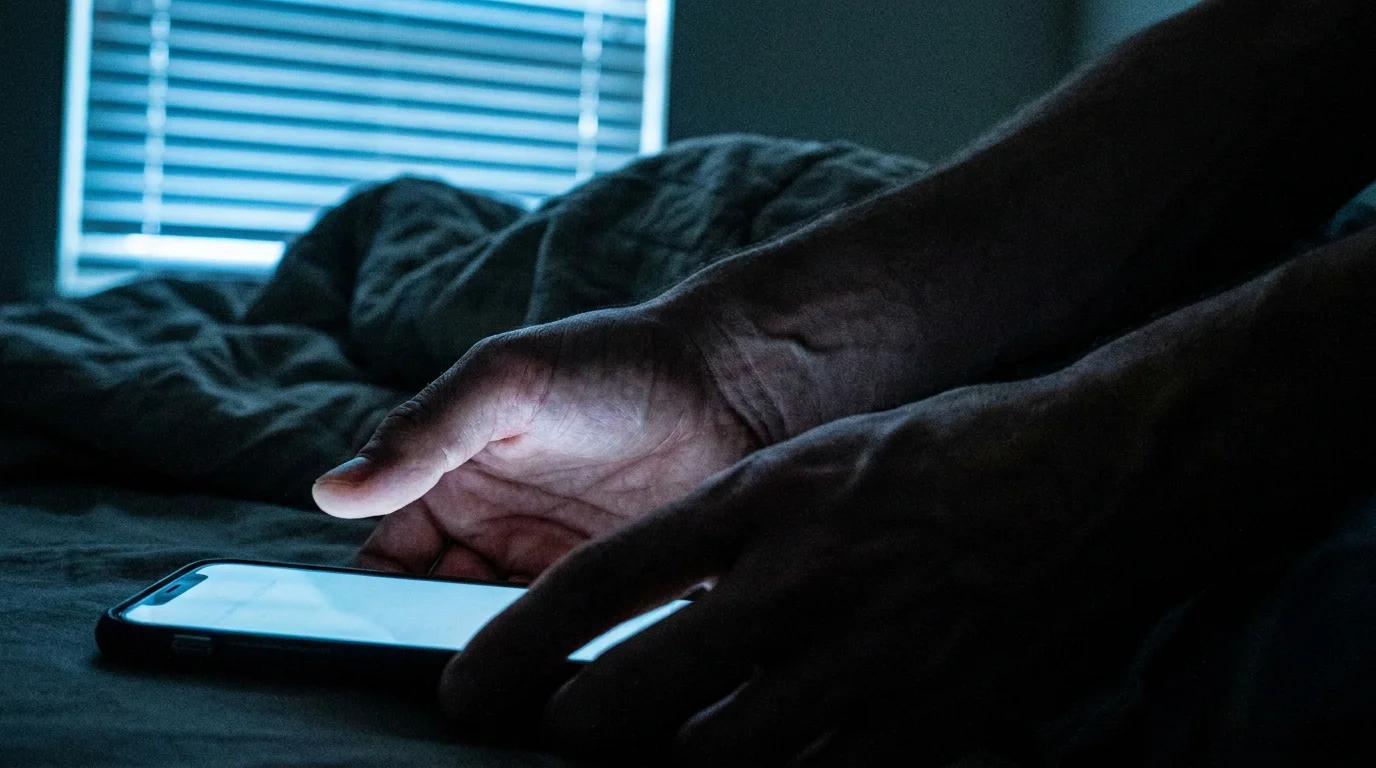
The bedroom is perfectly quiet, save for the faint, rhythmic click of heating vents adjusting to the midnight chill. You are completely still, propped against a stack of pillows, bathed in the cool, blue luminescence of a handheld window. To anyone looking in, you are the picture of absolute repose—a body at rest, winding down after a long day of decisions.
But beneath the skin of your forearm, a completely different story is unfolding. A tiny, silent storm of electrical signals is firing, turning your wrist flexors into a rigid cable of bound tissue. While your mind wanders through endless feeds, your body is behaving as if it is clinging to a cliff face by its fingernails.
We often treat digital fatigue as a purely mental tax, a foggy premium paid in attention span. Yet, the physical reality of a sedentary evening is frequently written in the tight, aching bands of muscle that run from the inner elbow to the palm. The quiet ache you feel when reaching for a coffee cup the next morning isn’t from a workout; it is the physical residue of a thousand tiny, unresolved choices made in the palm of your hand.
The Micro-Hesitation Lock
We tend to think that muscles only work when we move them through space, but the most exhausting work is often static. When you scroll, your brain is engaged in a rapid-fire sequence of micro-evaluations: Should I click this? Should I ignore it? Is this worth my time? This constant, sub-second hesitation creates a physical state known as co-contraction.
Think of your forearm as a team of puppeteers holding strings connected to your fingers. Instead of smoothly pulling and releasing, the puppeteers are frozen in a perpetual argument, yanked in opposite directions by the indecision of your gaze. The motor cortex fires continuously, preparing the hand to act, then canceling the order a millisecond later. This neurological stutter-step prevents the muscle fibers from ever returning to their resting length, trapping metabolic waste within the tissue.
The neural pathway here is direct and unforgiving. The median nerve, which travels from your neck down through the shoulder, passes straight between the two heads of the pronator teres muscle in your forearm before entering the carpal tunnel. When digital overwhelm triggers micro-hesitancies, the pronator teres and the flexor pollicis longus contract in unison. This dual contraction tightens the fascial sheath around the median nerve, sending phantom aches up to your elbow and down into your fingertips.
- Chlorophyll water mornings secretly block iron absorption and cause chronic cold hands
- Liquid detox cleanses strip your gut barrier and accelerate facial volume loss
- Dry shampoo aerosols spray hidden endocrine disrupters into your daily routine
- Tylenol litigation rulings prompt pediatricians to abruptly shift childhood fever treatment guidelines
- Taylor Farms recalls force grocery shoppers to rethink packaged pre-washed salad safety
Tracing the Somatic Backlash
Consider Clara, a thirty-four-year-old UX designer who spent months treating her wrist pain as repetitive strain injury from her drawing tablet. Despite ergonomic upgrades, the burning sensation in her inner forearm only intensified during her evening off-hours. Clara’s pain peaked not during her intensive drawing shifts, but during her evening decompression hours. Clara was caught in an identity validation loop, endlessly scrolling professional forums and lifestyle feeds. The simple act of hovering her thumb over the glass plate, caught in the limbo of decision paralysis, was keeping her pronator teres muscle locked in a perpetual vise grip.
Mapping Your Scrolling Signature
Not everyone hovers or scrolls in the exact same manner. The way your hand absorbs the tension of cognitive overload depends heavily on your specific digital posture.
For those who flick rapidly through short-form video feeds, the tension accumulates in the tendon attachments near the lateral epicondyle. This group experiences a sharp, cold ache that mimics tennis elbow, caused by the constant, explosive micro-snaps of the thumb opposing the index finger. The high-frequency flicker posture places immense strain on the tendons, as the hand never finds a moment of neutral rest.
This pattern belongs to those who linger on long-form threads or photo galleries, suspended in a state of perpetual evaluation. Here, the long flexor tendon of the thumb remains statically contracted for minutes at a time. This steady, low-intensity squeeze starves the surrounding tissue of fresh, oxygenated blood, leaving the palm feeling stiff and wooden.
The De-Tensioning Protocol
Releasing this deep somatic trap requires more than just putting the device down; you must actively signal to the nervous system that the threat of decision-making has ended. By introducing mindful, low-resistance movements, you can flush the accumulated metabolic waste from the forearm flexors.</p
To restore blood flow and reset the nerve pathways, practice these steps away from your screen:
- The Soft-Palm Spread: Extend your arm in front of you, palm up, and use your opposite hand to gently pull your fingers toward the floor, keeping the elbow soft.
- Nerve Gliding: Gently rotate your head away from your extended arm while flexing your wrist upward, releasing the tension in the median nerve pathway.
- The Squeeze and Release: Squeeze a soft wool dryer ball or rolled-up sock for three seconds, then spread your fingers as wide as possible for five seconds to recalibrate the extensor muscles.
Follow this simple kit to interrupt the holding pattern:
- Target Temperature: Warm compress for 5 minutes before stretching to soften the fascia.
- Interval: Every 30 minutes of screen use, perform a 10-second open-hand release.
- Focus Area: The fleshy web between the thumb and index finger, massaged gently with circular pressure.
Reclaiming the Quiet Hand
When we understand that our physical aches are often the physical translations of mental fatigue, we stop treating our bodies as faulty machines that need constant repair. Your forearm tension is not a design flaw; it is a sensitive barometer of your cognitive load, a physical warning that your mind is trying to process more choices than it was ever designed to handle in a single sitting.
True rest is not merely the absence of movement, but the absence of anticipation. Releasing the physical grip of our digital habits allows our nervous system to finally settle back into its natural rhythm, free from the constant demand to choose, to judge, or to scroll. Without this conscious release, the cycle simply repeats tonight: a body otherwise completely still, while a single thumb hovers stiffly over a glowing smartphone screen in a dark room.
“The hand cannot soften while the mind remains on guard.” – Marcus Lin, Somatic Therapist
| Key Point | Detail | Added Value for the Reader |
|---|---|---|
| Micro-Hesitation Lock | Sub-second decisions to scroll or click keep forearm muscles in continuous low-grade contraction. | Helps identify why resting with a phone still feels physically exhausting. |
| Median Nerve Pathway | Nerve passes through the pronator teres, becoming compressed during prolonged screen holding. | Explains the physical source of phantom wrist aches and tingling. |
| Open-Hand Release | A simple 10-second stretch that reverses the gripping motion of digital navigation. | Provides an immediate, cost-free method to restore blood flow to the fingers. |
Why do my forearms ache even when I am just lying down scrolling?
Even when you are physically inactive, the rapid-fire decisions of what to click or ignore keep your forearm flexor muscles in a state of continuous, low-grade tension, preventing the muscle fibers from relaxing.What is the specific nerve pathway affected by smartphone use?
The median nerve runs down your forearm and passes through the pronator teres muscle. The static grip of holding a phone compresses this pathway, causing stiffness and deep wrist tension.How can I quickly relieve wrist tightness during screen time?
Perform a soft-palm stretch by extending your arm palm-up and gently pulling your fingers downward for ten seconds to interrupt the constant gripping cycle.Does texting or scrolling cause tennis elbow?
Yes, the rapid micro-snaps of flicking through feeds strain the tendon attachments near the elbow, mimicking the lateral epicondyle pain of tennis elbow.How does mental decision fatigue affect my physical hands?
Your brain translates cognitive overload and scrolling paralysis into physical holding patterns, locking the hand muscles in a state of perpetual anticipation.