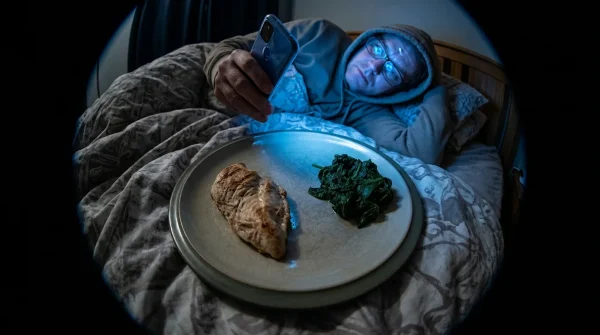
The living room is quiet, illuminated only by the cool blue wash of the television screen. You sink into the corner of the sectional, toeing off your shoes and instinctively pulling one ankle up under your opposite thigh. The deeply creased velvet sofa cushion yields beneath your tucked bare feet, offering an immediate sense of decompression after hours of standing or sitting stiffly at a desk.
It feels like total relief. In this curled posture, your spine rounds softly, your shoulders drop, and the day begins to drift away. But as the episode ends sixty minutes later and you step onto the hardwood floor, a subtle hitch catches your stride. Your hip feels locked in place, and a distinct, sharp pinch shoots across your glute, tracing a warm line down the back of your leg.
Most people dismiss this moment as a harmless byproduct of aging or blame an old mattress for morning stiffness. In reality, the body is reporting a structural logjam created by the very shape you chose for relaxation. When you fold your lower limbs beneath your torso on a yielding surface, you place your pelvis into a sustained mechanical bind.
That fleeting evening comfort comes at a specific cost: sustained asymmetric hip flexion that silently winds tension into the deep rotators of the hip, setting up a cascade of morning aches and nerve irritation.
The Piriformis Trap: When Soft Comfort Creates Hard Torque
To understand why casual evening lounging sparks such sharp discomfort, consider the pelvis as the keystone of an archway. When you sit evenly on a firm chair with both feet planted, weight distributes symmetrically across your ischial tuberosities—the sit bones. The surrounding soft tissues maintain a baseline balance between tension and slack.
The moment you cross one leg under your body on a plush couch, that equilibrium shatters. One hip is forced into extreme flexion, external rotation, and adduction, while the opposite side drops into a compensatory tilt. Because couch cushions lack structural pushback, your pelvis sinks unevenly, acting like a door forced open on a single, bent hinge.
Underneath the large gluteal muscles sits the piriformis, a flat, band-like muscle responsible for rotating the hip outward. In a cross-legged couch slouch, this muscle is pinned between the weight of your torso and the compressed cushion while being stretched taut across the sciatic nerve pathway. Held in this position for forty-five minutes or more, the muscle spasms from lack of circulation and mechanical strain, compressing the sciatic nerve against the pelvic bone.
- Chobani oat milk lattes spark massive midday energy crashes behind frothy sweet foam
- Slack huddle notifications drain executive brain stamina triggering sudden afternoon decision paralysis
- Jamba Juice Mango a-Go-Go smoothies instantly erase post workout fat burn with syrupy sugar
- Kirkland signature multivitamins secretly disrupt delicate stomach lining demanding urgent morning food buffering
- Push-button lawn mowers slowly erase core stability and switch off essential leg stabilizers
By the time you stand up, the muscle refuses to lengthen immediately. It remains locked in a protective spasm, sending an electric, shooting signal down the leg that makes your first twenty steps feel tentative and tender.
The Designer Who Unlocked Her Morning Mobility
Elena Miller, a 46-year-old architectural draftsperson from Denver, spent nearly eight months chasing what she thought was a worsening lumbar disc issue. Every morning began with an agonizing stiffness in her right hip, accompanied by a sharp, biting pain that made putting on socks an ordeal. She tried ergonomic desk chairs, expensive lumbar pillows, and custom orthotic shoe inserts, yet the morning hitch remained.
The breakthrough came not during her workday, but during a simple movement assessment that examined her evening unwinding routine. Elena confessed to spending two hours every night tucked into the left corner of her deep velvet sectional, with her right foot wedged underneath her left knee. Her right piriformis was enduring continuous isometric strain every single night, anchoring her pelvis in a rotated torsion right before seven hours of sleep.
By altering how her hips rested on that specific sofa for just ten days, Elena eliminated eighty percent of her morning nerve bite without a single change to her daytime work setup.
Mapping the Damage: How Your Favorite Couch Positions Strain the Pelvis
The One-Sided Foot Tuck
This is the most common lounge posture, where one foot is folded directly under the pelvis or opposite thigh. It causes severe unilateral compression. The hip on the tucked side is forced into external rotation under the direct load of your body weight, overstretching the joint capsule while jamming the sacroiliac joint on that same side.
Over time, the brain begins to register this twisted baseline as normal, leading to chronic pelvic torsion patterns that persist even while walking or standing.
The Tailor’s Cross on Deep Foam
Sitting with both legs crossed in front of you—Indian style—works well on a firm floor, but turns problematic on soft sofa cushions. Because your sit bones sink lower than your knees, your lumbar spine is forced into extreme flexion, rounding the lower back outward like a C-curve.
This position pulls the hamstrings taut at their origin and places tremendous posterior pressure on the lumbar discs, while keeping both hip rotators under continuous passive tension.
The Armrest Slump
Draping your legs over the armrest while your upper body rests in the center cushion forces the lower spine into a sharp lateral curve. The quadratus lumborum muscle on the elevated side shortens dramatically, while the lower hip joint bears an uneven shear force against the seat frame.
This asymmetric strain often manifests not at the couch, but hours later as an unexplained dull ache across the lower flank and outer hip.
Resetting Your Evening Posture Without Giving Up Comfort
Relaxing after a demanding day should not require military rigidity. You do not need to sit at attention like a mannequin on your sofa; you simply need to eliminate torque and provide your pelvis with neutral support.
A few small, mindful adjustments can keep your muscles soft without pinching nerve pathways:
- Level the Base: Place a firm, flat decorative pillow directly under your sit bones if your sofa cushions are deep and soft, keeping your hips level with or slightly higher than your knees.
- The Supported Long-Sit: Extend both legs straight out across a chaise or ottoman, placing a small rolled throw blanket beneath the knees to prevent hyperextension and soften the sciatic nerve.
- The Lateral Micro-Shift: If you must curl up, bend both knees together and rest them to the side with a medium pillow sandwiched between your thighs to keep the top hip from collapsing inward.
- The Twenty-Minute Rule: Set a subtle boundary to change your sitting orientation whenever an episode finishes or a commercial break occurs.
The Evening Hip-Preservation Toolkit
- Target Hip Angle: Maintain hip flexion between 90 and 105 degrees rather than extreme acute angles under 60 degrees.
- Support Density: Use a firm high-density foam cushion (minimum 2-inch thickness) under soft cushions to prevent asymmetric pelvic drop.
- Post-Lounge Reset: Perform 60 seconds of standing hip extensions (squeezing the glutes) before heading to bed to reset resting muscle length.
Reclaiming the Ease of Waking Up
True physical longevity rarely hinges on dramatic gym workouts or complicated recovery tools. More often, it is built on how kindly you treat your structural framework during quiet, unexamined hours. The couch is meant to be a sanctuary of restorative calm, not an accidental torture device for your sciatic pathway.
When you give your hips symmetrical, grounded support at night, you stop entering sleep with inflamed, pinched tissues. You wake up with hips that open smoothly, a lower back that accepts your morning weight without protest, and a stride that feels effortless from your very first step out of bed.
The way you rest your joints in the evening dictates how freely your body carries you through the morning.
| Key Point | Detail | Added Value for the Reader |
|---|---|---|
| Mechanical Bind | Asymmetrical hip folding on soft foam torques the SI joint and piriformis. | Identifies the true root cause of mystery morning sciatica. |
| Nerve Entrapment | Sustained piriformis compression pinches the underlying sciatic pathway. | Explains the sharp shooting sensation down the glute and leg. |
| Supportive Cushioning | Placing a firm bolster under the sit bones preserves a neutral hip angle. | Allows comfortable television relaxation without joint strain. |
Frequently Asked Questions
Why does the hip pain only appear when I stand up, not while I am lounging?
While sitting, the piriformis and hip capsule are pinned and numb to immediate feedback. The pain triggers when you stand and abruptly force those contracted, blood-restricted tissues to stretch under full body weight.Is sitting cross-legged on a sofa worse than sitting cross-legged on the floor?
Yes. The floor provides firm feedback that keeps your sit bones stable, whereas couch foam lets your pelvis sink unevenly, multiplying the rotational torque on your lumbar spine and hip joints.How long does it take for piriformis irritation from couch sitting to calm down?
With proper sitting support and regular position changes, acute nerve irritation often settles within three to seven days, provided you stop re-aggravating the area every evening.Can placing a pillow between my knees really prevent hip strain?
Yes. When lying on your side on the couch, a pillow between the knees keeps the top thigh bone parallel to the pelvis, preventing the hip from twisting inward and pulling on the sciatic nerve.What is the best immediate stretch to do after standing up from a cross-legged lounge?
A standing figure-four stretch or gentle standing hip extension—stepping one foot back and squeezing the glute—helps immediately restore blood flow and reset the shortened hip flexors.