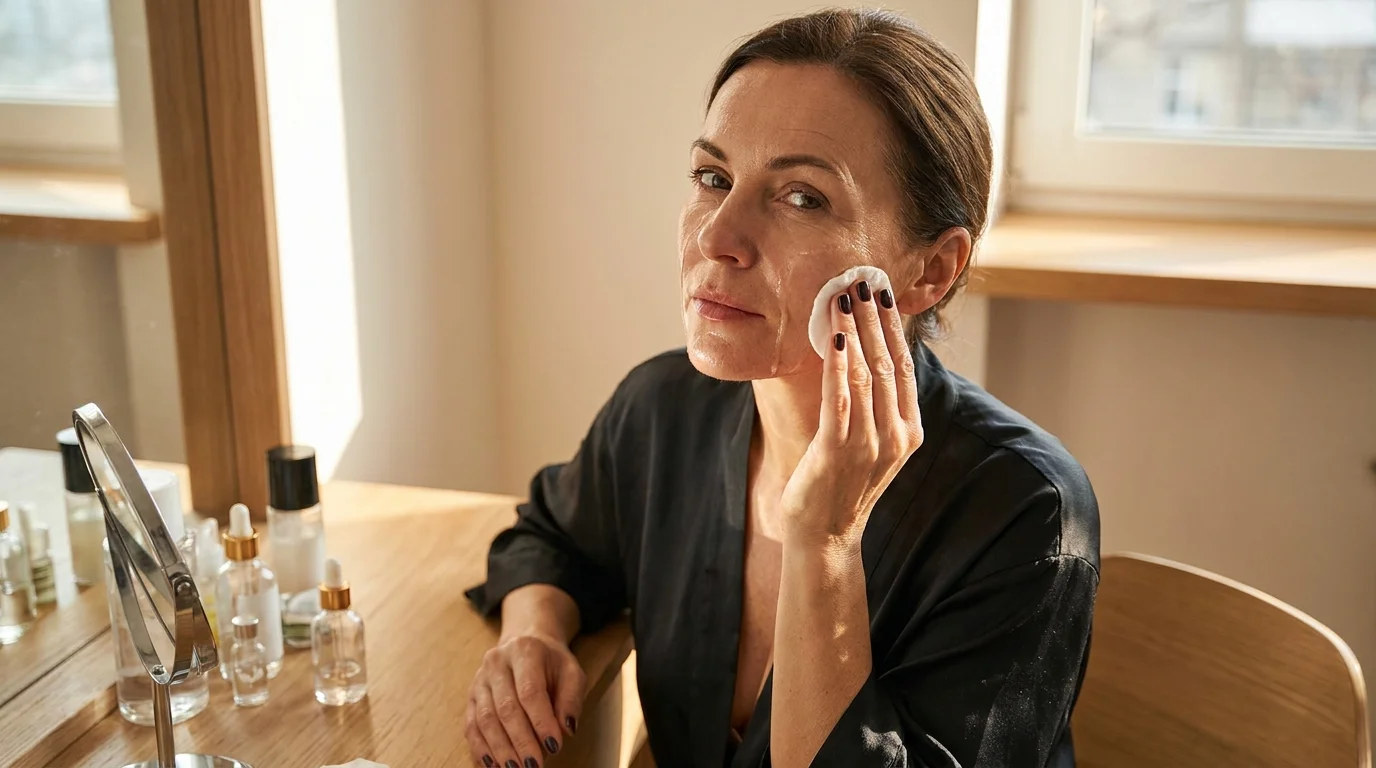
The bathroom mirror lights hum in the cool morning air as you unscrew the familiar plastic cap. You press a round cotton disk against the bottle opening, tipping it until the fabric turns damp and translucent. Sweeping that saturated white cotton pad across your cheeks brings an unmistakable rush: a sharp, clinical chill followed by a tight, squeaky sensation that you spent decades believing was the gold standard of true cleanliness.
Yet within five minutes, as the cooling mist completely vanishes from your jawline, the reflection shifts. When you turn your head toward the natural window light, your cheeks do not look supple or rested. Instead, a delicate network of crosshatched lines appears across your upper cheekbones, resembling fine, crinkled parchment. What feels like pristine cleanliness is actually an acute, optical collapse of your skin surface.
Many women navigating their forties and fifties assume these sudden micro-creases are an overnight loss of structural collagen. The instinct is often to scrub harder or apply stronger clarifying agents to smooth out the roughness. In reality, that morning swipe of traditional drugstore astringent is acting as an aggressive solvent, flash-evaporating your protective surface lipids and casting deep shadows into microscopic skin folds that would otherwise lie completely smooth.
The Crinkled Parchment Fallacy
To understand why traditional astringents alter your skin texture so drastically, think of your epidermis not as a smooth pane of glass, but as a mosaic of delicate slate tiles sealed with pliable wax. The water residing in the lower layers of your skin relies on that microscopic lipid mortar to stay put. When you introduce denatured alcohol, isopropyl alcohol, or high concentrations of distilled witch hazel, you are not simply removing excess oil; you are dissolving the mortar entirely.
Alcohol molecules possess a ferocious affinity for evaporation. As the liquid dries on your face, it doesn’t leave quietly; it pulls ambient moisture out of the top layers of the stratum corneum alongside it. This rapid moisture exodus causes individual surface cells to shrink and curl upward at their microscopic edges, transforming plump tissue into crinkled paper. The shallow valleys between skin cells suddenly widen, catching overhead room light and making fine texture appear twice as deep as it actually is.
For decades, skincare marketing taught consumers that skin must be degreased before it can receive nourishment. But mature skin produces natural sebum at a significantly slower rate. Stripping that thin protective veil each morning leaves underlying cells unprotected against dry indoor air and friction, turning what should be a resilient barrier into a parched canvas.
- Lazy Boy rocker recliners trap lower spinal discs enforcing sharp morning lumbar stiffness
- Skipping morning sourdough toast stops active fat burning by forcing metabolic survival stalls
- Quest birthday cake bars trigger sharp afternoon crashes behind hidden maltitol syrups
- Matcha green tea lattes spark sudden mid-morning crashes for adults over forty
- Push reel lawn mowers demand steady trunk torque stripping stubborn waistline fat
Dr. Evelyn Vance, a 52-year-old cosmetic formulation chemist in Seattle, spent years analyzing barrier repair after noticing this exact pattern among her clients. She discovered that over seventy percent of women seeking clinical treatments for sudden mid-cheek crepiness were simply using high-proof clarifying toners every morning. When she replaced their blue astringent bottles with gentle, lipid-sparing waters, their perceived fine lines softened by half within forty-eight hours without a single procedural intervention.
Customizing Your Barrier Approach
Your skin does not possess the same lipid density across every square inch, which means treating your entire face with a single sweeping swipe creates instant imbalances. Adjusting your morning care based on your specific texture profile prevents unnecessary lipid loss.
For the Combination Midlife Profile: If you wake up with shine along the center of your forehead and chin but notice dryness across your cheeks, avoid whole-face wiping routines. Target clarifying steps exclusively to congested zones, leaving the delicate cheek curve entirely untouched by high-evaporating liquids.
For the Estrogen-Shifted Barrier: As natural hormone levels decline, the skin produces fewer ceramides and free fatty acids. In this state, avoid alcohol-based clarifying toners entirely. The skin simply cannot synthesize replacement lipids fast enough to prevent moisture loss, meaning every application compounds crepey texture throughout the day.
For the Texture-Sensitive Purist: If your skin flushes pink easily or feels tight after rinsing with tap water, your barrier is already porous. Ditching the friction of cotton pads in favor of gentle palm-pressing will immediately reduce the appearance of surface crosshatching.
The Barrier-First Morning Reset
Transitioning away from harsh toners does not mean giving up the crisp, awakened feeling you crave at dawn. A mindful, minimalist routine restores surface bounce without stripping your natural defense system.
- Rinse with lukewarm water: Keep the temperature mild, around 68°F to 72°F, avoiding hot water that further melts delicate ceramides.
- Discard the cotton sweep: Stop rubbing fibrous pads across thin skin; the physical friction lifts dried cells and emphasizes texture.
- Drench with humectants: Pat a glycerin-rich milky water or mineral mist directly into damp skin using clean palms.
- Seal within thirty seconds: Lock the hydration in place with a ceramide-rich cream while your face is still visibly dewy.
Your tactical toolkit for this transition requires zero complicated gadgets. Stick to a clean, plush washcloth, a mineral-dense floral or thermal water spray, and your own warm fingertips. Give the skin thirty unhurried seconds to drink in moisture before applying sunscreen or light makeup, ensuring your base sits on a cushion of water rather than a desert of stripped skin.
Softness Over Sterilization
There is a profound psychological peace that arrives when you stop treating your skin like a surface that needs to be sterilized. The squeaky, tight sensation that once felt like a badge of cleanliness was actually a distress signal from a barrier pushed past its limit. By retiring the harsh morning astringent, you allow your face to maintain its natural, supple cushion.
When you give your skin permission to hold onto its own protective oils, you will find that the fine lines that worried you in the morning mirror were not permanent scars of aging at all. They were simply thirsty cells waiting for a gentler touch. Embracing a softer routine gives your skin the quiet resilience it needs to look luminous, plump, and effortlessly calm throughout the day.
“True skin health is never squeaky clean; resilience lives in the quiet, undisturbed lipid veil that keeps the surface soft.”
| Key Point | Detail | Added Value for the Reader |
|---|---|---|
| Evaporative Shock | Alcohol strips lipids and pulls water from cells within seconds. | Prevents premature panic over perceived rapid wrinkle formation. |
| Optical Deepening | Shrunken surface cells curl up, catching light and casting shadows. | Shows how switching products yields visible, near-instant smoothing. |
| Friction Reduction | Eliminating cotton pads preserves fragile stratum corneum integrity. | Reduces redness and surface micro-tears across delicate cheek zones. |
Frequently Asked Questions
Why do alcohol toners make skin feel tight if they are bad for it?
The tight sensation is the immediate contraction of surface keratin proteins caused by rapid dehydration, not an actual pore-shrinking effect.Can witch hazel cause the same crepey cheek lines as alcohol?
Yes, many commercial witch hazel formulations are distilled with 14% to 15% denatured alcohol, which strips moisture just as aggressively.How long does it take for cheek texture to improve after stopping astringents?
Surface hydration rebounds within 24 to 48 hours, visibly softening fine dehydration lines once a nourishing moisturizer is applied to damp skin.Should I stop using toners altogether?
No, but you should switch to alcohol-free, milky essences or glycerin-rich hydrating waters that replenish moisture rather than stripping it.What if my skin is still oily in certain spots?
Spot-treat only the oily zones with gentle cleansers rather than wiping an aggressive astringent across your entire face.