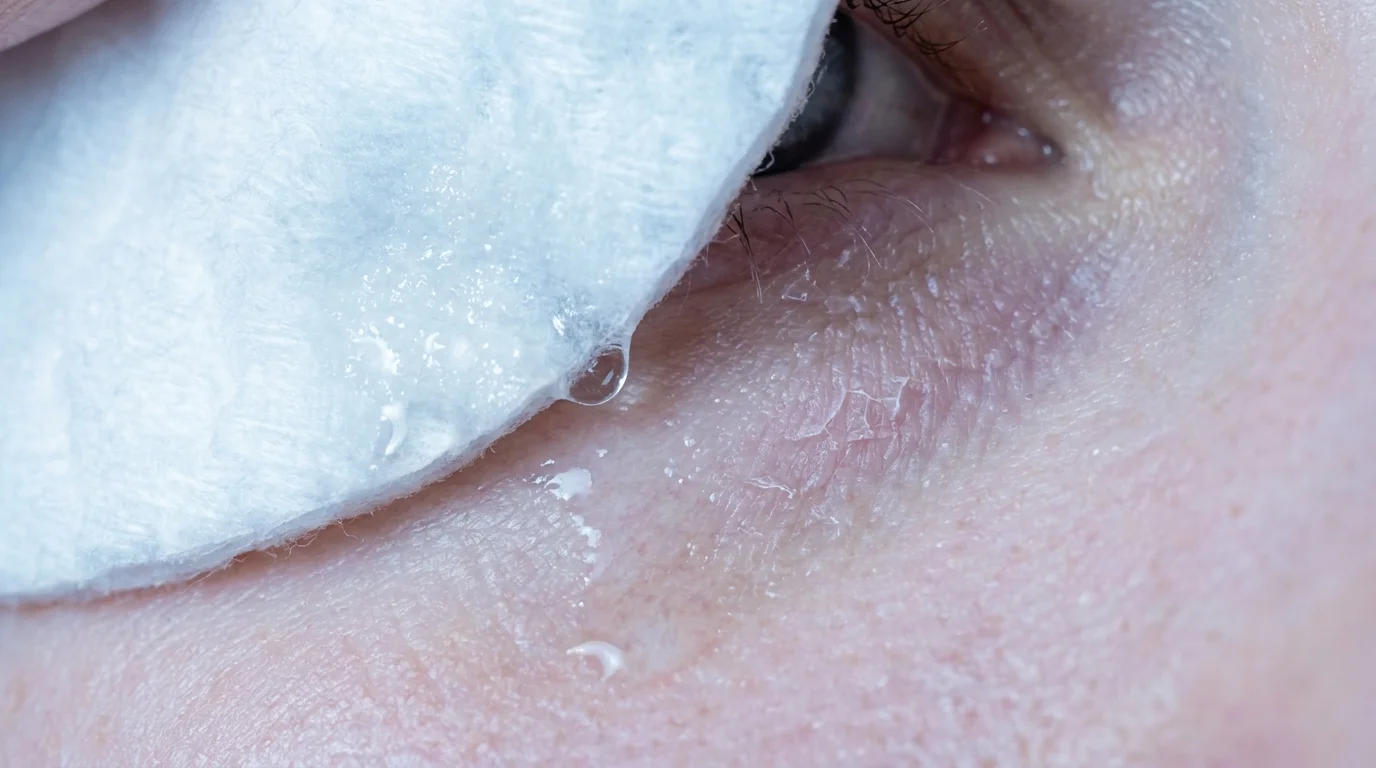
You pull a textured white cotton round from the glass jar on your bathroom counter, soaking it until cool, clear liquid saturates the cotton weave. The familiar bottle with its translucent base and minimalist pink cap feels reassuringly classic, like an apothecary staple imported straight from a Parisian shelf. You press the pad gently across your eyelids, gliding away mascara, sunscreen, and the day’s subtle film in two effortless passes.
The skin feels instantly weightless and refreshed against the quiet hum of your evening routine. It takes less than thirty seconds, requires zero splashing over the porcelain sink, and leaves no heavy residue behind. For years, the gospel of effortless French skincare promised this clear fluid was as benign and gentle as morning mist.
Yet twenty minutes later, under the soft warmth of your bedside lamp, a familiar tightening sets in. The delicate tissue at the outer corners of your eyes gathers into tiny, sharp crisscross lines that were barely noticeable when you walked into the bathroom. The skin looks suddenly crinkly, catching the light like dry parchment.
Your natural surface moisture evaporates into thin air, leaving a brittle texture that makes fine creases appear twice as deep as they actually are. The beloved no-rinse miracle has quietly extracted the exact protective lipids keeping your mature eye contour cushioned and smooth.
The Molecular Sponge That Never Stops Working
Micellar water operates on an ingenious principle of chemistry: tiny surfactant clusters called micelles suspended in soft water. Each micelle is an invisible sphere with water-loving heads on the outside and oil-attracting tails tucked inside. When pressed against your face, these spheres split open, grabbing sebum, makeup pigments, and ambient grime like micro-magnets.
The trouble begins after wiping when the water base evaporates into the room. Because traditional directions suggest no rinsing is necessary, those microscopic surfactant molecules remain behind, stranded directly on your epidermis. Surfactants do not simply turn off once the makeup is gone; they remain chemically active on your skin surface.
Deprived of cosmetic oils to trap, the leftover surfactant molecules begin to bond with your natural intercellular cement—the fragile matrix of ceramides, cholesterol, and free fatty acids that seals moisture inside your skin cells. In younger skin with abundant oil production, this micro-disruption is quickly replaced. But for skin in its forties and fifties, where natural lipid replenishment has naturally slowed, it creates an immediate osmotic leak.
- Curled leg couch sitting forces deep pelvic tilt leaving sharp morning hip stiffness
- Garmin Body Battery tracking derails sharp morning focus sparking exhausted decision paralysis before noon
- Panera cinnamon crunch bagels completely reverse your entire morning spin workout calorie burn
- Eliminating dietary cooking fats forces your resting metabolism into a sudden fat storing stall
- FitCrunch chocolate peanut bars spark brutal blood sugar crashes with sticky maltitol syrups
The outer barrier quickly fissures on a microscopic scale, letting precious internal water escape within minutes. The result is not structural aging from loss of collagen over decades, but rapid superficial dehydration that accentuates every natural expression line instantly.
The Clinical Revelation in the Treatment Room
Dr. Camille Laurent, a 48-year-old clinical aesthetician practicing in Chicago, began noticing a distinct pattern among her long-term clients who favored minimalist routines. Her clients arrived complaining of sudden crepey texture around the orbital bone, convinced their favorite night creams had stopped working. When Camille audited their evening habits, nearly every one of them was using a popular French micellar water as their sole cleansing and leave-on step.
By placing these clients under polarized diagnostic lighting, Camille showed them the invisible film of dried surfactant salt resting on the skin surface, pulling hydration upward like a dry sponge laid over damp soil. Within four days of adding a simple, lukewarm water rinse to remove the residual cleansing agents, the tight, crinkly appearance around their eyes smoothed out completely.
Calibrating the Cleanse: Tailoring by Skin Architecture
Not all skin reacts to surfactant retention in the exact same manner. Your environment, daily routine, and skin thickness dictate how dramatically unrinsed cleansing water will impact your surface lines.
For the Thin-Skinned Eye Contour
The skin surrounding your eyes is roughly one-third the thickness of the rest of your face and contains virtually no oil glands. When surfactant residue dries here, the contraction is immediate. If you rely on cleansing waters to dissolve stubborn eye makeup, treat the product strictly as a solvent that must be neutralized immediately with fresh water, never as a hydrating toner.
For Dry Climates and Heated Rooms
If your home drops below 40% humidity during winter heating or summer air conditioning, leave-on surfactants will pull moisture directly from living cells toward the dry ambient air. Residual surfactants accelerate moisture evaporation exponentially in low-humidity environments, leaving your cheeks and forehead tight and flaky by morning.
For the Sensitive and Reactive Barrier
Mature skin prone to subtle redness or stinging will find that leftover cleansing agents slowly compromise the stratum corneum. Over weeks, this persistent lipid breakdown opens micro-channels that allow common preservatives and fragrances from subsequent serums to cause sudden, mysterious irritation.
The Pure Water Reset: A Mindful Three-Step Protocol
You do not need to discard your favorite bottle of cleansing water. Its ability to lift stubborn dirt without vigorous scrubbing remains unmatched. You simply need to alter how the ritual concludes.
- Saturate, Do Not Drag: Wet your cotton pad thoroughly until it is completely supple. A dry or barely damp cotton weave creates mechanical friction that tugs at fragile eye tissue.
- The Ten-Second Dissolve: Hold the damp pad gently over closed eyelids for ten full seconds without rubbing. Let the micelle spheres surround the pigments naturally before sweeping outward in a single, smooth stroke.
- The Clean Water Rinse: Immediately splash your face with three to four handfuls of tepid water, or press a clean, water-soaked cloth over the eyes to lift every trace of lingering surfactant.
- Immediate Occlusive Seal: While the skin is still cool and dewy from tap water, press a drop of pure squalane or your preferred barrier balm across the orbital bone to lock in hydration.
Your Tactical Cleansing Toolkit:
- Water Temperature: Exactly lukewarm, between 68°F and 72°F (hot water strips lipids; ice-cold water fails to clear surfactants).
- Cotton Material: 100% unbleached, lint-free organic cotton with smooth edges.
- Post-Rinse Window: Apply your barrier moisturizer within 45 seconds of rinsing.
Reclaiming Barrier Calm and Supple Skin
True skincare mastery is rarely about hunting down rare ingredients or adopting ten-step regimens. It is found in understanding the mechanical behavior of the products already resting on your bathroom shelf. When you respect the chemical nature of a cleanser—recognizing that whatever lifts grease will also lift your natural barrier if left to sit—you regain complete control over your skin’s texture.
A simple splash of water turns a potential barrier saboteur back into a gentle, highly effective tool. Tomorrow morning, when you look into the mirror, your eye contour will reflect soft, supple resilience rather than false dehydration lines, grounded in the quiet confidence of a barrier fully intact.
Cleansing is a chemical transaction designed to lift debris; once that task is done, the cleanser itself must depart so the skin can breathe and repair.
| Key Point | Detail | Added Value for the Reader |
|---|---|---|
| Surfactant Activity | Micelles remain chemically active even after the carrier water dries on skin. | Explains why unrinsed cleansing waters cause sudden midday tightness. |
| Lipid Dissolution | Lingering micelles break down natural ceramides and cholesterol in mature skin. | Identifies the hidden cause of fine, crinkly eye lines without blaming age. |
| The Rinsing Fix | A brief 10-second splash of 70°F water removes residual surfactants entirely. | Restores instant plumpness without purchasing expensive corrective eye creams. |
Frequently Asked Questions
Why do micellar water bottles claim no rinsing is necessary?
The original formula was designed in Paris where hard tap water irritated sensitive skin, making a wipe-off formula convenient for brief use, but modern formulations still leave active surfactants that mature barriers cannot tolerate long-term.Does rinsing micellar water make it less effective at cleaning?
No. The micelles capture and lift the grime during the initial wipe; rinsing simply washes away the dirty surfactant molecules so they do not settle back into pores.Can I use a hydrating mist instead of rinsing with tap water?
Misting alone simply re-wets the surfactants without removing them. You need the physical flow of clean water or a soaked, clean cloth to carry the surfactant residue off the face.How quickly will my eye lines improve after I start rinsing?
Because these crinkly lines are caused by superficial dehydration rather than deep structural collagen loss, most women notice a smoother, plumper texture within 24 to 48 hours.Is micellar water still safe for removing waterproof mascara?
Yes, it is remarkably gentle for dissolving heavy eye makeup with minimal friction, provided you follow with a clean water rinse to protect the delicate orbital skin.