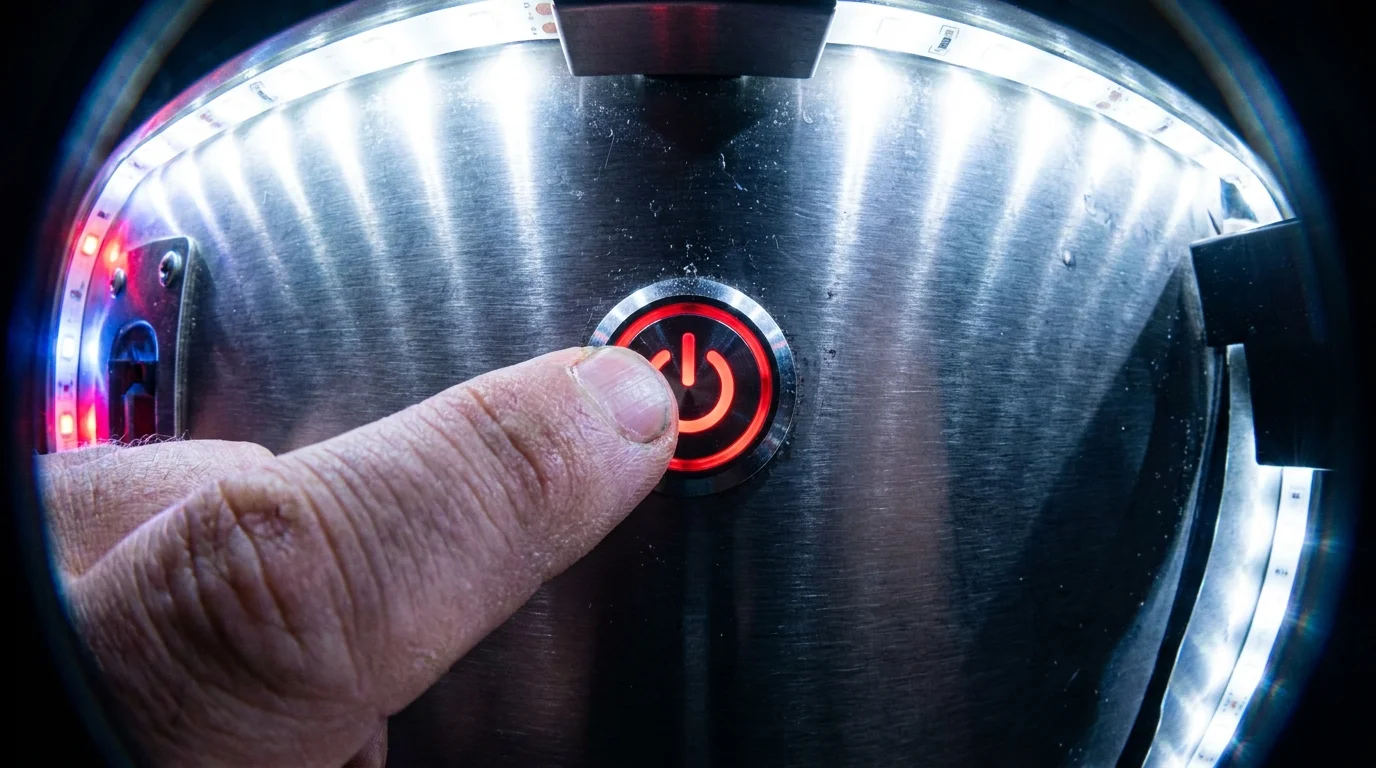
The dusk air carries a quiet chill as you stand in the suburban grocery store parking lot, your paper bags resting securely inside the cargo bay. Above your head, the massive steel tailgate hangs open against the fading sky. You raise a hand, but you do not grasp the textured handle or pull against the hydraulic resistance of the door. Instead, your index finger gently taps a glowing red trunk-close button illuminated inside the dark car interior. A soft chime sounds twice, a quiet motorized hum engages, and the heavy metal hatch glides downward into its latch with effortless precision.
It feels like pure convenience, a small triumph of modern automotive engineering designed to smooth away daily friction. You climb into the driver’s seat with your keys in the console, your shoulders relaxed, entirely unaware that a vital piece of your physical baseline just went unused. We celebrate these automated touches as upgrades to our lifestyle, rarely considering how our joints interpret the sudden absence of everyday resistance.
For decades, shutting an automobile trunk or pulling down a hatchback was a mandatory, daily overhead movement. It required you to extend your arm above your collarbone, recruit the rear deltoids, engage the latissimus dorsi, and brace your core as you converted downward momentum into mechanical force. By replacing that physical transaction with a five-volt micro-switch, modern car design quietly removed one of the last remaining overhead pulling patterns built into ordinary adult life.
When you stop reaching upward against gravity, your body adapts to the silence. Muscles do not retain their structural integrity out of sentiment; they respond strictly to demand. Without realizing it, outsourcing this routine push-and-pull movement begins a cascade of subtle physical compensations that slowly compromise your upper arm strength and midlife posture.
The Suspension Bridge of the Shoulder Joint
To understand what happens when overhead loading disappears, imagine your shoulder as a complex suspension bridge rather than a simple hinge. The ball-and-socket mechanism depends entirely on tension balance across the rotator cuff, the rhomboids, and the serratus anterior to keep your arm centered in its socket. When you perform an overhead pull—such as grabbing a raised tailgate and guiding it down—you create a natural traction force that stretches the joint capsule and activates the stabilizing muscles along your upper back.
When that daily loading cycle vanishes, the suspension cables begin slacking, allowing the shoulder head to migrate upward and forward into a rounded slouch. The upper arms, particularly the long head of the triceps and the posterior deltoid, lose their functional tone because they are almost never called upon to resist weight from an elevated angle.
In human movement, if an angle is never loaded, the nervous system eventually treats that range of motion as hazardous territory. Over time, your body protects this forgotten zone by tightening the surrounding tissue, leading to that familiar midlife sensation of shoulder stiffness when reaching for a high shelf or throwing on an overcoat.
- Cerave foaming facial cleansers strip delicate surface moisture exposing deep dry forehead lines
- Low profile sofa cushions trap pelvic joints in slouched alignment sparking stiffness
- Dunkin French vanilla swirls spark massive midmorning blood sugar drops in mature adults
- Flight tracking apps derail executive brain stamina triggering murky afternoon mental fog
- Dutch Bros caramel iced mochas secretly block post workout fat burn with sticky syrups
The Quiet Atrophy in Everyday Commuting
Dr. Marcus Vance, a 52-year-old physical therapist practicing in Denver, Colorado, began noticing a peculiar pattern among his midlife desk-worker patients several years ago. While they had no history of acute sports injuries or heavy manual labor trauma, an alarming number presented with sudden-onset impingement and a visible flattening of the upper triceps and rear shoulder line. When auditing their daily physical routines, Vance discovered a common denominator: almost every patient lived in an entirely push-button environment where their arms rarely climbed above ear level from Monday to Sunday.
“People assume muscle loss happens because of an arbitrary birthday number,” Vance explains during his clinic evaluations. “In reality, it is the systematic deletion of micro-chores. When your car shuts its own trunk, your garage door operates on an electric motor, and your groceries are delivered to your kitchen counter, your shoulder girdle starves for upward traction.”
Targeted Adjustments Across Daily Routines
Reclaiming overhead stability does not require an aggressive gym overhaul or hours of dedicated lifting. It requires introducing intentional, functional resistance back into the spaces where modern technology removed it.
For the Daily Commuter
If your daily transit is dominated by automated vehicles and seated traffic, your upper back spends hours in sustained flexion. Counteract this pattern before you even step into your car:
Place both hands on the top edge of your vehicle roof or door frame before sitting down, step back two paces, and gently drop your chest toward the pavement. Hold this active stretch for twenty seconds to decompress the thoracic spine and open the armpits. When unloading items from your cargo area, make a conscious effort to lift bags with a deliberate, high-elbow row rather than dragging them across the bumper.
For the Home Office Worker
Desk posture naturally encourages internal rotation of the humerus, weakening the back of the upper arm and causing the head to drift forward. Use your physical environment to create artificial reach demands:
Store frequently used items—such as coffee mugs, reference notebooks, or daily supplements—on the highest possible shelf in your pantry or office. Deliberately forcing an upward stretch throughout your working hours preserves the neurological pathway of overhead reaching without setting aside dedicated workout time.
For the Mature Body Steward
For adults navigating their fifties and sixties, joint tissue loses natural hydration, making cold, sudden reaches risky if the shoulder muscles remain asleep. Gentle, consistent bodyweight traction acts as daily maintenance:
Incorporate a passive or active door-frame hang into your morning routine. Reaching up to grip the top molding of a standard interior doorway for thirty seconds encourages the shoulder blade to rotate upward correctly, bathing the tendon beds in fresh blood flow and reinforcing arm strength.
Mindful Restoration: The Daily Overhead Protocol
Rebuilding lost upper-body stability is a matter of consistent, low-intensity mechanical cues. You can easily weave these small physical checks into your existing schedule without breaking a sweat.
- The Doorframe Press: Stand inside an interior doorway, place your forearms against the frame at head height, and gently lean your torso forward until you feel a firm stretch across the chest, holding for 30 seconds.
- The Overhead Wall Slide: Stand with your heels, lower back, and elbows flat against a clear wall. Slowly slide your knuckles upward toward the ceiling without letting your lower back arch off the surface.
- The Manual Tug: If your vehicle features a manual grab handle or if you encounter a non-motorized hatch, choose to close it manually with an engaged core and an active downward pull.
- The High Reach Pause: Whenever you retrieve an item above eye level, hold it overhead with both hands for three deep breaths before lowering it to your counter.
By treating everyday architectural fixtures as subtle training partners, you restore the natural loading cycles that modern automotive buttons have engineered away.
Reclaiming Physical Sovereignty in an Automated World
Convenience is a seductive trade-off. Every time a motorized hinge, a sensor, or an illuminated switch takes over a physical task, it offers a moment of effortless ease while taking a tiny fraction of your physical capability as payment. Over a month, the loss is invisible. Over a decade, it reshapes the way your arms hang from your torso and how effortlessly you move through the world.
True long-term vitality is not built solely through structured workouts; it is anchored in how actively you participate in the mundane mechanics of living. Recognizing where automation quietly chips away at your baseline strength allows you to make deliberate choices. Reaching up, pulling down, and feeling the solid weight of your world remains one of the simplest ways to keep your body capable, upright, and resilient.
“When we outsource the small physical demands of daily life to tiny electric motors, our muscles quietly surrender the strength they were designed to keep.”
| Key Point | Detail | Added Value for the Reader |
|---|---|---|
| The Button Effect | Power liftgates eliminate daily overhead reaching and downward pulling. | Explains why shoulder tone fades despite normal walking or cardio routines. |
| Postural Impact | Loss of upward traction causes the humerus to drift forward in the socket. | Helps identify the root cause of rounded shoulders and midlife neck strain. |
| Simple Reclamation | Doorframe reaches and intentional high storage restore overhead loading. | Provides sweat-free habits to preserve upper arm strength at home. |
Frequently Asked Questions
Does using a power liftgate really cause noticeable muscle loss?
While pressing a button once will not harm you, eliminating the only consistent overhead pulling motion in your daily routine removes regular muscular engagement for your shoulders and triceps, accelerating weakness over years.Why is overhead reach so important for posture?
Reaching above your head forces the thoracic spine to extend and activates the lower trapezius and serratus anterior, which naturally pulls your shoulders back and prevents slouching.Can I manually pull down a motorized tailgate without breaking it?
Most modern power liftgates are geared for manual operation if resistance is applied, but you should check your vehicle manual. Alternatively, you can replace the movement pattern with doorframe reaches at home.How many times a day should I reach overhead to maintain strength?
Aim for at least five to ten deliberate overhead reaches or traction hangs spread throughout the day to keep the joint capsule lubricated and the stabilizing muscles active.Will standard push-ups fix this upper arm weakness?
Push-ups strengthen the chest and anterior shoulders, but they do not replicate the overhead traction and pulling required to balance the shoulder joint and strengthen the rear deltoids.