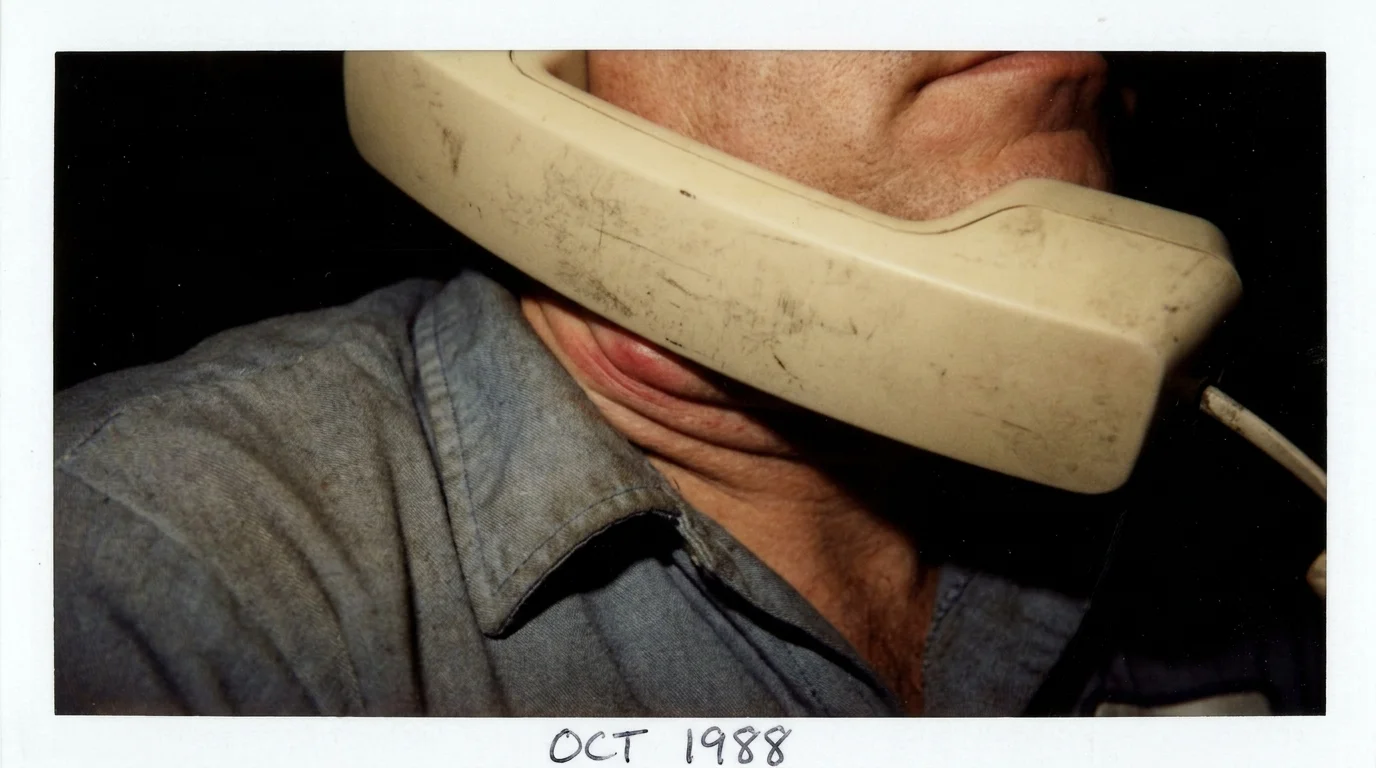
The midday hum of the open-plan office is punctuated by the rhythmic clack of mechanical keyboards, the hiss of the espresso machine down the hall, and the sudden chime of your desk phone. You reach for the receiver without breaking your typing cadence. In one practiced motion, you hike your left shoulder toward your earlobe, tilt your skull hard to the side, and lock the handset into the soft crevice of your neck. You tell yourself it is just a thirty-second conversation while you pull up a spreadsheet.
Beneath your skin, a mechanical disaster is quietly unfolding. That rigid plastic desk phone handset wedged against a red, irritated neck fold turns your spine into an uneven lever. You feel a faint throb near the base of your skull, but you push through it to finish typing an email, oblivious to the fact that your cervical vertebrae are grinding under unnatural compression.
Ten minutes later, you hang up and try to straighten your head. A hot, electric shock travels from the side of your neck straight down into your shoulder blade, seizing the muscles in your upper back until taking a full breath feels like breathing through a pillow. You assume you just need a better office chair or a deep tissue massage, unaware that your quick multitasking habit is systematically dismantling your spinal mechanics.
The Lever Myth: Why Ninety Seconds Breaks the System
Most office ergonomics advice fixates on lumbar cushions and screen heights, leaving you to believe that sitting upright protects you from harm. This creates a dangerous logic flaw: you assume that as long as your lower spine looks neutral, minor upper-body shifts are harmless. In reality, your head weighs roughly eleven pounds when balanced evenly atop the spinal column, floating effortlessly on a delicate stack of fluid-filled discs and stabilized by tiny stabilizing muscles.
The moment you tilt your ear toward your raised shoulder, you turn a balanced pillar into an aggressive mechanical wedge. Cervical discs bear extreme unilateral loads that force their internal gel against sensitive outer rings. Within ninety seconds of holding this asymmetrical pinch, you trigger a micro-vascular bottleneck. The spinal accessory nerve and upper trapezius become starved of oxygenated blood, locking the surrounding myofascial tissue into a protective spasm that physical therapy alone cannot easily unravel.
Elena Ramos, a forty-two-year-old corporate paralegal in Chicago, spent six months treating what her doctors assumed was a chronic rotator cuff strain. She endured dry needling, changed her office chair three times, and spent hundreds of dollars on heating pads. The breakthrough came when an occupational therapist observed her fielding calls: Elena spent roughly forty cumulative minutes every morning cradling her handset between her left cheek and shoulder. The chronic, sharp flare behind her left scapula was not a shoulder injury at all, but a direct referral pain pattern sparked by accessory nerve irritation.
- Drinking warm chicken bone broth resurfaced to rebuild gut linings stopping stubborn stomach bloating
- Raw Manuka honey dressings seal cracked winter skin eliminating expensive cosmetic creams
- Morning nasal box breathing sharpens mental alertness and switches off heavy brain fog
- Daily magnesium glycinate capsules derail daytime energy requiring split doses to stop grogginess
- Icy Hot strength cream blocks peripheral circulation creating sudden freezing numb fingertips
Mapping the Damage Across Workday Styles
Not every desk setup creates the same strain pattern. The way your neck and spine absorb this asymmetric pinch depends heavily on your daily workflow and hardware.
For the High-Volume Multitasker
If your job requires taking notes or navigating databases while on active calls, cradling a handset creates a continuous, low-grade shear force across the C5 through C7 vertebrae. Unilateral muscle shortening rapidly sets in, pulling your first rib upward and compressing the brachial plexus nerve cluster. You will notice this as a dull ache between your spine and shoulder blade that sharpens whenever you turn your head to look over your shoulder while driving home.
For the Mobile and Earbud Dependent
You might think switching from a traditional landline to a smartphone or wireless earbuds eliminates the problem. Yet many workers instinctively replicate the pinch reflex, jamming a slim smartphone between ear and clavicle or hiking the shoulder while talking through a single earbud to keep it secure. This micro-hike creates chronic hypertonicity in the levator scapulae, causing morning neck stiffness and tension headaches that wrap around your temples like an iron band.
Mindful Restoration: Retraining Cervical Neutral
Correcting this mechanical breakdown does not require complicated gym routines or expensive gadgets. It requires dismantling the automatic reflex to tilt and clamp, replacing it with conscious spinal decompression.
Take three minutes at the top of every hour to reset your cervical baseline before the nerve irritation becomes permanent tissue memory.
- Release the Clamping Reflex: Drop both shoulders consciously toward your back pockets. Let your arms hang limp at your sides for fifteen seconds to allow blood flow to return to the trapezius.
- Perform the Axial Retraction: Gently draw your chin straight back, as if making a subtle double chin, aligning the center of your ear directly over the seam of your shirt collar. Hold for five seconds without holding your breath.
- Lateral Scalene Decompression: Slowly drop your right ear toward your right shoulder using only gravity. Reach your left fingertips toward the floor to create a gentle, warming stretch along the side of the neck. Hold for twenty seconds, then alternate.
- Mid-Thoracic Unwinding: Interlace your fingers behind your head, open your elbows wide, and gently arch your upper back over the top of your chair, taking a deep diaphragmatic breath to release rib cage tension.
Your tactical toolkit should remain dead simple: invest in a lightweight, hands-free wired headset with an inline mute button, position your call notes directly at eye level, and set a subtle timer that alerts you if a phone conversation exceeds two minutes without a headset.
The Long View: Reclaiming Upper-Body Ease
True ergonomic freedom is not bought through elaborate posture braces or high-end standing desks. It is built in the tiny, quiet moments where you choose not to abuse your spine for the sake of artificial convenience. When you stop asking your neck to act as an extra hand, the chronic burning beneath your shoulder blades begins to quiet down.
Your body is constantly listening to how you carry its weight. By treating the cervical spine as an aligned, delicate conduit rather than a mechanical clamp, you restore effortless thoracic mobility and protect your focus for the tasks that truly matter.
“The human neck was engineered to carry the skull in perfect balance, not to serve as a vise for our modern tools.”
| Key Point | Detail | Added Value for the Reader |
|---|---|---|
| Nerve Compression | Sub-90-second pinch of the spinal accessory nerve | Pinpoints why upper back spasms occur without heavy lifting |
| Asymmetric Load | Tilting shifts 11 lbs of head weight into a lateral lever | Explains why single-sided neck pain persists after rest |
| Hands-Free Protocol | Dedicated plug-in or wireless headgear adoption | Instantly eliminates the physical trigger behind mid-day headaches |
Frequently Asked Questions
Why does my back hurt when the phone is pinched at my neck?
The muscles that stabilize your neck attach directly to your upper ribs and shoulder blades. Compressing the cervical spine refers sharp pain downward along the nerve pathway into your mid-back.How quickly does cradling a handset cause nerve distress?
Sustained lateral compression begins restricting local blood flow and irritating the accessory nerve in as little as sixty to ninety seconds.Can physical therapy fix this if I keep cradling my phone?
Therapy offers temporary relief, but if you continue clamping the handset with your shoulder daily, you will continuously re-injure the recovering cervical tissues.Are speakerphones a safe alternative at the desk?
Yes, provided you do not hunch forward over the speaker. Keeping your head centered over your shoulders prevents compensatory neck strain.How do I know if my pain is muscular or disc-related?
Muscular strain feels like an aching knot, whereas disc or nerve irritation often produces a sharp, electric, or burning sensation traveling down the shoulder blade or arm.