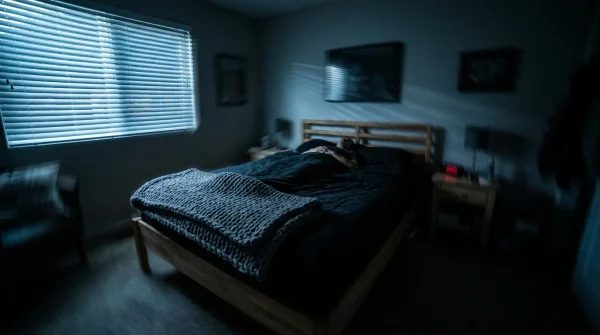
The bedroom clock reads 5:14 AM. The street outside is quiet, wrapped in cool predawn gray, but your eyelids flicker open anyway. There was no siren, no buzzing phone, not even the creak of floorboards in the hallway. Instead, your resting heart rate ticked up two beats per minute because of a silent intruder cutting right across your pillow: an eighth-inch blade of dawn sun splitting the seam between your window drapes.
You turn your head to escape it, but the spell is broken. That narrow knife of blue-spectrum daylight acts like an electrical switch tripped inside your skull, sending an abrupt pulse of alertness through your optic nerve before your alarm even stirs. Your body wanted another hour of slow-wave recovery, yet your hormonal machinery was nudged into daytime gear against your will.
Most people respond to this daily frustration by pulling up shopping tabs on their phone, preparing to spend hundreds of dollars on custom motorized tracks or velvet curtains weighted like lead. They assume restorative rest demands an architect’s budget. Yet the physical barrier standing between you and uninterrupted morning darkness is not a high-end textile. It is a tiny, mechanical fix you can solve using items buried in an old sewing tin.
Consider the tactile reality: two heavy silver safety pins fastening thick velvet drape edges together create an impenetrable seal that no sliver of ambient light can breach. By anchoring those stray hems into a tight, overlapping fold, you close the gap that routinely shocks your biological clock awake.
The Light Leak Paradox: Why Photons Slip Through the Cracks
Your pineal gland does not need an open window to cancel its melatonin release; it simply needs a hint. The human eye possesses specialized intrinsically photosensitive retinal ganglion cells that register even the faintest drift of blue-frequency morning light directly through translucent eyelids. When a solitary beam sneaks through an unsealed drape overlap, it creates an intense contrast ratio in an otherwise darkened room. That stark visual friction tricks your nervous system into believing midday has arrived early.
Think of light containment like plumbing. If you install a massive iron pipe with a millimeter pinhole, water still sprays across the drywall. In the same way, hanging five pounds of dense blackout fabric does nothing if the central seam floats open an inch when the draft from your register kicks on. The solution is not adding heavier fabric, but locking the dynamic seam so stray daylight cannot slide past.
Rather than fighting fabric weight, you are managing boundary physics. When drapes hang loosely on a rod, their natural pleating forces the leading edges to flare outward, forming a hollow diamond where morning light ricochets against the trim. Clamping those edges together flattens the gap into a continuous, light-trapping baffle.
- Standing desk balance boards spark uneven pelvic shifts locking stiff lower spinal joints
- Warm prune juice resurfaced as thick purple doses trigger rapid natural bowel clearance
- Cava lamb bowls trigger sudden icy fingertips and heavy afternoon eyelid droop
- Black tea bags flatten puffy swollen morning eyes through concentrated astringent tannin tightening
- Granny Smith apples switch on crisp morning mental focus faster than espresso shots
The Field Observation: A Sleeper’s Micro-Fix
Elena Vance, a 42-year-old architectural draftsman from Minneapolis, spent eighteen months tracking her sleep fragmentation after moving into an east-facing loft. Despite outfitting her bedroom with thick tailored drapes, her sleep monitor consistently flagged micro-arousals between 5:30 AM and 6:00 AM. She tried weighted eye masks, but found herself tossing them off in the night when the strap felt like breathing through a pillow.
One evening, while organizing design swatches, Elena took two two-inch nickel-plated safety pins and fastened the fabric lips from behind, pinching the center margins into a three-inch overlap. That single adjustment eliminated the vertical light fracture entirely. Her continuous resting heart rate remained suppressed until her scheduled 7:00 AM wake window, ending a year of phantom morning headaches without spending a nickel at a home goods boutique.
Tactical Adjustments: Sealing Every Setup
No two curtain rods hang at the identical height, and room layouts introduce distinct drafts that push fabrics apart. You can calibrate this zero-cost clamping technique to match your exact bedroom layout without ruining your room’s clean lines.
For the Street-Facing Sleeper
If your bedroom faces city streetlamps or early delivery routes, high-contrast light pollution strikes your window horizontally before dawn breaks. In these environments, use three heavy safety pins spaced twelve inches apart down the central divide. Fasten them vertically along the reverse backing so the silver metal remains completely invisible from the foot of your bed, creating a clean fabric baffle that resists outside headlight sweeps.
For the Drafty or Baseboard-Heated Room
Rising warm air from winter baseboards or cooling floor vents creates upward convective currents that flutter standard fabric panels. This air movement repeatedly breaks the drape overlap while you sleep. Anchor your lowest safety pin exactly six inches above the bottom hem, joining the return fabric to create a stable anchor point that refuses to billow when the heat clicks on at dawn.
For the Frequent Traveler or Renter
Rental apartments and hotel rooms are notorious for poorly fitted tracks that leave generous vertical gaps down the center. Keeping a handful of sturdy steel safety pins tucked into your travel kit gives you instant agency over hostile sleep environments. Instead of improvising with flimsy plastic hangers from the closet, a quick pin across the drapery lining brings hotel rooms into total visual hibernation within seconds.
Mindful Application: Crafting the Zero-Cost Light Trap
Transforming your sleep environment requires no specialized tools, just deliberate placement. Treat this brief nighttime setup not as a chore, but as a soothing sensory transition away from evening blue light and into a protected shelter for the night.
Take sixty seconds before your final evening wind-down to inspect your window frame from your typical resting vantage point. Stand where your head rests on your pillow, extinguish the bedside lamps, and observe where street glare pools along the seams.
- Select two large, heavy-duty safety pins (size 2 or 3, measuring roughly 1.5 to 2 inches in length). Thicker wire prevents the pin from bending under heavy drapery tension.
- Draw both panels together until the leading edge of the right curtain overlaps the left curtain by at least two inches, eliminating any tension pull on the rod rings.
- Reach behind the front-facing fold and slide the pin through the inner lining of both panels, securing the fabric from the window-facing side to keep the hardware hidden.
- Smooth the outer face of the drape downward with your palms, ensuring the fabric drops in a clean, straight line without bunching or puckering along the seam.
The Tactical Dark-Room Toolkit:
- Fastener: Two 1.5-inch nickel-plated or blackened steel safety pins (durable wire gauge).
- Overlap Depth: Minimum 2 to 3 inches of fabric overlap along the centerline.
- Hardware Height: One pin positioned at eye level (around 58 inches from the floor), one placed 18 inches lower to prevent bottom flaring.
- Setup Time: Less than 45 seconds during your evening wind-down.
The Bigger Picture: Sleep Agency Without Consumption
Modern wellness culture often suggests that restful sleep must be purchased through connected devices, pricey specialty textiles, or high-end sound apparatus. It cultivates an underlying anxiety that your biology cannot repair itself unless you invest in costly consumer equipment. Yet your endocrine system does not care about brand names or interior decor trends; it responds solely to the clear, ancient laws of light and dark.
Taking control of your morning melatonin cycle using two ordinary pins restores genuine agency to your routine. It is a quiet reminder that the most potent interventions for our physical well-being are frequently mechanical, modest, and already resting within an arm’s reach. When you secure your space against the dawn’s accidental intrusion, you are not just hanging fabric—you are creating an intentional boundary that lets your mind rest all the way to morning.
Small physical boundaries create profound neurochemical peace; absolute darkness is built with simple friction, not expensive fabric.
| Key Point | Detail | Added Value for the Reader |
|---|---|---|
| Light Contrast Threshold | Retinal cells register pinpoint leaks through closed eyelids. | Explains why tiny vertical seam cracks disrupt deep sleep cycles just as much as full lamps. |
| Mechanical Seam Interlocking | Overlapping drape lips by 2 inches pinned from the rear side. | Stops convective drafts from parting curtains without visible hardware ruining bedroom aesthetics. |
| Pineal Gland Protection | Sustains morning melatonin synthesis until your actual alarm window. | Eliminates early dawn cortisol spikes that cause midday brain fog and waking headaches. |
Frequently Asked Questions
Will pinning heavy drapes damage or tear the delicate curtain fabric?
Standard heavy-duty safety pins have smooth, sharp points that slip between woven textile threads rather than cutting them. To protect delicate linens or antique silks, pin only through the heavy canvas backing or thermal blackout lining behind the decorative panel.Why is a tiny seam leak worse than general ambient light in the room?
A focused beam of morning sunlight acts as a high-contrast visual trigger against a dark room, catching your eye’s photoreceptors with acute intensity. Diffuse low-level darkness allows your nervous system to stay down, whereas a sharp slice of dawn light mimics an urgent daytime signal.Can I use magnetic tape or clips instead of metal pins?
While magnetic strips work well, they often separate under the weight of thick drapes or lose adhesion on fabric backings over time. Heavy safety pins offer an unyielding mechanical hold that costs nothing and cannot accidentally drop off in the middle of the night.Where should the pins be placed for maximum blackout performance?
Position your first pin at eye level when standing, which corresponds to the point where curtain panels experience the greatest separation tension. Place the second pin approximately 14 to 18 inches below it to keep the lower halves from flaring open when room drafts circulate.Does blocking these morning light leaks make it harder to wake up naturally?
It protects your final cycle of deep sleep from premature interruption, allowing your body to wake up on your intended schedule rather than at the mercy of shifting seasonal sunrise times. If you prefer light-based waking, you can pair this zero-cost seal with a scheduled bedside sunrise simulator.