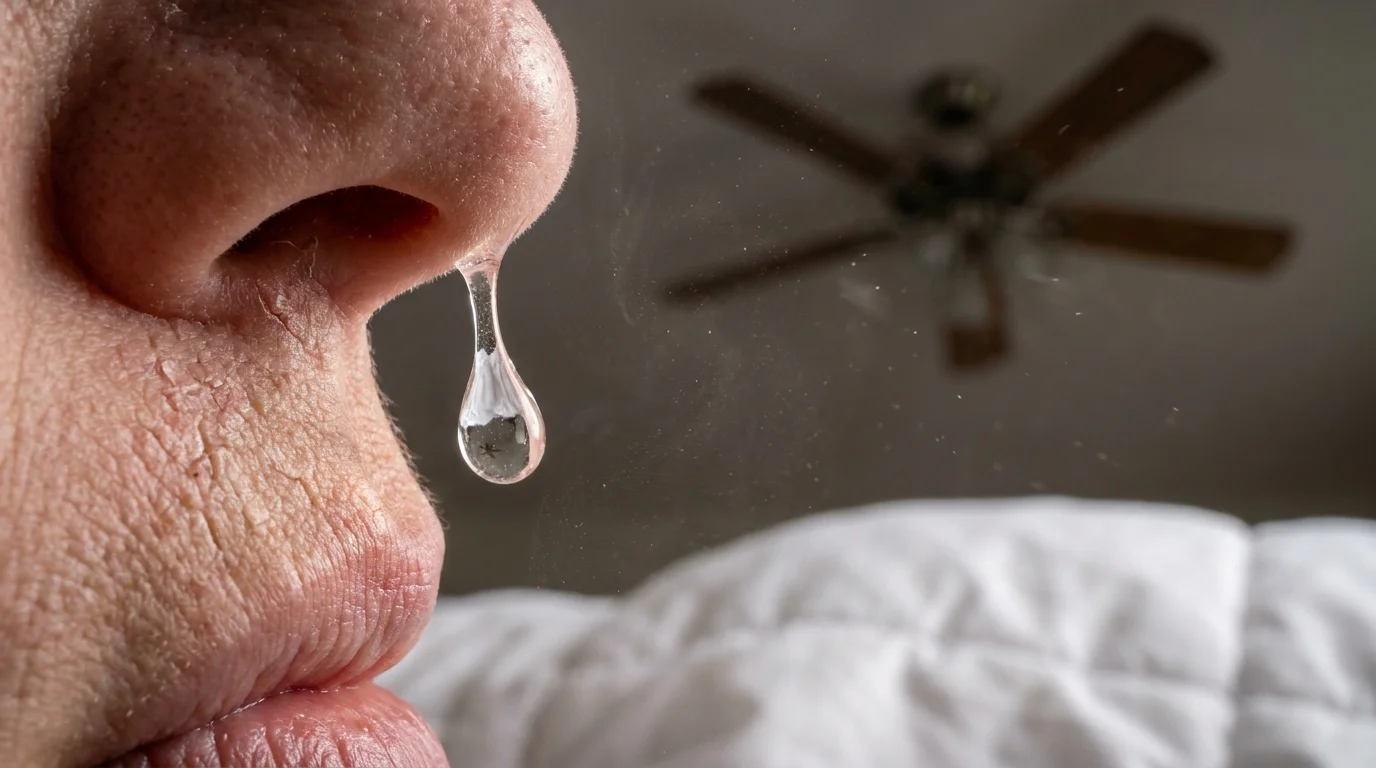
The faint, rhythmic hum of the motor blends into the quiet of three in the morning, while dusty wooden fan blades spinning above a rumpled cotton bed sheet push a steady column of air across your forehead. Outside, a heavy summer heat hangs in the darkness, making the artificial breeze feel like an absolute necessity. You pull the light linen sheet to your waist, confident that this simple fixture is preserving your rest.
Yet at six o’clock, you stir awake with a sandpaper sensation scraping against the back of your palate. Your tongue feels like dry felt, your mouth hangs uncomfortably open, and your first quiet morning greeting rasps out as a hollow, broken croak. You reach blindly for the water glass on the nightstand, assuming you caught a sudden seasonal draft or that local pollen counts spiked overnight.
The water brings temporary relief, but the tight, raw ache in your vocal cords lingers long after breakfast. It is a frustrating, familiar ritual that repeats itself throughout the hottest stretches of the year. You chalk it up to dehydration or fatigue, rarely suspecting the silent machine whirling just six feet above your pillow.
What feels like gentle cooling is actually functioning as an unyielding evaporative pump. When overhead blades drive a continuous downdraft onto your resting body for eight uninterrupted hours, they vaporize the moisture layer guarding your upper airways, triggering an autonomic cascade that changes how you breathe while unconscious.
The Wind Tunnel on Your Pillow
Your nasal passages are not simple hollow pipes; they are living heat-and-moisture exchangers lined with delicate ciliated tissue and a thin sheath of protective mucus. This barrier is designed to warm, filter, and humidify ambient air before it ever reaches your lungs. When natural moisture evaporates at a normal pace, microscopic goblet cells quietly replenish the fluid layer without alerting your nervous system.
A direct, downward ceiling fan stream completely overwhelms this balance. By creating a continuous low-pressure vacuum directly over your face, the current pulls water molecules away faster than your tissues can generate them. Within hours, the mucosal lining desiccates, shrinking and stiffening like parchment left out in the midday sun. Once your nasal passages dry out and become irritated, your body involuntarily triggers a defense mechanism: it drops your lower jaw to pull in larger volumes of air through your mouth.
Mouth breathing solves the oxygen demand, but it completely bypasses your nasal filtration system. Cold, dry air streams directly across your vocal folds and pharyngeal walls, stripping their lubrication and forcing vocal cord micro-inflammation that greets you every morning as raspy, strained hoarseness.
- Apple cider vinegar shots dissolve protective mucosal linings and trigger burning chest spasms
- Wire grocery basket neglect weakens adult stabilizer muscles and sparks sudden walking instability
- Laura Mercier translucent powder strips delicate surface oils and exposes crepey under-eye lines
- Scrubbing bathtub porcelain on knees forces abrasive cartilage pressure sparking throbbing joint stiffness
- Starbucks blonde vanilla lattes strip midlife vitality leaving leaden limbs and heavy sluggishness
The Clinic in the Heatwave
Dr. Marcus Vance, a 48-year-old sleep environment specialist based in Austin, Texas, spent years watching patients cycle through his practice with complaints of mysterious morning throat tightness and chronic vocal fatigue during blistering summer months. Most arrived convinced they had developed sudden acid reflux or adult-onset allergies, brandishing bags of throat lozenges and nasal steroid sprays that offered little help.
When Marcus visited his patients’ homes to conduct room-climate audits, he found a nearly universal pattern: heavy paddle fans bolted directly above mattresses, running on medium or high speed throughout the night. By simply altering room airflow pathways and stopping direct air velocity over the face, Marcus resolved over seventy percent of these vocal strain cases within three nights—without a single pharmaceutical intervention.
Tailoring Your Airflow to Your Biology
Air movement is not inherently harmful, but how your body interacts with that movement depends on your personal physiology and sleep posture.
For the Back Sleeper: When you sleep on your back, your nose and mouth remain squarely exposed to the downdraft. The force of the moving air can irritate your corneas if your eyelids do not seal shut with firm pressure, while directly desiccating your lips and larynx. Back sleepers benefit most from indirect displacement, letting air sweep along the perimeter walls rather than downward onto the chest.
For the Allergy-Sensitive Sleeper: Running ceiling fans at high velocity creates turbulence that constantly stirs settled dust mites, pet dander, and microscopic debris from carpets and bedcovers into the air. If you already fight allergic rhinitis, this relentless particulate suspension keeps your sinuses in a chronic state of low-grade swelling, ensuring you sleep with an open mouth and wake up with a swollen, gravelly voice.
For the Chronic Hot Sleeper: If you naturally radiate body heat, you do not need gale-force winds to achieve thermal comfort. The cooling sensation you desire comes from evaporative heat transfer off your skin, not from wind pressure on your face. Lowering the fan’s speed setting while shifting your body slightly out of the blade’s central vortex preserves your airway moisture while still shedding core body heat.
Recalibrating Your Bedroom Wind Patterns
Restoring deep, humidified sleep does not mean sweating through sweltering nights. It simply requires transforming an aggressive down-draft into gentle, indirect air circulation.
Evaluate your fan’s blade direction switch on the central motor housing. In high summer, most people run their fans counterclockwise to push air straight down, creating a direct wind tunnel. Reversing the rotation to clockwise at a low speed pulls warm air upward toward the ceiling, displacing cooler air gently down the walls without buffeting your head.
If you prefer standard downward circulation, reduce the setting to its lowest possible speed. The goal is subtle thermal displacement, not aerodynamic drag.
- Reverse blade rotation to clockwise to direct airflow up toward the ceiling corners.
- Keep bedroom relative humidity strictly between 45% and 55% using a clean evaporative console.
- Shift your bed frame or sleep position so your pillows sit outside the central three-foot column of the blade circumference.
- Wipe the leading edges of all wooden fan blades with a damp microfiber cloth once every ten days to halt particulate recirculation.
Your sleep environment should protect your recovery, not force your autonomic defenses to work overtime against indoor weather. Gentle atmospheric management transforms your morning routine from a raspy struggle into clear, effortless ease.
Restoring the Quiet Rhythm of Rest
Waking up should feel like a soft re-entry, not a physical recovery from overnight dehydration. When your airway stays moist, your vocal cords remain pliable, your vocal tone stays clear, and your body skips the unnecessary morning stress of repairing dried mucosal barriers. Mastering the invisible mechanics of your bedroom climate allows your body to truly rest, proving that the most restorative sleep often comes from the gentlest air.
“True sleeping comfort is not measured by the velocity of the air moving across your face, but by how quietly your body can breathe inside it.”
| Key Point | Detail | Added Value for the Reader |
|---|---|---|
| Airflow Direction | High downward airflow dries nasal passages rapidly. | Switching to clockwise rotation circulates room air without face-level desiccation. |
| Mucosal Barrier Health | Continuous wind strips natural airway fluid defenses. | Prevents involuntary mouth breathing and morning laryngitis. |
| Dust Disturbance | High-speed fan rotation resuspends settled allergens. | Reduces sinus congestion and nighttime airway reactivity. |
Frequently Asked Questions
Can I still use my ceiling fan if I wake up with a dry throat?
Yes, but drop the speed to its lowest setting and consider reversing the blade direction so air pushes upward instead of directly downward onto your bed.Why do my vocal cords specifically get hoarse from an overhead fan?
When the fan dries out your nasal tissues, your jaw naturally drops open during sleep. Cold, dry air then bypasses nasal warming and humidification, hitting your vocal folds directly and causing mild overnight tissue swelling.Does putting a bowl of water in the room offset fan-induced dryness?
Passive evaporation from a bowl is far too slow to balance the rapid moisture-stripping effect of moving air. A dedicated humidifier set between 45% and 55% relative humidity is significantly more effective.Are oscillating floor fans better than ceiling fans for bedroom airflow?
Yes, provided they oscillate away from your head. Oscillating fans move air across the room intermittently rather than bathing your airway in a continuous, uninterrupted downward stream.How frequently should ceiling fan blades be cleaned to protect air quality?
Wipe down blade surfaces every two weeks with a damp microfiber cloth to prevent accumulated dust, pet hair, and pollen from being blown into your breathing zone.