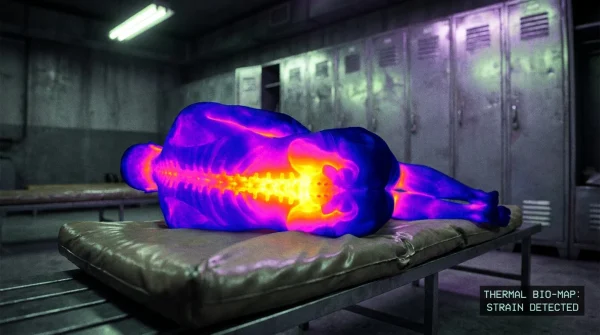
The late-afternoon sun cuts horizontally through the office blinds, slicing across your keyboard while an urgent email alert chimes in the corner of your monitor. Your breath hitches high in your collarbones, barely clearing your throat, but you do not stop typing. Instead, beneath the fabric of your trousers, something quiet and primitive takes hold: your tailbone draws slightly inward, your sit-bones pinch together, and your deep hip rotators lock down like an anchor dropped into rocky seabed.
By five o’clock, standing up feels like unfolding rusty sheet metal, with a hot, dull toothache radiating from the center of your right glute directly into your lower lumbar spine. You blame the cheap foam of your task chair, or perhaps yesterday’s rushed lunge set at the gym, assuming a mechanical breakdown caused this stubborn pinch. Yet the actual culprit is far more elusive: your body has spent eight straight hours quietly bracing for an emotional impact that never arrived.
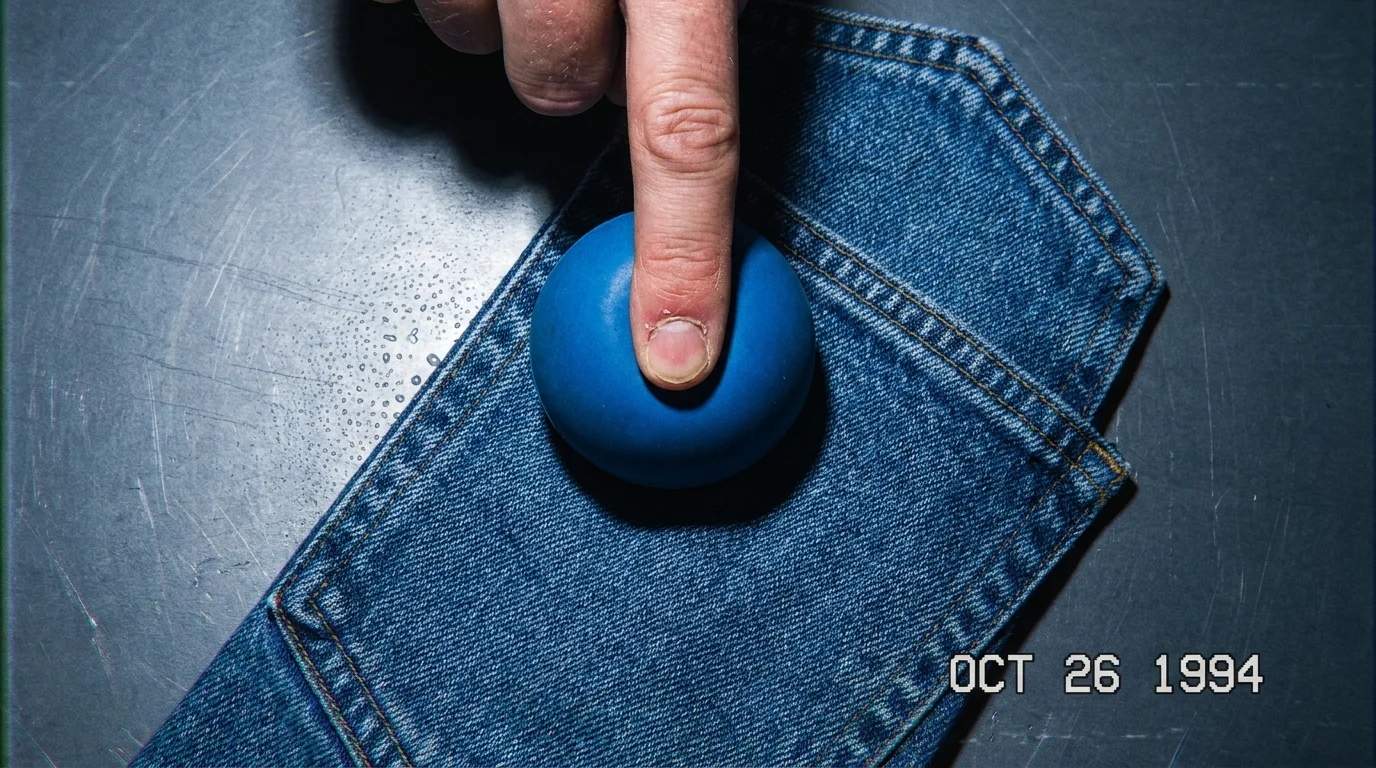
Later that evening on the living room rug, a dense blue rubber massage ball sinks into the outer edge of your denim pocket, meeting an unyielding knot of muscle that pushes right back. As the hard rubber compresses the tissue, your eyes water and your ribcage involuntarily clenches. You are not treating an athletic overuse injury; you are pressing against the physical vault where your nervous system filed away today’s unexpressed professional panic.
The Pelvic Vault: Why Ergonomic Chairs Cannot Fix Fear
Modern ergonomics treats your skeleton as an assembly of hinges and bolts that simply require proper angles, armrest heights, and lumbar cushions. When persistent, burning tension grips the deep posterior hip, conventional advice urges you to buy a standing desk or stretch your hamstrings until your toes go numb. This purely mechanical approach fails because it ignores how your fascia and autonomic nervous system intertwine during moments of social and professional threat.
Your piriformis is a small, pear-shaped muscle running horizontally from your sacrum to the top of your femur, sitting directly above—and sometimes threaded right through—the massive trunk of the sciatic nerve. In ancestral biology, social danger, boundary violations, or unexpected demands triggered a sprint reflex, curling the tailbone inward to shield the pelvic viscera before driving the legs into motion. In a corporate cubicle or high-stakes Zoom meeting, you cannot physically run, so the command stalls mid-circuit, leaving muscles trapped in survival mode while you smile politely and nod at a screen.
Because the piriformis shares fascial continuity with the pelvic floor and the deep stabilizers of the sacroiliac joint, this constant, low-grade autonomic bracing pulls your sacrum out of neutral alignment. The lower back muscles must then work overtime simply to keep your spine upright against the inward tension of your pelvis. The result is not merely a tight hip; it is an unyielding lumbar stiffness that stubbornly resists conventional foam rolling and casual stretching.
- Tight bottom bedsheets lock ankle joints overnight sparking agonizing midnight calf cramps
- Thick leather wallets derail pelvic alignment sparking agonizing sciatic nerve pinches daily
- Traditional cod liver oil resurfaced as liquid armor restoring brittle splitting winter nails
- Ground turmeric root paste stops burning summer heat rash within ten soothing minutes
- Pennsylvania measles outbreaks force regional health clinics to switch mobile immunization protocols immediately
Somatic physical therapist Marcus Reed, 46, based in Denver, observes this silent compensation daily in high-output corporate professionals whose spine MRIs come back unremarkable. He notes that nearly every client walking in with mysterious, non-disc sciatica admits to holding their breath while answering project management pings, subconsciously squeezing their glutes to anchor themselves against psychological overwhelm. The issue was never their lumbar spine; the tissue was simply acting as a silent, physical dam for unvoiced professional dread.
Mapping Your Strain Pattern: Three Autonomic Bracing Profiles
Not everyone holds stress in the hip through the same somatic posture. Your unique physiological wiring dictates how your rotators seize when a workplace boundary is crossed, creating distinct tension footprints that require tailored approaches.
The Sacral Tucking Profile
Common among those who internalize urgent deadlines and fear structural failure. You tend to roll backward onto your coccyx while typing, flattening the natural inward curve of your lower back while squeezing your inner glutes tightly together. This position places the piriformis in a state of sustained, shortened contraction under direct body weight, creating a suffocating clamp around the sciatic nerve that sparks dull aching into the upper hamstring.
The Asymmetric Leaner Profile
Typical for multi-taskers managing shifting workplace conflicts or relentless decision-making loads. You subconsciously shift all your pelvic weight onto one sitting bone, hiking the opposite hip while crossing an ankle over your knee. This winds deep myofascial tension patterns tightly through one side of your pelvic girdle, forcing that single piriformis to carry the entire torsional load of your torso and causing one-sided lower back locking.
The Phantom Sprinter Profile
Seen in professionals operating under persistent hyper-vigilance, anticipating the next operational crisis or demanding client call. You sit on the front half-inch of your chair with your feet tucked far behind your knees, calves coiled and external rotators fired up as if you must spring out of your seat on a moment’s notice. The piriformis never receives the neurological signal that it is safe to power down, leading to chronic twitching, cramping, and morning sacral stiffness.
The De-Tensioning Protocol: Down-Regulating the Deep Rotators
Aggressive, painful digging into an already terrified muscle only causes your autonomic nervous system to brace harder against the perceived assault. True release requires teaching the sensory receptors inside the fascial envelope that the emergency has passed, coaxing the fibers to let go rather than forcing them open.
- Grounding the Ischial Tuberosities: Sit on a firm, unpadded wooden chair with both feet flat on the floor, uncrossing your legs entirely. Slide your hands palms-up under your buttocks until you locate the hard, bony points of your sit-bones, then tilt your pelvis gently forward until your weight balances directly atop them, taking tension off the back wall of your pelvis.
- The Sub-Threshold Ball Release: Place a dense rubber massage ball not directly beneath your sit-bone, but two inches toward the outer hip seam of your jeans. Lean sideways into the ball until you locate a dull, sweet-sore ache, stopping short of any sharp or electric sciatic nerve sensation.
- Extended Vagal Exhalations: Rest entirely still on that tender junction for two continuous minutes without grinding or rolling the rubber back and forth. Inhale slowly through your nose for four seconds, letting your belly soften, then exhale through slightly parted lips for seven seconds, imagining the muscle tissue dissolving like melting butter over the rubber contour.
- Isometric Micro-Oscillations: Once the initial sensitivity dampens by roughly half, gently draw your knee inward toward your midline by a single millimeter, hold for three seconds, then let it fall outward into absolute slack. This tells the spindle fibers in the piriformis that they are safe to recalibrate their resting length.
Assemble your minimalist tactical toolkit: secure a high-density rubber lacrosse ball (not a soft tennis ball, which collapses beneath tissue), set your room between 68 and 71 degrees Fahrenheit to prevent defensive shivering, and commit to six unbroken minutes per side daily at the exact moment your workday ends.
Reclaiming the Seat of Ease
Addressing the piriformis as an emotional and somatic structure fundamentally transforms your relationship with daily work fatigue. When you understand that a locked lower back is not a sign of personal physical fragility, but rather your body’s earnest, clumsy attempt to shield you from relentless psychological pressure, the frustration vanishes. You stop viewing your hips as broken machines needing aggressive repair, and begin recognizing them as honest barometers of your daily boundaries.
Restoring freedom to your pelvis requires more than just mechanical intervention; it asks you to notice the moment a tense email arrives and intentionally keep your belly soft and your pelvic floor quiet. By clearing the backlog of silent panic stored deep in your glutes, you do more than walk without a limp. You teach your nervous system that work can happen around you without needing to be locked inside you, leaving your body open, fluid, and entirely your own.
The deep rotators of the hip do not seize because they lack strength, but because they carry the physical burden of the conversations you were never allowed to have.
| Key Point | Detail | Added Value for the Reader |
|---|---|---|
| Underlying Cause | Subconscious autonomic pelvic floor clamping driven by persistent, unvoiced workplace anxieties. | Shifts focus from mechanical chair ergonomics to real nervous system self-regulation. |
| Anatomical Target | Piriformis muscle crossing directly over or through the primary sciatic nerve trunk. | Explains why lower back stiffness is often secondary to gluteal nerve compression. |
| Release Strategy | Static compression with a firm rubber ball paired with lengthened seven-second exhalations. | Prevents protective muscle guarding provoked by aggressive, painful foam rolling routines. |
Frequently Asked Questions
How can I tell if my back pain is coming from my piriformis rather than a herniated lumbar disc?
Disc issues typically worsen when bending forward to touch your toes and often produce sharp, shooting lightning down the front or back of the leg. Piriformis entrapment generally presents as a deep, agonizing, localized toothache in the center of the buttock cheek that flares dramatically after prolonged sitting and softens during gentle walking.Why does aggressive foam rolling seem to make my deep hip ache worse the next morning?
Vigorously grinding a firm foam roller across a hyper-sensitized piriformis directly compresses the sciatic nerve against the underlying pelvic bone. This mechanical trauma inflames the protective nerve sheath, provoking your nervous system into clenching the surrounding rotator cuff muscles even harder to guard the vulnerable pathway.Does sitting on an exercise ball chair prevent this subconscious pelvic bracing?
Not inherently; in fact, for individuals already locked into hyper-vigilance, an unstable surface can backfire. Your brain senses instability and reflexively fires the deep pelvic rotators to keep you balanced, worsening the clamping cycle unless you are actively mindful of softening your pelvic floor.How quickly does somatic hip release alleviate lower back stiffness?
While localized muscular slack can be felt within five to ten minutes of slow vagal-downregulation work, durable relief usually requires seven to ten days of consistent practice. The nervous system needs repeated, calm evidence that it can face daily work stressors without defaulting to pelvic splinting.Can I do this release work while sitting at my desk during the workday?
Yes, placing a firm rubber ball directly under your outer glute while on a flat chair for two minutes can interrupt an acute clenching cycle. However, the release will remain temporary if you return to shallow apical breathing and sustained deadline hyper-vigilance moments later.