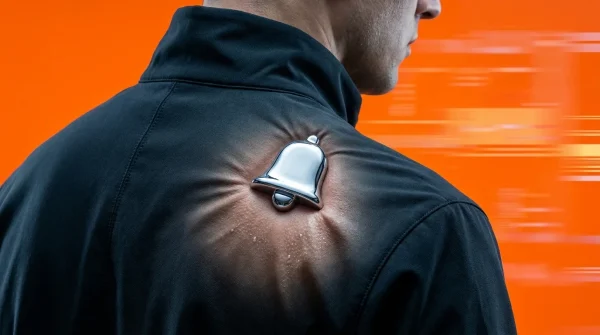
The fluorescent fixtures hum at 3:15 on a Tuesday afternoon, casting a flat, cold sheen over your keyboard while an agenda-less conference call drones through your headset. You press a knuckle firmly into your right temple, rationalizing that the hot, tightening clamp around your forehead is just another casualty of screen glare or a skipped glass of water. But the display monitor is innocent. Beneath your skin, the true architect of your discomfort hides in plain sight along the slender corridor of your neck.
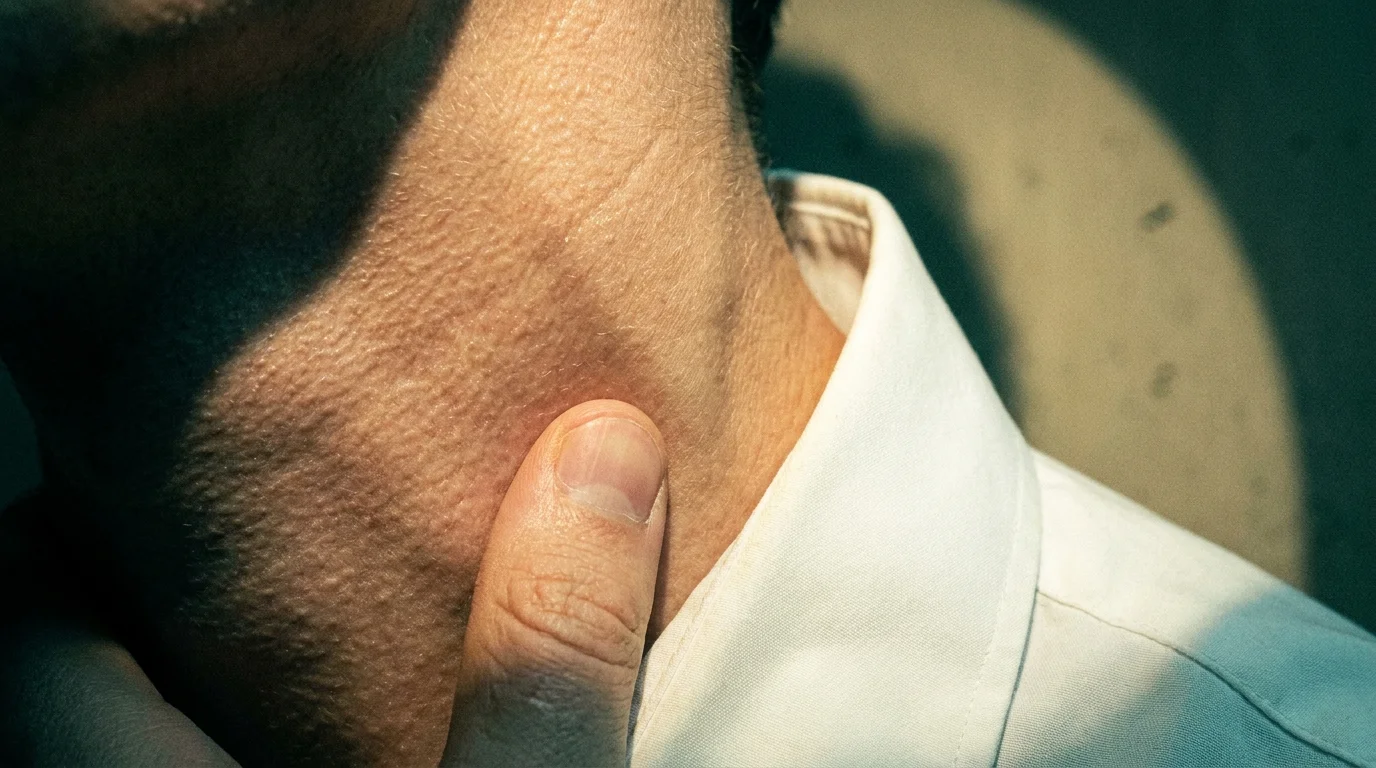
Slide your fingers just underneath the angle of your jaw, trailing them down toward the inner edge of your collarbone. Notice the corded cable of flesh pulled taut under your touch. A taut neck tendon protruding tightly beside the stiff fabric of your work shirt is not merely bad posture; it is a physical barricade. You have spent the last forty-five minutes biting back your instinct to challenge a chaotic timeline, quietly swallowing sentences before they could pass your teeth.
Every time you hold back a clear boundary, absorb passive-aggressive feedback, or keep your chin frozen in place so your video frame looks composed, your autonomic nervous system mounts a silent defense. The sternocleidomastoid—the thick, two-headed muscular strap running from your sternum and clavicle up to the mastoid process behind your ear—locks into an isometric brace. It stops functioning as a fluid rotator of your skull and transforms into an emergency brake for your voice.
By late afternoon, this unyielding muscular siege projects pain upward along well-mapped neurological referral pathways. The resulting sensation mimics an iron band cinched across your brow and temple, leaving you searching through desk drawers for over-the-counter tablets that never seem to dissolve the source of the ache.
The Throat Brake: Why Holding Your Tongue Locks Your Skull
We are taught to treat tension headaches as isolated cranial misfires, yet human anatomy rarely separates unspoken emotion from mechanical tension. Regard your sternocleidomastoid (SCM) as the physical brake pedal for your vocal expression. When threat appears in nature, the anterior neck contracts instantly to tuck the chin, shield the carotid artery, and brace the cervical spine against blunt impact.
In an open-plan office or a digital conference room, physical violence is non-existent, but social evaluation is relentless. When you repress righteous frustration or swallow a sharp response, holding back instinctive verbal boundaries triggers the vocal cords to seize while the lateral neck muscles tense in protective anticipation. Your nervous system steps down hard on the gas pedal of workplace stress while your conscious decorum slams on the physical throat brake.
- Updated flu shot guidelines enforce immediate protocol changes across high risk senior care facilities
- Acoustic voice analysis screenings reveal early cognitive decline patterns across regional neurology clinics
- Darkening bedroom digital clocks blocks harsh night glare switching restless brains into heavy sleep
- Standing on locked knees forces sharp pelvic tilts sparking rigid lower back morning stiffness
- Mustard plaster chest wraps resurfaced as proven home relief that loosens tight rattling phlegm
This continuous tug-of-war forms dense, irritable trigger points within the belly of the SCM muscle fibers. These contractures refer dull, throbbing pain into your temples, behind the eye orbit, and across your forehead, often masquerading as classic sinus pressure or screen-induced migraine. Tinting your monitor amber or scheduling an eye exam fails to bring relief because the tension was forged in the muscular scaffolding of your throat.
Julian Vance, a 42-year-old corporate logistics manager from Chicago, spent nearly three years fighting daily 3:00 PM temple throbs that derailed his evenings. After brain scans returned clear and ergonomic desk retrofits offered no change, a manual therapist noticed Julian subtly cocked his head and locked his left SCM whenever discussing project roadblocks. Julian was bracing against conflict before he even picked up the telephone. Once he learned to spot his throat bracing and release the anterior neck during difficult calls, the three-year headache cycle resolved in two weeks.
Reading Your Grip: The Three Somatic Strain Profiles
Not every worker internalizes occupational stress identically. Your behavioral coping habits dictate where the mechanical strain collects along the cervical column.
The Diplomatic Swallower
This pattern develops in individuals tasked with managing difficult client expectations or keeping peace in fragile teams. When tension surfaces, your immediate reflex is to withdraw the chin backward and down, flattening your throat to preserve an even, agreeable speaking tone. The sternal branch of the SCM bears the brunt of this constriction, radiating sharp, pinching pain into the temple and around the back of the eye socket.
The Forward-Tilt Pleaser
Common among remote professionals, this posture blends modern screen slouch with eager agreement. As you nod enthusiastically at your camera while quietly drowning under unmanageable workloads, magnifying the skull’s effective weight strains the anterior structures. Your head drifts forward, compelling the clavicular head of the SCM into chronic hypertonicity that triggers a sickening, dull band across your forehead.
The Unspoken Defense Clencher
If you grind your molars while reading urgent emails or grit your jaw to stop yourself from interrupting, your masseters and neck work as a unified clamp. This joint contraction traps nearby suboccipital and trigeminal nerve pathways, leaving you with tender temples, facial soreness, and a sensation that your head is caught in a carpenter’s vise.
The Lateral Release: Mindful Interventions for Locked Cervical Strands
Resolving this somatic knot requires quiet, targeted patience rather than deep, aggressive gouging. The lateral neck is a delicate intersection of vascular and neurological pathways, meaning touch must always remain gentle and responsive.
Loosen your collar and take two unhurried nasal breaths, directing your breath into your belly rather than lifting your collarbones. A muscle locked in psychological defense will only release once your nervous system feels completely safe.
- Locate the muscle belly: Turn your chin thirty degrees to the left, then tilt your ear softly toward your left collarbone. With your right hand, grasp the thick, rope-like diagonal muscle running from behind your ear toward your breastbone between your thumb and curved index finger.
- The Pincer Grip: Do not pull the tissue away from your neck. Simply apply light, steady pressure, identical to the firmness you would use to pinch a ripe peach. Hold this steady contact for twenty to thirty seconds until the muscle softens.
- The Exhale Sweep: While maintaining light compression, slowly rotate your chin in the opposite direction while exhaling gently through parted lips. Repeat this gliding motion across the upper, middle, and lower sections of the muscle strand.
- The Vocal Sigh: Drop your lower jaw, let your tongue sink toward the floor of your mouth, and release an audible, soft sigh. This instantly disengages the hyoid muscles that pull the SCM into sympathetic co-contraction.
The Workplace Somatic Toolkit
Equip your workstation with a few subtle physical cues to defuse the clamp before it blooms into an incapacitating headache:
- Warmth Application: Rest a warm, moist towel (between 100°F and 105°F) against your lateral neck for five minutes prior to performing gentle pinches.
- The Tongue Rest Cue: Place a small visual reminder on your monitor bezel to remind you to keep the tongue resting softly on the palate with your back molars separated by two millimeters.
- Panoramic Vision Breaks: Every half hour, look away from your screen to trace the distant horizontal corners of your room for sixty seconds, which reflexively dials down suboccipital and neck guarding.
Reclaiming Your Voice from Your Fascia
A throbbing temple is rarely a spontaneous mechanical breakdown of your skull; it is a physical ledger of words swallowed and personal limits compromised. When you begin to read your body as a living log of your workplace habits, the dull ache ceases to feel like an unpredictable enemy. It reveals itself as an urgent message from muscles that have spent months holding your protective armor in place.
By catching the subtle hardening beside your collar long before the temple throb takes hold, restoring natural cervical mobility daily transforms how you handle pressure. You give your neck permission to lengthen, your jaw space to drop, and your voice room to breathe. In releasing the physical grip on your throat, you reclaim your mental clarity from the workday grind.
The voice you swallow does not vanish; it gathers in the throat and tightens the skull until you finally listen.
| Key Point | Detail | Added Value for the Reader |
|---|---|---|
| Root Driver | Suppressed speech and defensive throat bracing | Identifies the hidden emotional trigger behind persistent temple pain |
| Primary Muscle | Sternocleidomastoid (SCM), sternal & clavicular heads | Directs self-care away from the temples down to the anterior neck |
| Release Tactic | Light pincer compressions combined with gentle chin rotations | Provides an instant, cost-free desk intervention requiring zero tools |
Frequently Asked Questions
Why does an anterior neck muscle cause pain in my temples?
The sternocleidomastoid shares complex neural pathways with the trigeminal and occipital nerve networks. When hyperirritable trigger points form in its muscle belly, the nervous system misinterprets those distress signals as pain occurring across your temples, forehead, and behind the eyes.Can poor posture alone cause this SCM tightness?
While forward-head posture certainly increases the workload on your anterior neck, emotional bracing dramatically amplifies the issue. Swallowing your words or tensing against stress forces the muscle into constant isometric strain that ergonomic chairs cannot fix on their own.How firm should my touch be during self-release?
Very gentle. The neck houses the carotid artery and sensitive nerves. You should never dig aggressively or cause sharp discomfort. Use only enough pressure to grip the muscle rope securely, roughly equivalent to checking the firmness of ripe fruit.How quickly does temple pain subside after releasing the SCM?
Many people feel an immediate softening of temple pressure within two to three minutes of a successful pincer release. Consistent daily application over one to two weeks helps permanently retrain the resting tone of the tissue.When should I seek medical attention for my headaches?
If your headache strikes suddenly with unprecedented severity, or is accompanied by neurological symptoms like vision loss, slurred speech, numbness, or high fever, seek immediate professional medical evaluation to rule out acute vascular or systemic events.