The steam curls off the white ceramic plates, carrying that faint scent of citrus rinse-aid and scalded glass into the quiet kitchen air. It is late evening, or perhaps the calm lull before breakfast, and the house hums with quiet predictability. You reach down to tug the heavy wire rack of your dishwasher forward, hearing the wet scrape of nylon wheels gliding along a stamped stainless-steel track. It is the most mundane movement in your domestic day, an automatic task carried out thousands of times without a second thought.
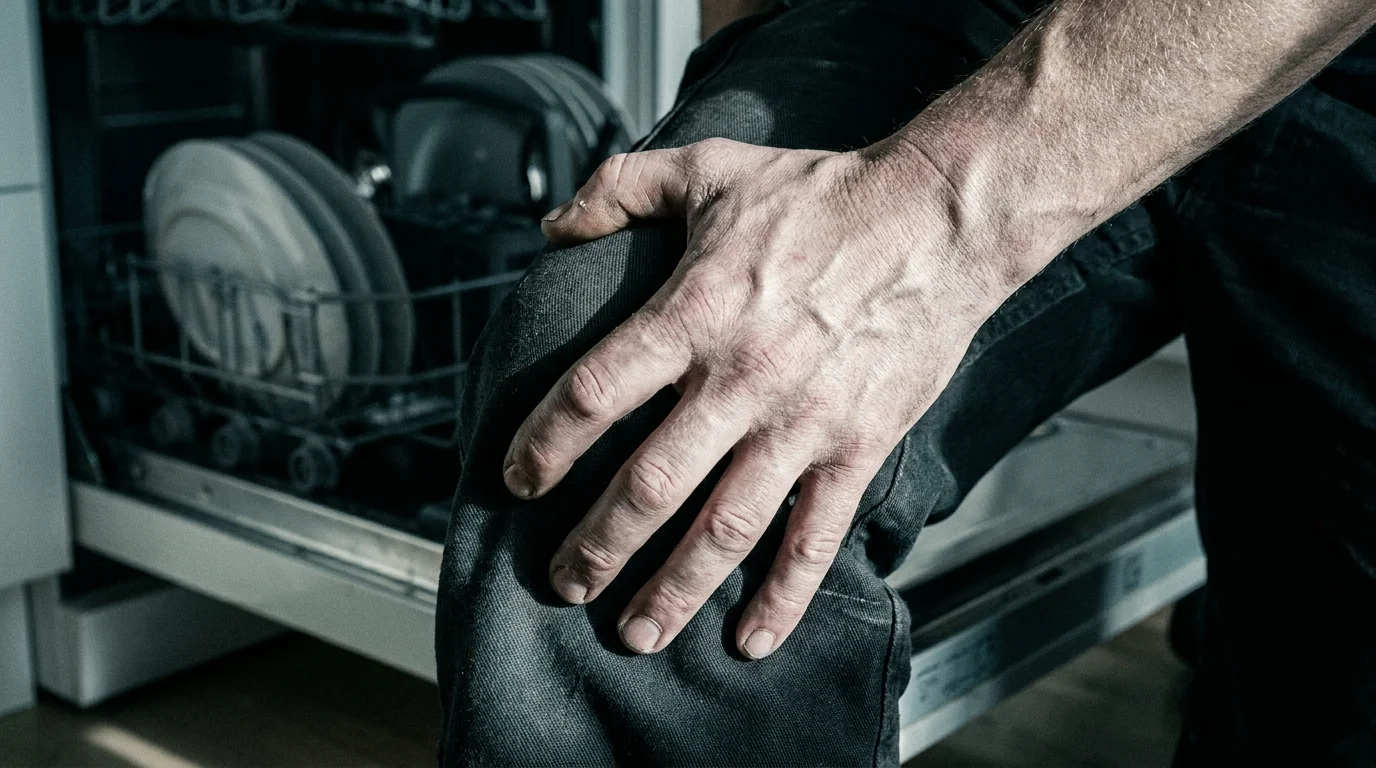
Then, as you lean forward to snag a cluster of dinner plates, reaching across your centerline to slot them toward the counter behind you, a sudden, searing pinch catches you off guard. It might register first as a hot wire in your lower back, but within a fraction of a second, an unmistakable burning heat shoots through your patella. You hesitate, one foot planted awkwardly sideways on the kitchen linoleum, waiting for the joint to unlock. You blame the staircase you climbed earlier, or perhaps the brisk walk you took through the autumn chill, but the true culprit sits wide open on your kitchen floor.
We tend to imagine joint wear as the consequence of theatrical athletic injuries or the inevitable rust of aging. We picture heavy barbells, steep rocky trails, or sudden missteps on slick ice. Yet our cartilage often endures its most punishing damage during our quietest moments, quietly shaved down by millimeters through unconscious micro-torsions.
The Corkscrew Effect: Re-Imagining the Dishrack
Consider the architecture of a twisting door hinge. If you apply pressure purely along its swinging path, steel swings against steel with barely a whisper of resistance for fifty years. But if you pry the door upward while forcing it inward, the brass pins warp, the screws back out of the jamb, and the mechanism begins to groan. Your body operates under these identical physical laws. When you clear out a low dishwasher rack, you rarely drop straight down into a symmetrical squat. Instead, your feet stay pinned in place while your shoulders sweep sideways, turning your spinal column and leg joints into an overloaded corkscrew.
This asymmetrical reach creates a severe shearing force across your patellar tendon and the soft retro-patellar cartilage tucked behind your kneecap. Because the low basket forces your center of mass forward over your toes, your kneecap is slammed hard against the groove of the femur. Twist your torso just fifteen degrees to place a pan on the island counter, and that crushing contact suddenly becomes a grinding rotary sander. Rotational load degrades softer joint surfaces far faster than honest, straight-line compression ever could.
The Shared Secret from the Movement Floor
Clara Mendoza, a 52-year-old architectural draftsman and weekend woodworker from Portland, spent four months visiting specialists for an intermittent, biting flame beneath her left kneecap. She had stopped taking evening strolls and assumed her decades of stand-up drafting were finally taking their toll on her legs. It was only during an in-depth clinical movement screen that her physical therapist noticed a stark pattern: Clara had pristine hip mobility when stepping forward, but her left foot turned out at an awkward angle every time she reached below hip height to grab a pencil or retrieve dropped lumber. A short inquiry revealed she emptied her low kitchen wash-basin twice daily, consistently planting her left leg like a pivot post while wrenching her torso back toward the cupboard. Three weeks of changing that single mechanical habit dissolved the burning sensation completely, without a single cortisone injection.
- Warm salt sock compresses drain trapped middle ear fluid restoring clear sinus pressure
- Raw thyme honey neutralizes stubborn ticklish throat coughs through thick antimicrobial coatings
- Raw cacao nibs restore razor focus without afternoon nervous system jitters
- Commercial contrast tubs spike arterial pressure shifts leaving adults with dizzy spells
- Stacked reading pillows alter cervical spine angles triggering dull base skull throbbing
Mapping the Wear: Adjustment Layers for Every Kitchen
Every body moves into household tasks with distinct baseline habits, and our kitchen footprints rarely match our ideal biomechanics. Addressing this rotational drag requires identifying your specific domestic pattern.
For the Counter-Hugging Pivot
If your kitchen layout places the dishwasher parallel to your primary storage drawers, you likely perform a continuous hip-swivel while bearing weight. You lean down, grab four heavy coffee mugs, and swing ninety degrees while your knees stay pointed at the baseboards. To stop this shear stress, you must turn your feet into mobile castors rather than rigid anchor pins. Step through the entire rotation instead of letting your lower back and knee joints absorb the turning radius.
For the Deep-Bender with Tight Hamstrings
If reaching the bottom rack feels like touching your toes with stiff morning legs, your lower back automatically rounds out into a deep curve to bridge the gap. This round-back posture deactivates your gluteal muscles entirely, leaving the delicate lumbar facet joints and the anterior knee structures to bear the entire gravitational load of your torso. You are essentially dangling your upper body weight over bent knees without the muscular brake pads designed to protect them.
For the Rapid Multitasker
Speed is the silent accelerator of joint shearing. Rushing to empty the wash cycle while the coffee brews encourages snatch-and-grab motions where dishes are held far away from your ribcage. Holding a heavy stoneware skillet at arm's length amplifies its effective weight by nearly six times across your lumbar discs and patellar surfaces. Keeping items close to your sternum before changing direction drastically reduces this lever arm.
Mindful Application: The Kitchen Hip-Hinge Reset
Protecting your knees and lower spine does not require remodeling your kitchen or buying an elevated, commercial-grade washing unit. It simply demands replacing an unconscious, twisting reach with a clean, grounded hip-hinge.
Instead of bending from the waist or rounding your spine toward the floor, you initiate the descent by sending your tailbone straight back toward an imaginary wall behind you. Your shins remain nearly vertical, shifting the mechanical burden away from your kneecaps and placing it squarely into the powerful glutes and hamstrings.
- Clear the landing zone first: Open the cupboards and drawers where clean items will go before you ever pull out the bottom rack. Eliminating the mid-movement pause keeps you from holding awkward, bent-over postures.
- Square your belt buckle: Keep your belt buckle pointed directly at the dish you are grabbing. Never lift a plate while your hips face one wall and your shoulders face another.
- The Wide Stance Base: Step your feet wider than shoulder-width, turning your toes slightly outward. This drops your pelvis closer to the bottom basket without forcing excessive knee flexion.
- Step, do not twist: When moving an unloaded item from the rack to the shelf, physically pick up your feet and face the destination rather than pivoting through the knee joint.
- Rest one hand: Place your non-lifting hand on the kitchen counter edge or your own thigh to disperse fifty percent of your upper body weight through your arm.
The Domestic Joint Toolkit: Keep your stance set at roughly 1.5 times shoulder-width when working below the knee. Limit single-hand lift loads to under five pounds when reaching into the back corners of the lower rack. Take exactly three seconds to hinge down and three seconds to rise, using the rhythm to build glute awareness instead of relying on ballistic momentum.
The Space Between Everyday Movements
We often measure our vitality by the grand markers of physical freedom: the miles we can hike, the flights of stairs we can climb without gasping, or the freedom to sit comfortably through a long dinner with friends. Yet that freedom is rarely stolen in an instant. It is chipped away in the quiet shadows of our home, inside the tiny, thoughtless compromises we make while unloading forks, carrying laundry baskets, or tying our shoes on the run.
When you transform the mundane chore of emptying the dishwasher into an intentional, grounded physical practice, you are not merely preserving patellar cartilage. You are asserting quiet command over how your frame interacts with gravity. The burning knee twinge is not a permanent sentence of aging; it is simply your body asking for better geometry. When you give it the support of your largest muscles, the kitchen stops feeling like an obstacle course, and your joints can return to doing what they were designed to do: carry you through life with steady, painless grace.
“Joint preservation is rarely won through extreme interventions; it is mastered by correcting the thousands of tiny, asymmetrical twists we repeat every single day.”
| Key Point | Detail | Added Value for the Reader |
|---|---|---|
| The Mechanical Trap | Twisting the spine while bearing weight with knees fixed in place. | Identifies why back strain and knee burning often share the exact same physical origin. |
| The Joint Impact | Crushing and rotary shearing of retro-patellar cartilage against the femur. | Explains that joint aches are frequently caused by bad friction rather than structural decline. |
| The Movement Fix | Employing a wide hip-hinge while stepping your feet through every directional change. | Instantly offloads patellar strain by transferring daily lifting work to the glutes. |
Frequently Asked Questions
Why does an issue in my lower back make my knee burn?
The nerves that feed sensation to your kneecap, primarily the femoral and saphenous nerves, emerge directly from your lumbar spine. Compressing or torquing the lower back joints can refer a burning, stinging signal down the front of the leg, mimicking local knee inflammation.Is it better to squat all the way down to empty the bottom rack?
Deep knee flexion past ninety degrees places enormous compressive pressure on the kneecap. For many adults over forty, a wide-stance hip-hinge with relatively vertical shins is far gentler on cartilage than a deep, full squat.Should I wear supportive shoes while doing chores in the kitchen?
Hard linoleum, tile, or wood floors offer zero shock absorption. Slipping on a structured, supportive indoor shoe or stepping onto a cushioned anti-fatigue mat significantly softens joint loading during chores.How do I know if my knee pain is cartilage wear or nerve irritation?
Cartilage irritation usually aches deeper inside the joint during weight-bearing movement or pressure, whereas referred nerve tension often feels like a surface burn, tingling, or an unexpected electric zip. A doctor can confirm the precise source.Does loading the dishwasher carry the exact same physical risk?
Yes. Loading often carries an even higher risk because plates are slippery, greasy, and handled with unpredictable tempos, making sudden asymmetrical twists even more likely if you do not step your feet toward the rack.