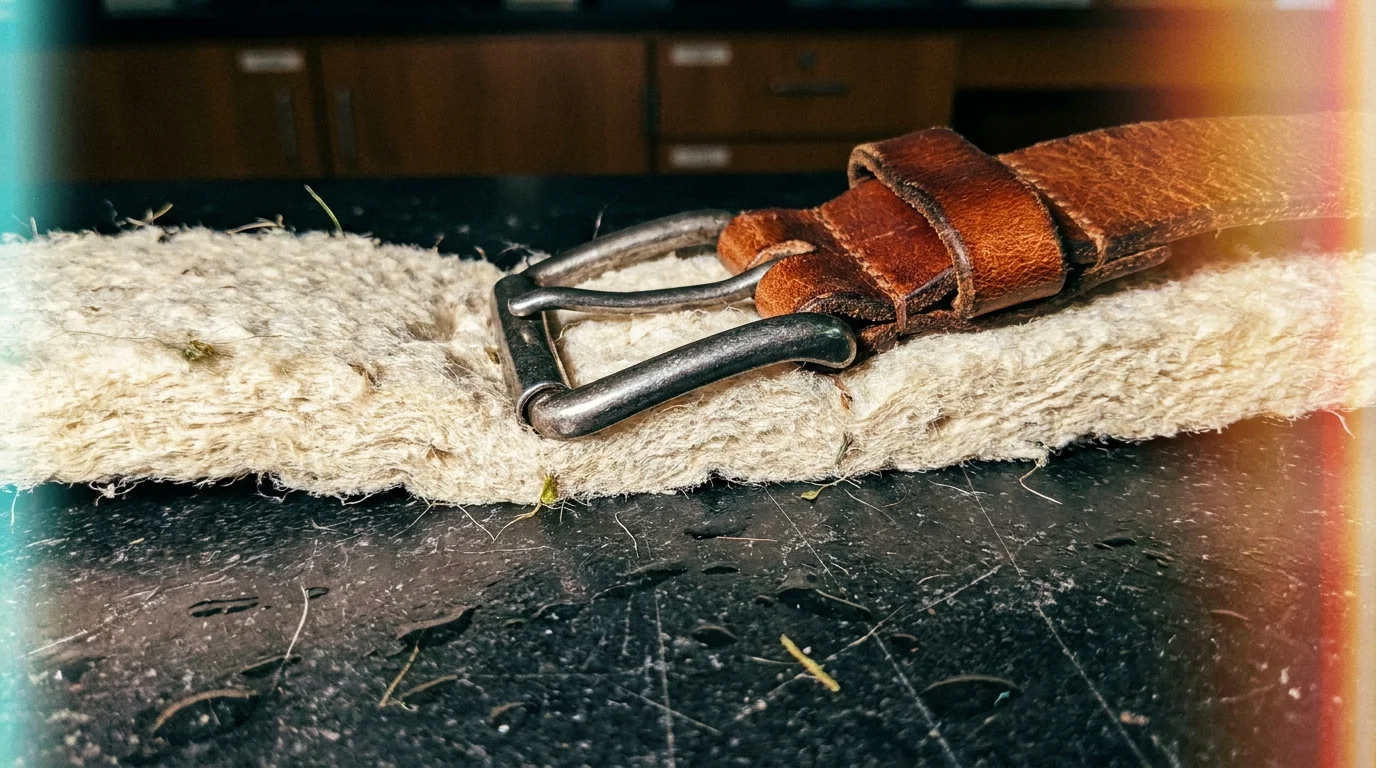
The midday light cuts across your desk, glinting off the polished brass tongue of your belt buckle. You lean slightly forward toward two glowing monitors, fingers resting lightly on the mechanical keys, feeling entirely focused. Then, without warning, the air in the room suddenly feels thinner. You inhale, but the breath snags somewhere halfway down your sternum, leaving your ribs feeling banded in iron. A faint tremor of alarm runs through your pulse—not quite an overt panic attack, but a quiet, insidious signal that you simply cannot draw enough air.
You shake your shoulders loose, roll your neck until it pops, and sit up straight, wondering if you drank too much dark roast coffee or if winter dust in the central heating vents is catching in your bronchioles. You swallow hard, attempting to yawn to force your lungs open. Nothing works. The phantom squeeze stays right against the margin of your floating ribs, a dull constriction that feels eerily close to a sudden cardiac flutter or a locked chest spasm.
The culprit is not your lungs, your heart, or sudden onset work stress. It is resting exactly two inches below your navel. That stiff, thick-cut steerhide strap cinched to the third notch—the one that looks sharp and holds your trousers perfectly crisp while you stand by the elevator—has quietly turned into an anatomical vise. When you transition from standing to sitting, your pelvic bowl tilts backward, folding your soft abdominal wall directly over the unyielding perimeter of tanned cowhide.
The Hydraulic Trap: When Leather Blocks the Piston
To understand why a simple strip of leather can manufacture the physical sensations of suffocation, you have to picture the torso not as an empty cavity, but as an elegant, closed hydraulic cylinder. At the top sits your diaphragm, a broad dome of skeletal muscle shaped like an open parachute. Every time you draw breath, that muscular dome contracts, flattening downward toward your pelvis like a mechanical piston. For that piston to descend, your viscera—your liver, intestines, and stomach—must fluidly displace outward into the pliable wall of your lower belly.
When you sit, your abdominal real estate compresses by roughly thirty percent. If your waistline is encircled by thick, inflexible leather, those displaced organs have nowhere to expand. The hydraulic wave hits an unyielding wall, forcing your digestive organs straight back up against the underside of the descending diaphragm. The piston jams mid-stroke.
Denied its natural downward clearance, your nervous system registers this sudden mechanical block not as a wardrobe mistake, but as systemic mechanical asphyxiation. The phrenic nerve—originating high in your cervical spine and innervating the diaphragm—begins firing frantic sensory alarms back to the brainstem. Starved of diaphragmatic range, your body instinctively switches to secondary accessory muscles: the scalenes in your neck, the pectoralis minor across your collarbones, and the intercostal bands between each rib. You begin breathing high, shallow, and fast, blowing off carbon dioxide and kicking off the classic neurochemical cascade of low-grade panic.
- Daily levothyroxine tablets stall metabolic burn when taken under outdated morning schedules
- Arnica cooling gels trigger pale cold fingertips and sharp temple throbbing
- Pressed joint caplets deposit undissolved chalky filler provoking stubborn lower stomach bloating
- Firm watchband presses silently halt runaway panic spikes during crowded boardrooms
- Spicy mustard spoonfuls shock racing panic loops to restore steady breathing instantly
Dr. Julian Vance, a 48-year-old sports biomechanist and physical medicine consultant in Chicago, sees this pattern arrive in his clinic weekly under the guise of unexplained costochondritis or mysterious mid-day breathing crises. Vance spent years tracking autonomic tone in desk workers, discovering that patients wearing rigid dress belts while seated exhibited a 42 percent reduction in forced expiratory volume compared to their standing baselines. When patients sat buckled into rigid leather for six hours, their salivary cortisol spiked purely from the respiratory muscle exhaustion caused by fighting the belt with every single inhalation.
Mapping the Thoracic Splint: Anatomy of a Compression Band
The mechanical pinch rarely stays confined to your waistband. The human body is a continuous matrix of connective tissue, and when you choke off mobility at the base of the ribcage, the tension telegraphs upward along specific neural pathways.
The lower thoracic nerves—running from T8 through T12—emerge from the spine and wrap around the lower margins of the ribs, terminating right at the boundary where your belt presses into your abdomen. Constant mechanical compression over these nerve endings dulls localized sensation while heightening visceral alarm. You do not feel your skin hurting; instead, you feel a vague, tight band encircling your heart and lungs, a phenomenon known clinically as diaphragmatic splinting.
For the Commuter and Desk Professional
If your workday alternates between bucket seats in a car and an ergonomic mesh chair, your hip flexors remain in acute flexion for hours. In this seated posture, a stiff dress belt acts as an external tourniquet. The floating ribs lose their outward flare, forcing the upper chest to pull double shifts just to keep your blood oxygenated. By 3:00 PM, this muscular strain registers as a deep, burning ache beneath your shoulder blades and an irresistible urge to constantly adjust your posture.
For the Tailored Wardrobe Enthusiast
Heavy selvedge denim and structured wool trousers are designed around precise silhouettes that demand rigid waistlines to stay positioned. When you cinch these fabrics tight with heavy-duty tooling leather, you effectively brace your midsection as if you were preparing to lift a two-hundred-pound barbell. But bracing during passive sitting locks your thoracolumbar fascia into rigidity, denying your kidneys and digestive organs their natural rhythmic massage during the breathing cycle.
Mindful Waistline Calibration: The Two-Knuckle Release
Resolving this thoracic suffocation reflex does not require discarding your favorite belts or surrendering to loose sweatpants. It demands that you treat your waistband as an active, adjustable joint rather than an immovable structural brace.
Begin by checking your clearance while seated, not while standing in front of your bedroom mirror. When you sit down, slide your index and middle fingers flat beneath your belt buckle, pressing down against your abdomen. If you cannot comfortably rotate those two fingers forty-five degrees without the leather biting into your skin, your belt is restricting your phrenic descent. Release the buckle by one notch immediately before you begin your focused screen work.
- Audit the Leather Temper: Swap out rigid, double-layered workwear leather belts for supple, vegetable-tanned hides with natural give, or woven elastic webbing for long desk days.
- Adopt the Sitting Notch: Establish an automatic habit of shifting your buckle one notch looser the moment your hips contact your office chair.
- The Floating Rib Check: Place your thumbs on the lower edges of your side ribs. Draw air in through your nose; your thumbs should visibly move outward at least an inch without your shoulders lifting toward your ears.
- Midday Decompression: Stand up once every ninety minutes, unbuckle completely, interlace your fingers behind your head, and take four slow, four-second nasal breaths into your lower belly to reset diaphragm tonus.
The Tactical Breath Toolkit
Keep these specific operational benchmarks in mind to maintain clear thoracic movement throughout your daily work blocks:
- Seated Waist Expansion: Ensure a minimum of 1.5 inches of free circumference expansion between standing posture and deep seated inhalation.
- Breathing Cadence: Maintain a 4-second nasal inhale paired with a 6-second unhurried exhale to immediately damp the accessory muscle panic loop.
- Belt Width Ratio: Select bands no wider than 1.25 inches for seated desk work, reducing the surface area pressing into the lower thoracic nerve margins.
The Space to Breathe Without Guarding
There is a profound psychological weight to moving through a day with your midsection braced against impact. Many of us carry an unspoken habit of holding our bellies flat, an aesthetic reflex reinforced by rigid clothes and tight leather. We imagine that pulling everything tight projects competence, sharpness, and discipline. Yet the nervous system interprets that perpetual grip as a sustained life threat.
When you give your viscera permission to move, your diaphragm reclaims its ancestral rhythm. The invisible band around your sternum slackens, your shoulders drop naturally away from your ears, and that sudden, mysterious midday air hunger evaporates into steady, effortless clarity. True composure does not come from locking your midsection behind a wall of stiff cowhide; it comes from having the biological freedom to take a full, unrestricted breath.
The nervous system cannot distinguish between an external threat and an internal restraint that stops the ribs from expanding.
| Key Point | Detail | Added Value for the Reader |
|---|---|---|
| Phrenic Nerve Splinting | Rigid waistbands push abdominal contents up, blocking diaphragm descent and triggering mechanical suffocation alarms. | Explains why afternoon chest tightness is usually a clothing mechanics issue rather than sudden panic. |
| Lower Thoracic Compression | Stiff leather pinches T8-T12 nerve pathways around the floating ribs. | Helps you identify localized rib spasms instead of assuming you have cardiac or lung dysfunction. |
| The Two-Knuckle Clearance Rule | Your belt must allow two flat fingers to turn freely while you are in your natural seated position. | Provides an instant, zero-cost physical diagnostic you can check at your desk in three seconds. |
Frequently Asked Questions
Why do I only feel chest tightness when sitting, but never when standing or walking?
When standing, gravity pulls your abdominal organs downward, leaving ample room for your diaphragm to expand. Sitting compresses your torso length by roughly a third, forcing those same organs directly against your rigid belt line.Can tight clothing really cause heart palpitations or chest spasms?
Yes. Restricting the diaphragm forces you to breathe using your neck and upper rib muscles, which alters blood carbon dioxide levels and activates the sympathetic nervous system, occasionally provoking harmless but startling premature ventricular contractions.Are suspenders a better medical alternative for people with desk-bound jobs?
Suspenders are biomechanically ideal because they suspend trousers from the shoulder girdle, completely freeing the lower ribcage and abdominal perimeter for full three-dimensional breathing.How long does it take for the chest tightness to vanish after loosening my belt?
Once mechanical pressure on the lower thoracic margin is removed and you take three to four slow belly breaths, normal autonomic signaling typically restores within two to three minutes.Does this mean I should stop wearing structured leather belts entirely?
No. It simply means selecting supple leathers that flex with your body or adopting the habit of moving your belt one hole looser whenever you transition to prolonged seated work.