The bedroom is dark, cool, and ostensibly quiet. You did everything by the book: skipped the late double espresso, traded overhead bulbs for warm amber table lamps, and left your phone face down on the nightstand. Yet around two in the morning, your eyes snap open to an unsettling ceiling stare. There is no barking dog outside, no car horn echoing down the pavement, just a strange, pressurized hush that feels less like peaceful rest and more like breathing through a heavy pillow.
You turn your head, shifting weight against the mattress, trying to settle back into that sweet downward drift. What your conscious mind cannot quite isolate, your subcortical wiring is screaming at: an almost imperceptible, insect-like shrillness hovering right beside your ear. It is a razor-thin needle of acoustic friction, emanating directly from that bargain charging brick plugged into the outlet six inches from your temple.
We tend to blame our midnight tossing on racing work thoughts or subtle dinner indigestion. But more often than you think, your nervous system is simply running a localized threat-response drill against your nightstand hardware. Unregulated switch-mode power units quietly bleed high-frequency resonance directly into your sleep environment, turning what should be a nightly sanctuary into a high-pitched acoustic treadmill.
The Magnetostrictive Hum: Rethinking Nightstand Physics
To grasp why your brain refuses to settle, you have to peel back the plastic casing of modern fast chargers. Inside sits a tiny step-down transformer tasked with taking 120 volts of erratic alternating wall current and taming it into five to nine volts of smooth direct current for your battery. In modern electronics, this conversion relies on high-speed switching transistors flicking on and off tens of thousands of times every second.
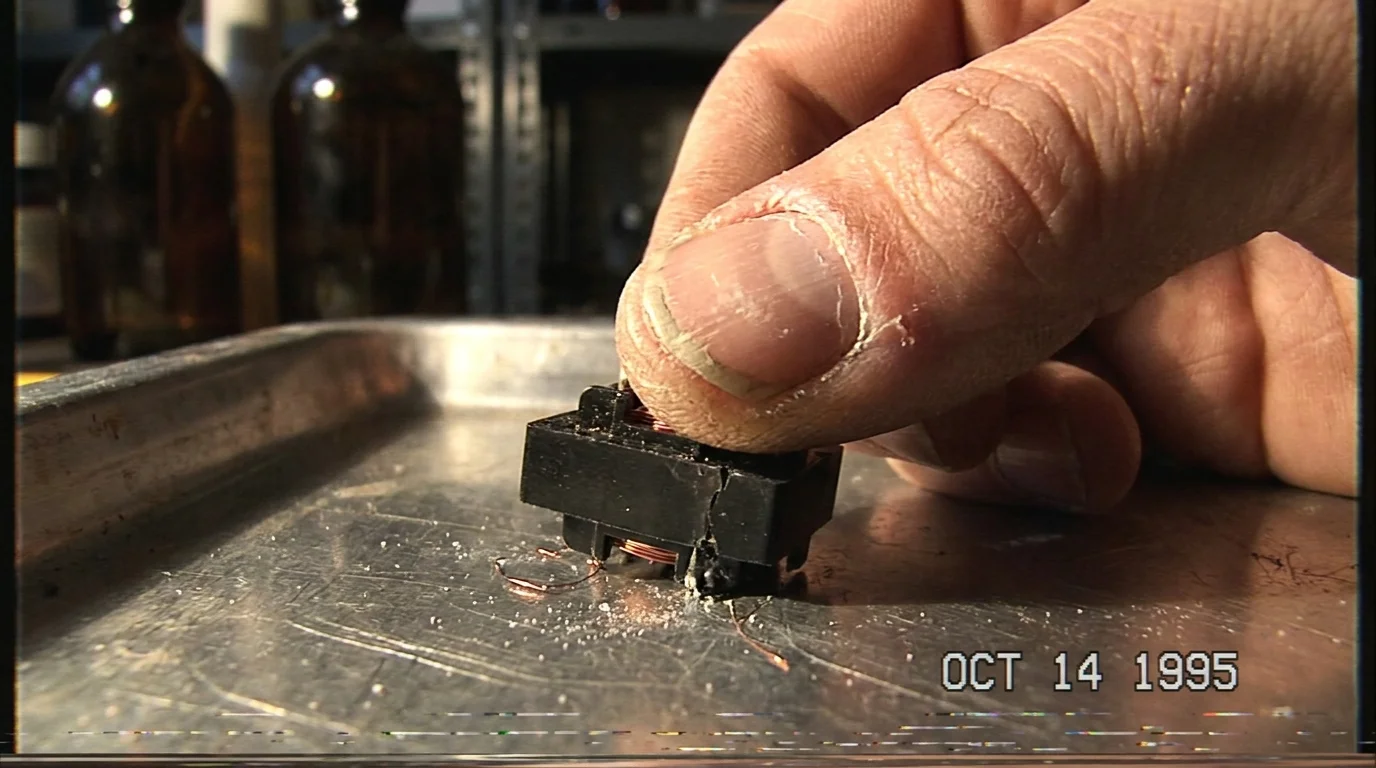
When electrical current pulses through the transformer core, it induces a phenomenon known as magnetostriction. The magnetic metal plates physically contract and expand microscopically with every single surge. Internal copper windings chatter against their ceramic cores when manufacturers scrimp on dampening resin or insulating glue, creating a distinct mechanical acoustic leak known colloquially as coil whine.
While this frequency often hovers between 12,000 and 18,000 Hertz—right on the ragged outer perimeter of adult conscious hearing—your auditory nerve does not simply ignore it because you fail to name it. Instead, the signal bypasses conscious awareness and fires straight into your auditory cortex and thalamus, triggering persistent micro-arousals that pull you out of slow-wave delta sleep before your body can truly repair itself.
- Curved gaming chairs force unnatural pelvic tucking triggering sharp lower lumbar spasms
- Baking soda rinses neutralize burning throat scratchiness and block raw morning irritation
- Warm flaxseed compresses drain clogged eyelid glands to restore soothing moist eye comfort
- Fresh mint leaves trigger icy mental clarity while banishing jittery caffeine shakes
- Cold tub immersions trap deep muscle fluid sparking stiff morning knee grinding
A Quiet Discovery in the Acoustics Lab
Dr. Julian Vance, a 48-year-old psychoacoustics researcher based outside Boston, stumbled onto this phantom disturbance while studying ambient sleep environments in residential apartments. Vance had spent weeks tracking nocturnal restlessness in subjects who claimed their rooms were completely silent, yet their sleep trackers showed erratic, jagged heart rate variability and missing delta waves every night between midnight and dawn.
When Vance brought calibrated omnidirectional microphones within arm’s reach of their headboards, the monitors lit up with aggressive acoustic spikes hovering at 16.4 kHz—spikes completely absent when measuring from the center of the room. The culprit in nearly every flat was a worn-out third-party wall adapter or budget charging cube wedged behind the pillow. Once those small blocks were unplugged, the subjects experienced a dramatic twenty-percent rebound in uninterrupted restorative sleep without changing a single other bedtime routine.
Mapping the Acoustic Interference Zones
Not every bedside setup produces the same degree of neurological agitation. The way this ambient noise infiltrates your sleep depends heavily on charging architecture, cable degradation, and proximity to your ear canal.
The High-Wattage Overdrive Setup
Modern GaN (Gallium Nitride) fast-chargers push massive wattage through tiny footprints. While efficient during daytime desk use, placing a 65-watt or 100-watt charging brick on an extension strip right next to your mattress turns your headboard into an acoustic resonance chamber. As your phone reaches eighty percent capacity, the charger dials down its draw, paradoxically shifting the switching frequency directly into the human ear’s most sensitive friction band.
The Budget Multi-Port Hub
Multi-device charging stations that power a watch, earbuds, and phone simultaneously create a messy polyphonic flutter. Because each device negotiates power draw at different rates, uneven electrical pulse loads cause the internal inductors to vibrate out of sync, generating an undulating sonic interference pattern that repeatedly startles your subconscious brain awake.
The Deteriorating Cable Circuit
An aging charging cable with frayed strain relief or dirty contacts forces the wall block to constantly recalculate resistance. This continuous handshaking loop produces rapid, staccato micro-bursts of high-frequency squeal. Your ears register these sudden changes in tone as immediate spatial alerts, preventing the brain from entering stable, restorative delta rhythms.
The Distance Reset: A Mindful Evening Protocol
Fixing this phantom sleep thief requires zero financial investment; it simply requires restoring sensible physical boundaries between your central nervous system and your electronics. You can silence this invisible noise instantly with a few intentional adjustments to your nighttime layout.
- Enforce the Six-Foot Perimeter: Move all AC/DC transformers at least six feet away from the perimeter of your bed frame. Sound pressure drops dramatically over short distances; pushing that transformer across the carpet eliminates acoustic intrusion entirely.
- Adopt Slow Nighttime Charging: Fast-charging heats up internal components and accelerates mechanical vibration. Use an old, certified low-wattage block (5W) for overnight replenishment, which draws power so gently that the transformer stays nearly silent.
- Switch to Passive Wall Outlets: Avoid running flexible power strips along the floor directly beneath your headboard. Wall studs and baseboards act like sounding boards, amplifying subtle transformer chassis vibrations through the bed frame itself.
- Engage Scheduled Cut-Off Timers: If you must charge across the room, plug your adapter into a simple mechanical outlet timer set to shut off power entirely after two hours of sleep.
Take five minutes tonight to run a baseline audit. Clear the headboard shelf completely, trace power cords back to their wall sources, and leave the nightstand cleared of anything that hums, blinks, or steps down line voltage.
The Sanctuary of Absolute Stillness
We live in a world that constantly asks our sensory organs to process relentless, low-grade input from dawn until dusk. When you finally turn out the lamp and rest your head, your room ought to offer unconditional decompression, not an invisible electronic chorus tugging at your brainstem.
Reclaiming deep sleep is rarely about buying an expensive supplement or investing in high-tech mattress toppers. More often, it is about stripping away the unnoticed technological intrusions we have carelessly invited into our private quarters. By moving that buzzing power adapter across the room, you silence the hidden friction that keeps you tossing, creating the pure, quiet baseline your nervous system has been waiting for all along.
“Restorative rest returns the moment we treat our immediate sleeping perimeter as an acoustic sanctuary rather than an electronics dock.”
| Key Point | Detail | Added Value for the Reader |
|---|---|---|
| Magnetostriction Risk | Transformer metal expands microscopically during voltage conversion, leaking 12-18 kHz whine. | Explains why mysterious restlessness occurs even in seemingly quiet, dark bedrooms. |
| Trickle-Charge Spike | Chargers shift to irritating switching frequencies once phone batteries cross eighty percent. | Identifies why sudden mid-night waking happens predictably two to three hours after sleeping. |
| Six-Foot Separation | Sound wave pressure drops exponentially when moving power blocks off nightstands. | Provides an immediate zero-cost intervention to reclaim restorative deep-wave delta sleep. |
Frequently Asked Questions
Can white noise machines block high-frequency coil whine?
White noise machines generate diffuse, low-to-mid frequency sounds that mask traffic or voices, but they often fail to drown out targeted high-frequency spikes above 14 kHz. In fact, layering white noise over an active coil whine can raise baseline sound pressure in the room, creating more overall sensory fatigue for your auditory cortex.Why do I hear coil whine when my partner hears nothing at all?
Human hearing upper limits degrade naturally with age, loud noise exposure, and genetics. While older adults often lose sensitivity to frequencies above 12 kHz, children and younger adults hear up to 18 kHz with ease. Even if someone cannot consciously hear the tone, the auditory system still receives the vibrational stimulus and responds with elevated baseline arousal.Do wireless charging pads eliminate the transformer whine problem?
No, wireless pads frequently make the issue worse. In addition to the wall block transformer, wireless charging bases house internal induction coils that emit their own alternating magnetic fields. These fields frequently rattle against nearby plastic housings or internal shield plates, generating both high-frequency coil chatter and subtle clicking cycles.Is coil whine a sign that my phone charger is about to catch fire?
Generally, no. Coil whine is usually a purely mechanical symptom of loose winding wire or insufficient vibration-damping adhesive inside the transformer core, not necessarily an electrical failure. However, a sudden, dramatic increase in volume or a change to an irregular buzzing sound can indicate degrading capacitors that warrant swift replacement.Does turning my phone to Airplane Mode stop the charger from making noise?
Airplane Mode only turns off cellular, Bluetooth, and Wi-Fi antennas; it does not change how the battery draws electrical current from the wall. The charger’s transformer will still vibrate based on the power load required by your device. The only way to stop the noise is to unplug the adapter or move it away from the bed.