The metallic hum of the gym treadmill fades into white noise as you adjust your posture, expecting that tight, reassuring hug around your midsection to validate your effort. Instead, a peculiar sensation creeps up behind your sternum. The air feels thin, like breathing through a heavy wool blanket, and your collarbones float upward with every frantic intake. You check your smartwatch, wondering why your pulse spikes while you are barely walking at three miles per hour.
It starts with a subtle numbness across the base of your skull, followed by an unmistakable wave of lightheadedness. You tell yourself it is just dehydration or perhaps an empty stomach, but your ribcage feels locked inside a vice. Your lungs cannot expand downward, so your neck muscles strain to drag oxygen into the very top lobes of your chest, creating a hollow, dizzy flutter that mimics a sudden anxiety attack.
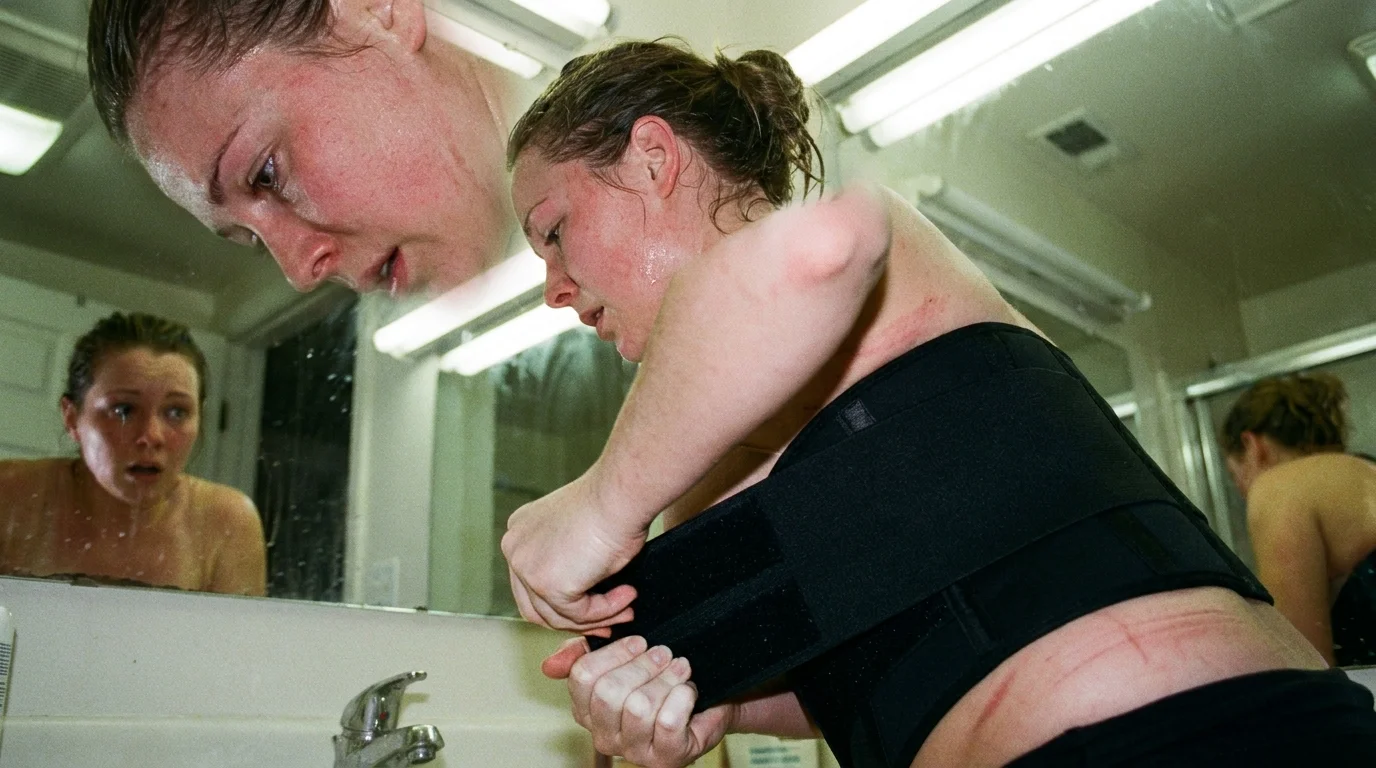
By the time you sit down on a locker room bench to unpeel the sweat-soaked rubber, your hands are trembling slightly. The sudden rush of blood back into your abdominal wall feels hot and disorienting. What was marketed as a harmless tool for sweat activation and core firmness has quietly triggered an ancient, involuntary survival reflex deep inside your nervous system.
The Phantom Suffocation Loop: Mechanical Armor vs. Biological Bellows
We are conditioned to treat the abdomen as a passive container to be sculpted, tucked, and bound into submission. Yet anatomically, your lower ribcage is not a rigid cage; it is a dynamic bellows designed to swing outward like bucket handles with every natural breath. When dense neoprene binds this lower rim, it halts that lateral swing entirely, forcing the diaphragm to slam against an immovable synthetic wall.
This mechanical bottleneck does something far more insidious than restrict air volume: it physically pinches the intercostal nerves and alters the mechanics of the phrenic pathway. When your lower ribs cannot splay, your diaphragm cannot drop. Your body interprets this sudden immobility not as external compression from workout gear, but as an acute airway obstruction. The brain stem receives a barrage of distress signals declaring that the respiratory pump has stalled.
In response, your sympathetic nervous system fires a silent alarm. It dumps adrenaline into your bloodstream, narrows peripheral blood vessels, and sends you spiraling into hyperventilation. You are not actually suffocating, but your brain cannot tell the difference between a tight fitness band and a collapsed breathing apparatus. The resulting panic is entirely mechanical, manufactured by fabric rather than fear.
- Tragus ear pressing overrides sudden racing heartbeat during acute solitary panic spikes
- Inner wrist pressing halts crowded room panic surges without drawing single glances
- Tabasco sauce drops shock runaway panic loops to restore steady rhythmic breathing
- Morning omeprazole capsules stall daily metabolic clearance triggering bloated midday stomach cramps
- Canola cooking oil scorches at high pan heat triggering sudden sinus pressure
Dr. Elena Vance, an integrative pulmonologist and sports physiologist based in Denver, sees this exact pattern several times a month in healthy athletes. Last spring, she evaluated Marcus, a 34-year-old strength coach who began wearing high-compression sweat bands during seated office hours to maintain posture. Within two weeks, Marcus was visiting urgent care clinics for unexplained dizziness and acute chest tightness during mid-day client calls. Standard cardiac panels and chest scans showed pristine health, but Elena noticed his lower ribs were completely frozen during resting respiration. Once the neoprene wrap was permanently discarded, his chest tightness and phantom panic vanished within forty-eight hours.
Mapping the Thoracic Splint: How Compression Alters Physiology
Not every body responds to midsection binding in the exact same manner. The severity of the suffocating sensation often depends on your posture, daily movement demands, and how your unique ribcage carries tension under stress.
The Seated Desk Worker
If you wear a neoprene wrap while sitting at a computer, you create a catastrophic pressure fold right at the junction of your eleventh and twelfth floating ribs. Prolonged spinal flexion traps nerve branches against the synthetic lining, reducing venous return from your lower limbs. The blood pools in the pelvic basin, starving the brain of immediate oxygenated flow and leaving you with brain fog, cold fingers, and a persistent urge to gasp for air during routine video meetings.
The High-Repetition Lifter
During heavy squats or kettlebell circuits, intra-abdominal pressure is supposed to fluctuate dynamically. Rigid neoprene acts like an artificial hydraulic brake, preventing the abdominal wall from rebounding naturally between reps. This sudden spike in internal pressure forces blood against your carotid sinus, triggering a reflex drop in blood pressure that leaves you seeing stars the moment you rack the weight.
The Nighttime Posture Sleeper
Some users wear wraps to bed hoping for passive shaping. During sleep, however, your parasympathetic tone naturally slows respiration and relies almost exclusively on the diaphragm. Binding the lower ribs overnight cuts off slow-wave restorative breathing, causing microscopic awakenings every few minutes. You wake up with a pounding pulse, dry mouth, and an overwhelming sense of morning dread before your feet even touch the floor.
Restoring the Bellows: A Tactically Calmed Nervous System
Recovering from the physical stress of lower rib binding requires more than simply taking the garment off. You must actively reassure the phrenic nerve and chest wall that movement is once again safe and unrestricted.
- Strip off the compression wrap immediately and lie flat on your back on a firm surface, placing your calves onto a chair at a ninety-degree angle.
- Place your hands firmly around the lower edges of your ribcage, fingers pointing toward your sternum and thumbs wrapping around your back flank.
- Inhale slowly through your nose for a count of four, focusing entirely on pushing your hands outward with your ribs rather than letting your chest rise.
- Hold the breath gently for two seconds without closing your throat, allowing the intercostal muscles to register the lateral stretch.
- Exhale through softly pursed lips for six seconds, letting your ribs sink inward toward your spine under natural gravitational weight.
- Repeat this specific pattern for ten continuous cycles until the tingling sensation in your fingertips and temples subsides.
Keep a physical recovery toolkit near your training space to counteract acute thoracic stiffness. Use a soft foam roller positioned horizontally across your mid-back for three minutes to open the facet joints. Sip room-temperature water with a pinch of unrefined sea salt to restore cellular fluid balance, and avoid tight sports bras or stiff waistbands for at least seventy-two hours while your respiratory tissues recalibrate.
The Architecture of Ease
Real physical strength is never rigid; it is adaptable, resilient, and deeply rooted in your ability to breathe without negotiation. Sacrificing the natural biomechanics of your ribcage for the fleeting illusion of a cinched waist trades long-term autonomic peace for temporary aesthetic control. When you free your lower ribs, you do not just eliminate dizzy spells and chest pressure—you restore the baseline biological truth that your body is built to expand, support, and sustain you with effortless clarity.
The human ribcage was designed to dance with every breath, not to be bolted into an artificial frame.
| Key Point | Detail | Added Value for the Reader |
|---|---|---|
| Biomechanical Freeze | Rigid wraps prevent lateral swing of lower ribs 10 through 12. | Explains why deep breaths feel impossible despite healthy lungs. |
| Neurological Alarm | Restricted diaphragmatic descent mimics real-time suffocation cues. | Validates that dizziness is a physiological nerve response, not mental panic. |
| Venous Impairment | Excessive midsection constriction impedes upward blood return. | Reveals the hidden root cause of cold hands and sudden workout lightheadedness. |
| Intercostal Strain | Accessory neck muscles overcompensate for frozen diaphragm motion. | Connects unexplainable afternoon neck aches directly to morning garment wear. |
Frequently Asked Questions
Why do I feel dizzy even after taking the waist trainer off?
When you suddenly remove a tight midsection wrap, blood vessels that were compressed abruptly dilate, causing a transient dip in blood pressure. Resting horizontally with your legs elevated for five minutes normalizes this shift quickly.Can wearing a neoprene wrap permanently damage my ribs?
Permanent structural damage is rare, but chronic compression can cause painful inflammation of the rib cartilage (costochondritis) and create persistent dysfunctional breathing patterns that last for months.Why does my throat feel tight when the wrap is around my stomach?
When your diaphragm cannot move downward, your body recruits the scalene and sternocleidomastoid muscles in your neck to lift the chest. This extreme tension radiates into the throat, mimicking an airway closure.Does sweating heavily around the midsection burn targeted belly fat?
No. The fluid lost through neoprene-induced sweat is simply localized water drawn from skin and interstitial tissues, which returns immediately once you rehydrate.How long does it take for the nervous system to calm down after an episode?
Once the garment is removed and lateral rib breathing is restored through slow, focused exhalations, acute symptoms of hyperventilation typically subside within ten to fifteen minutes.