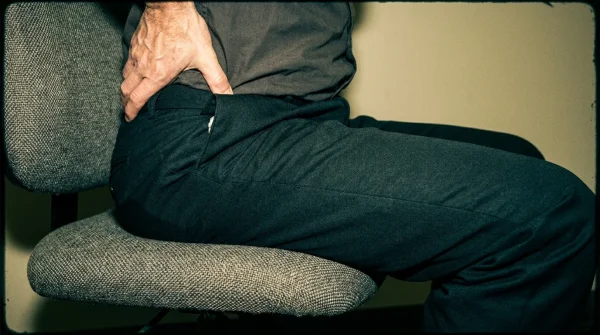
You sit at your desk at 3:15 in the afternoon, surrounded by the faint mechanical hum of the office and the cooling dregs of black tea. There is a low, persistent smolder running from beneath your right earlobe down into the tip of your collarbone, blooming outward into a raw, electric ache across the meat of your shoulder. When you try to stretch it, the tissue resists like cured leather.
You press your thumb hard into the side of your throat, hunting for the knot you assume was caused by an imperfect office chair or a night sleeping on the wrong pillow. The cord of muscle under your fingertips feels hot, wire-thin, and dangerously taut. You roll your head slowly toward the opposite shoulder, listening to the dry, gristly scrape deep within the cervical spine.
Standard medical advice routinely insists this is simple postural fatigue. You are told to pinch your shoulder blades together like a soldier on parade, perform mechanical chin-tucks against a wall, or roll a dense rubber ball against your upper back until your eyes water. Yet thirty minutes later, the hot, stinging thread returns, running straight down your inner arm toward your thumb like water tracing a crack in concrete.
What you are feeling is not a simple ergonomic failure. It is your scalene neck muscles clamping shut around the sensitive branches of your brachial plexus—not because your screen is an inch too low, but because your nervous system has spent the last month physically bracing against unmade decisions.
The Suspension Cables of Chronic Hesitation
Your neck houses three distinct bands of muscle on either side: the anterior, middle, and posterior scalenes. In a balanced body, these fibers act as quiet rigging cables, anchoring the cervical vertebrae to your top two ribs. They are meant to act as an emergency secondary breathing crew, stepping in only when you sprint for a train or haul firewood up a steep hill.
When you live in a state of chronic hesitation, that emergency system becomes your baseline reality. Every time you draft an email you are afraid to send, linger over a career choice you refuse to finalize, or bite back a clear boundary with a partner, your mid-brain registers the indecision as an unresolved environmental hazard. Your diaphragm freezes in self-defense, and your scalenes take over the simple act of keeping you alive.
By lifting the first rib upward to suck air into the top third of your lungs, these slender bands stay contracted twenty thousand times a day. Over weeks of emotional stall, that constant hoist narrows the narrow passage between your neck and your chest wall. The scalenes turn into a biological vice, pinching the delicate bundle of nerves and blood vessels that feeds your arm.
- Avoiding staircase climbs dissolves posterior chain power accelerating stiff hip posture
- Absorbing coworker venting erodes deep restorative sleep cycles leaving heavy morning exhaustion
- Dengue emergency protocols force immediate hospital triage updates across southern states
- Debby Ryan injury reports spark urgent clinical warnings over unnoticed concussions
- Bedside LED clocks disrupt nighttime melatonin cycles driving restless morning fatigue
Physical therapy routines that focus purely on stretching these muscles often fail because they treat an alarm system as the structural flaw. Pulling forcefully on a frightened, overworked muscle only triggers its stretch reflex, forcing it to contract with even greater fury the moment you walk out of the clinic door.
The Discovery in Room 4B
Dr. Marcus Sterling, a 52-year-old neuromuscular clinician practicing in Portland, spent nearly two decades watching patients arrive with diagnoses of stubborn thoracic outlet syndrome and rotator cuff impingement that defied ordinary rehab. He noticed an odd, reliable behavioral quirk among them: whenever he asked a question about a stalled life choice or an unresolved boundary, his patients took a tiny, sharp gasp through their teeth, visibly hoisting their collarbones toward their ears before uttering a single word.
When Marcus gently palpated their anterior scalenes during these moments of cognitive hesitation, the fibers beneath his fingers tightened into rigid, guitar-string cords. The burning pain running down their arms was not originating in their shoulders at all; it was an acute nerve-strangulation provoked by the habit of holding breath at the crest of the throat while waiting for certainty that never arrived.
Mapping the Strain: Three Profiles of Scalene Lock
Because indecision wears different masks depending on how you navigate pressure, scalene tension manifests along three distinct physical pathways. Pinpointing your specific pattern is the first step toward releasing the grip.
The Operational Staller (Workplace Paralysis)
This pattern appears in those who manage relentless administrative volume. You spend hours toggling between open browser tabs, delaying difficult phone calls, and letting micro-tasks linger in mental limbo. Your breathing becomes shallow and quiet, restricted entirely to the collarbones. The physical result is a localized, sharp pinch right behind the middle of the collarbone, accompanied by cold fingertips and a distinct heavy-arm sensation by mid-afternoon.
The Boundary Hesitator (Relational Guarding)
Common in habitual peacekeepers who swallow disagreement to avoid friction. The tension here settles heavily into the anterior scalenes, creating a feeling of mild throat tightness or a sensation akin to swallowing over a small dry pill. The pain travels laterally across the top edge of the shoulder blade, often masquerading as a stubborn trapezius spasm that no massage seems able to dissolve.
The Analytical Perfectionist (Over-Auditing)
This dynamic takes hold when you obsessively weigh pros and cons for minor daily decisions, endlessly rehearsing potential outcomes before taking action. The posterior scalene locks down to stabilize the base of the skull, producing a dull, grinding ache at the rear corner of the neck that radiates straight into the temple and causes your jaw to subtly clench without your awareness.
A Somatic Reset: Disarming the First Rib
To persuade the scalene complex to release its defensive grip, you must speak directly to the autonomic nervous system while mechanically offloading the first rib. This requires delicate, non-combative movement rather than aggressive traction.
The goal is to stop hoisting the breath from above and allow the ribcage to drop back into its natural cradle. Work through these steps once in the morning and once before your evening meal:
- The Collarbone Cradle: Sit comfortably on the edge of a firm chair. Place your left hand flat over your right collarbone, fingers pointing toward your throat. Rest your right hand over your left to add gentle, downward downward skin traction—no more weight than you would use to hold a ripe peach.
- The Micro-Tilt: Very slowly, ease your head two inches toward your left shoulder, then turn your chin slightly upward toward the ceiling until you sense a subtle, feather-light lengthening along the right front of your neck. If you feel a sharp electric pulse, you have moved too far; back off immediately.
- The Sigh of Finality: Inhale gently through your nose into the bottom of your belly for a count of four. Hold for two seconds. Then, exhale through pursed lips for seven seconds, feeling your chest drop completely away from your chin. Perform four cycles.
- The First-Rib Drop: At the end of the fourth exhale, gently depress your hands an eighth of an inch downward toward your lap, anchoring the rib while letting the scalene stretch into the slack rather than pulling against it.
Use this tactile toolkit to keep the tissue compliant throughout demanding workdays:
- Moist Heat: Apply a damp, warm towel (around 105 degrees Fahrenheit) across the base of your throat for seven minutes prior to starting desktop tasks. Avoid dry heating pads, which can dehydrate superficial fascia.
- Auditory Exhales: Every time you make a definitive decision—clearing an email, sending a proposal, or committing to an appointment—let out an audible, unforced sigh to remind the brain the loop has closed.
- Bilateral Elbow Support: Adjust your desk armrests so your elbows rest at a true ninety-degree angle, physically lifting the shoulder girdle and taking mechanical load off the scalene attachments.
Reclaiming the Space Between Choice and Action
There is a profound, quiet relief in discovering that your body is not broken, fragile, or permanently misaligned. That stubborn, burning nerve ache running down your arm is simply the physical echo of postponed clarity. Your neck has been gallantly trying to carry the weight of questions you have refused to answer.
When you choose to make choices cleanly—accepting that no path comes with guaranteed comfort—the chronic need for internal bracing begins to dissolve. Your diaphragm drops back into its effortless, tidal rhythm. Your first rib sinks down to rest upon your chest wall, and the scalenes finally soften their grip on the nerves that give your hands their power.
Healing this structural tension is ultimately an exercise in everyday courage. Every small, honest decision you make is not just an organizational victory; it is a direct biological instruction that tells your upper body it is finally safe to breathe.
“The neck holds the questions that the mind refuses to settle, turning every unmade choice into an anchor hung from the first rib.” — Dr. Marcus Sterling
| Key Point | Detail | Added Value for the Reader |
|---|---|---|
| Underlying Trigger | Subconscious physical bracing driven by unmade life choices and boundaries | Validates why standard biomechanical therapies fail when emotional loops remain open |
| Anatomical Impact | Scalenes hoist the first rib upward, compressing the brachial nerve plexus | Explains the precise mechanical cause of burning shoulder and arm sensations |
| Intervention Strategy | Low-load somatic resets combined with long, deliberate exhales | Restores space around compressed nerves without triggering protective muscle spasms |
Frequently Asked Questions
How do I distinguish scalene nerve pain from a torn rotator cuff?
Rotator cuff injuries typically cause localized pain deep inside the shoulder joint that spikes sharply when lifting your arm out to the side. Scalene-induced nerve entrapment creates an electric, burning, or tingling pathway that travels down the collarbone, across the shoulder blade, and frequently extends into the arm, forearm, or fingers.Why does traditional neck stretching make the burning ache worse?
When muscles are locked in a protective spasm to shelter pinched nerves, aggressive pulling activates the myotatic stretch reflex. The muscle misinterprets the stretch as an attack and clamps down tighter, increasing nerve compression within minutes of finishing the stretch.How long does it take for compressed scalene nerves to calm down?
Once the mechanical pressure from the elevated first rib is reduced through diaphragmatic breathing and subtle positional resets, nerve irritation often diminishes noticeably within five to seven days, provided you avoid aggressive pulling or heavy overhead pressing.Can shallow desk breathing alone cause this condition?
Yes. If you habitually breathe into the upper chest rather than utilizing the full excursion of your diaphragm, your scalenes contract up to twenty thousand times a day to lift the ribcage, eventually producing the same physical tightness as high-stress indecision.What is the best sleeping posture to avoid pinching these nerves overnight?
Sleep on your back or your unaffected side with a contoured pillow that keeps your cervical spine strictly neutral. Avoid sleeping on your stomach or curling into a tight fetal ball, as both positions push the chin toward the chest and crush the space between your scalenes and collarbone.