The room is dead quiet, save for the sudden, violent hammering behind your ribs. It usually starts without an invitation: a stray thought, a shift in ambient temperature, or simply waking up at two in the morning with your sheets tangled and your pulse rocketing past one hundred beats per minute. You try the advice everyone gives you. You attempt to draw air down into your belly, but your throat feels like a pinched straw, and trying to count to four only makes you hyper-aware that your chest is fluttering like a trapped sparrow.
When panic hijacks your nervous system while you are completely alone, standard mindfulness exercises can feel like trying to snuff out a grease fire with a silk handkerchief. Your cognitive brain has gone dark, surrendered to a primal surge of epinephrine that screams you are in immediate danger. Telling yourself to calm down does nothing because the panic did not start as a rational calculation; it arrived as a raw, electrical reflex.
In those isolated moments, you do not need another meditation app or an abstract mental visualization. Your nervous system needs sensory leverage to break the neurological loop before your thoughts run away with you entirely. That leverage is sitting quietly in your kitchen silverware drawer right now, waiting between the butter knives and soup ladles.
Walking barefoot across cool floorboards to grab two metal tablespoons from the freezer sounds mundane, almost absurdly domestic, when your vision is tunneling and your palms are slick with cold sweat. Yet the instant that chilled metal makes contact with the tender junction just beneath your earlobes, something ancient and mechanical takes over.
The Thermal Circuit Breaker at the Angle of Your Jaw
To understand why this works when breathing fails, you have to stop viewing panic as an emotional failure and see it as an electrical malfunction. When acute fear takes the wheel, your sympathetic branch redlines, shunting blood to your limbs and demanding rapid, shallow gasps. Trying to think your way out of that loop is nearly impossible because the prefrontal cortex has effectively been locked out of the control room.
Instead, you need a physiological backchannel. Just beneath the mandibular angle—that distinct corner of bone right below your ears where your jaw turns upward toward the skull—runs a high-density intersection of the vagus nerve and the carotid sinus baroreceptors. Direct thermal contact here acts like flipping the main breaker in a house when the lights begin to flicker.
- Wasabi paste dabs shock runaway nervous system surges halting acute panic loops
- Tongue roof pressing halts silent boardroom panic spikes without drawing single glances
- Standard metformin dosing stalls liver glucose clearance sparking stubborn morning fatigue
- Sunflower cooking oil searing releases choking volatile vapors sparking sudden sinus pressure
- Aquafina purified water flushes essential cellular electrolytes triggering stubborn midday exhaustion
When intense cold meets this specific neurovascular junction, it activates a modified variation of the mammalian dive reflex. Your brainstem receives an unmistakable, high-priority sensory transmission that ambient conditions have changed drastically. It does not deliberate or ask for permission. It simply orders the sinoatrial node of your heart to throttle back, slowing the pulse and forcing dilated blood vessels to normalize.
Marcus Brody, a forty-four-year-old critical care paramedic in suburban Chicago, has guided dozens of hyperventilating patients through this exact physical reality during solo night shifts. “People think de-escalation is all soft words and deep sighs,” Marcus often notes to trainees. “In the field, when an isolated patient is spiraling into a supraventricular rhythm from sheer panic, cold metal placed firmly along the mandibular notch will pull the emergency brake faster than twenty minutes of guided breathing.”
Adapting the Chill to Your Personal Threshold
Not every panic surge carries the same physical fingerprint, and your tactile tolerance shifts depending on where and how the overwhelm strikes. Customizing how you apply cold ensures you trigger relief without shocking your skin into defensive shivers.
For the Midnight Panic Spike
Waking up in an empty room with a racing pulse is uniquely terrifying because your rational defenses are dormant. Keep two standard stainless-steel dessert spoons resting inside a small ceramic mug in your refrigerator door or on an ice pack inside a bedside mini-cooler. You want them cold to the touch—around forty degrees Fahrenheit—rather than frozen stiff from the deep freezer, which can cause painful skin adhesion.
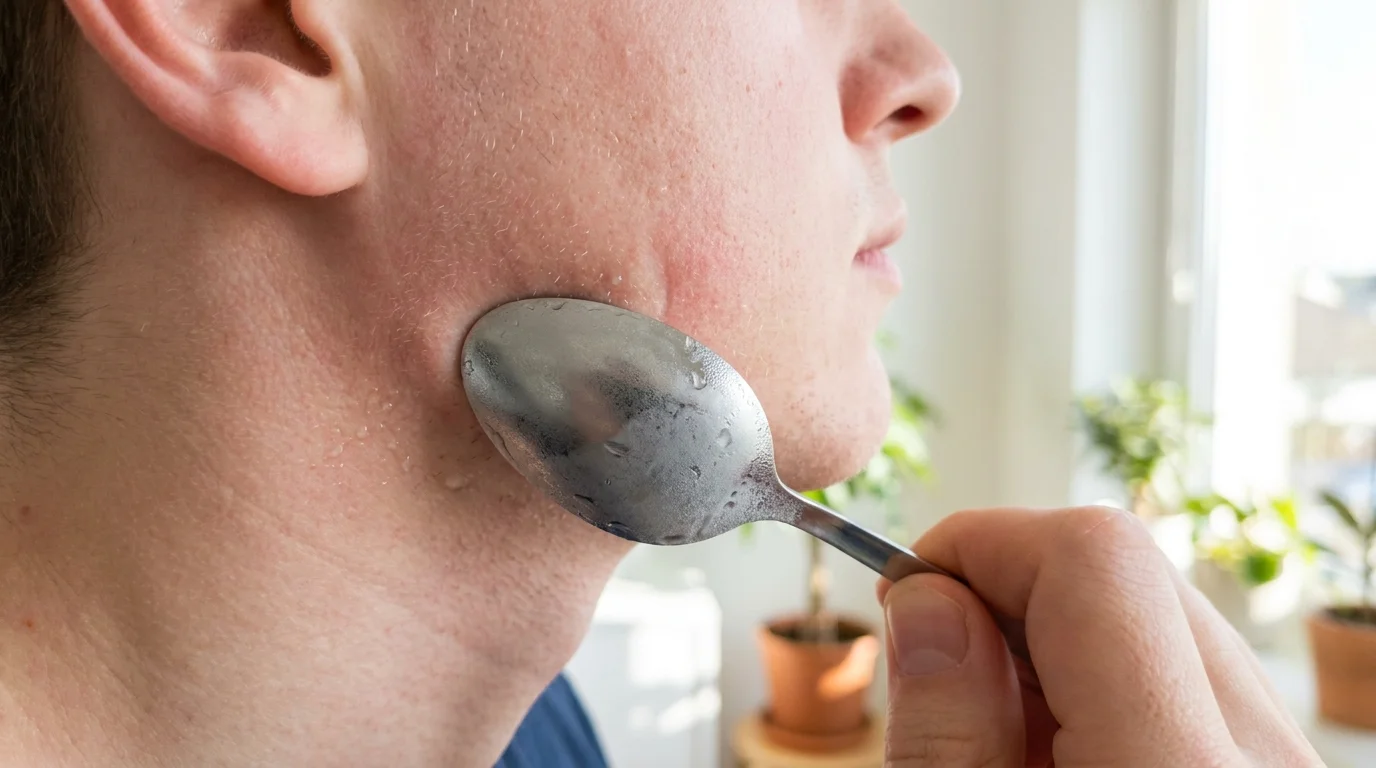
Sit upright with your feet planted firmly against the floorboards to establish immediate physical grounding. Rest the curved convex back of each spoon against the soft indentations directly below your jawline, applying steady, inward pressure. Breathe through your nose softly as the chill leaches the buzzing heat from your neck, and hold the position until the metal warms to match your skin.
For the High-Sensory Responder
If sudden, intense cold triggers a sensory recoil that makes your shoulders knot up around your ears, buffer the transition. Wrap the bowls of the chilled spoons in a single layer of damp paper towel before lifting them to your face. This softens the initial bite while still delivering the steady, sustained conductive drop your baroreceptors need to initiate down-regulation.
Focus your attention entirely on the metallic weight of the handles in your fingers. By anchoring your tactile senses to the physical mass of the utensils, you pull focus away from the phantom air hunger in your chest. Allow the cold to seep gradually inward, picturing the electrical storm in your temples settling down into calm, heavy stillness.
The Tactile Protocol: How to Execute the Reset
Executing this technique requires precision rather than force. You are not massaging sore muscle tissue; you are sending an unequivocal thermodynamic signal straight to your autonomic control center. Keep your actions slow, deliberate, and unhurried.
- Retrieve two clean metal spoons and check their surface temperature against the back of your wrist to ensure they are cool without sticking to dry tissue.
- Locate the bony angle of your jaw with your fingertips, sliding inward just a half-inch into the soft hollow directly below the earlobe.
- Press the smooth, rounded backs of the spoons firmly into these twin recesses simultaneously, angling the pressure slightly inward and upward.
- Drop your tongue from the roof of your mouth and let your teeth part slightly, releasing the clench reflex that keeps the cranial nerves on high alert.
- Maintain steady, unyielding pressure for sixty to ninety seconds while keeping your gaze fixed on a single stationary object across the room.
The Somatic Reset Toolkit
Primary Tool: Two heavy-gauge stainless steel tablespoons (avoid lightweight aluminum or silver-plated sets, which lose cold too rapidly).
Target Temperature: 38°F to 42°F (standard refrigerator chilling; avoid dry ice or sub-zero freezers).
Application Duration: 90 seconds per set, repeatable once after a two-minute room-temperature interval.
Contact Point: The retro-mandibular notch, precisely midway between the mastoid process and the jaw angle.
A Quieter Way Home to Yourself
There is profound comfort in knowing that panic, for all its terrifying noise, is still bound by the laws of human biology. It feels infinite and unmanageable while it holds you captive in the dark, but it is ultimately an autonomic cascade that answers to tangible physical mechanics. You do not need to wage an exhausting mental war against your own thoughts to find solid ground again.
Understanding this shifts your relationship with panic entirely. It transforms an unpredictable emotional monster into a simple mechanical error that you have the literal tools to fix. You possess the somatic power to manually step in, steady the wheel, and guide your heart back to its natural, unhurried rhythm whenever you need to.
The fastest way out of a racing mind is through the quiet, physical levers built directly into your flesh and bone.
| Key Point | Detail | Added Value for the Reader |
|---|---|---|
| Primary Nerve Target | Vagus nerve branches and carotid sinus baroreceptors below the jaw | Bypasses exhausted cognitive efforts to directly trigger parasympathetic heart slowing. |
| Optimal Tool Choice | Chilled heavy-gauge stainless steel spoons | Retains smooth thermal conductivity and fits the anatomical curve of the neck hollows. |
| Mechanical Response | Localized activation of the mammalian dive reflex | Drops peripheral vascular resistance and curbs hyperventilation within ninety seconds. |
Frequently Asked Questions
Can I use ice cubes directly against my jaw instead of metal spoons?
Direct ice is often too aggressive, risking skin damage and triggering a defensive startle response that can spike your adrenaline further. Chilled metal provides a controlled, smooth thermal drop without melting or dripping water down your collar.How hard should I press the spoons into my neck?
Use firm, gentle pressure comparable to testing the ripeness of an avocado. You should feel clear, distinct contact against the soft tissue behind the jawbone without causing pain, choking sensations, or throbbing pulses.Why does this work better than standard slow breathing?
During severe panic, respiratory muscles often lock into a splinting pattern that makes deep breathing feel suffocating. Chilled contact mechanically slows the cardiac pacemaker node first, allowing natural, easy breathing to return on its own.How long do I need to keep the spoons in the fridge beforehand?
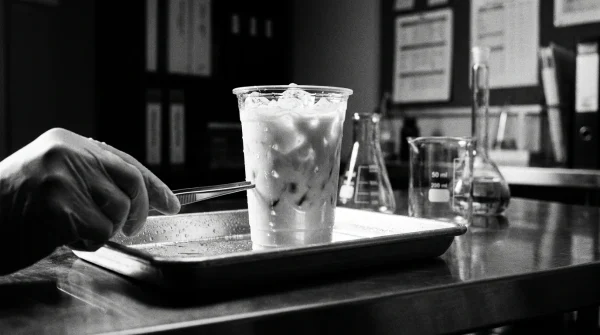
Ten to fifteen minutes in a refrigerator or five minutes resting in a glass of ice water will bring stainless steel to the ideal therapeutic temperature. Keep a dedicated pair stored in the door so they are ready whenever an emergency arises.Is it safe to repeat this if my heart continues racing?
Yes, you can repeat the ninety-second application after a two-minute resting pause. However, if racing heartbeats persist alongside chest tightness, radiating pain, or shortness of breath, seek clinical medical evaluation immediately.