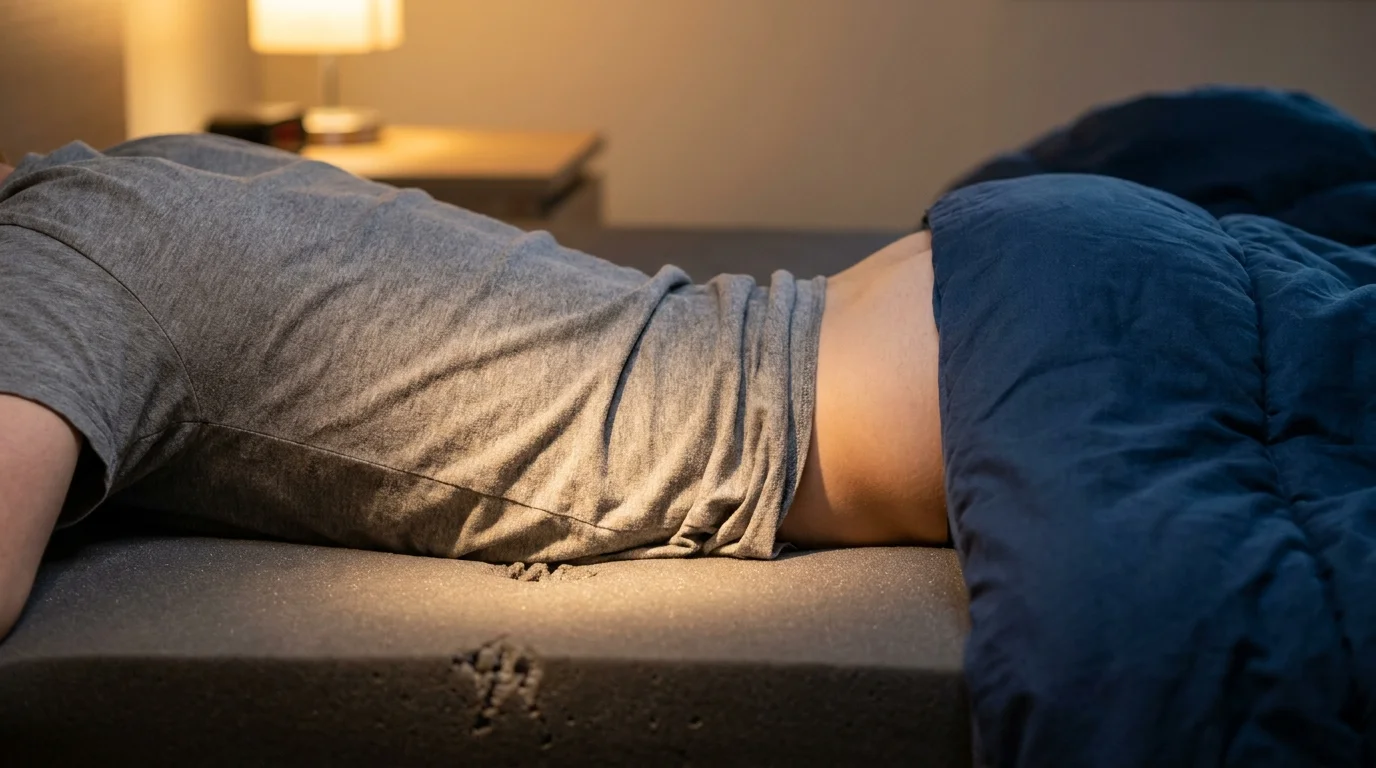
The gray morning light creeps across your ceiling while the house remains dead silent. Outside, a neighbor gently latches a gate, but you cannot roll over to watch the sunrise. When you try to shift your legs, a sharp, grinding dullness locks deep within the small of your back, forcing you to grip the edge of the blanket and catch your breath.
You bought the bed because it felt like falling into a cloud. In the showroom, pressing your palms into the dense, velvety polyurethane felt like pure mercy after a grueling workweek. The material yielded slowly, contouring to every ridge of your body, promising an end to the restless tossing that left you haggard at your desk.
Yet here you are at dawn, feeling twenty years older than your driver’s license claims. Your feet touch the cool floor with tentative caution, your torso angled forward like a half-opened pocketknife as you shuffle toward the kitchen kettle. The bed gave you luxury, but it took your mobility in return.
That sinking sensation wasn’t restorative surrender. It was a structural collapse. When your heaviest points drop unimpeded into an unyielding thermal cushion, your skeleton loses its ground.
The Hammock Trap and the Sagging Fulcrum
We tend to judge a bed by its surface sweetness, assuming that if a mattress treats the skin kindly, it must be treating the vertebrae with equal grace. But your spine does not care about velvet textures; it answers purely to gravity and lever arms. When you lie down on ultra-plush memory foam, your pelvis—the densest, heaviest anatomical block of your body—begins an uninterrupted downward drift.
Think of your spine as an arched suspension bridge built of stone blocks. If the central pylon drops three inches below the riverbanks, the keystones wedge together under crushing abnormal pressure. In a bed that yields too willingly, your hips bottom out into the foam core while your lighter ribcage and feet stay buoyed near the surface. You spend seven hours suspended in an involuntary human hammock.
This prolonged sag forces the lordotic curve of your lumbar spine into sustained mechanical extension or exaggerated side-bending. Your facet joints, designed to glide smoothly against one another with fluid grace, grind tight against their bony stops. Surrounding muscle bands—the quadratus lumborum, the multifidus, the deep erectors—realize the skeleton has lost structural stability. They panic, clamping down into rock-hard protective spasms to prevent your nerve roots from being pinched while you dream.
- Sipping cold brew over ice triggers midmorning energy crashes and heavy brain fog
- Measles quarantine rules trigger urgent triage overhauls across crowded community urgent care centers
- Epsom salt soaks in hot baths ease painful calf cramps after long shifts
- Raw clover honey dissolved in warm water relieves stubborn scratchy throat tickles instantly
- Blackout window film blocks morning street glare for deep uninterrupted sleep cycles
By the time your alarm sounds, your muscles have performed an eight-hour isometric contraction. You awaken not restored, but thoroughly exhausted from a nighttime endurance match against your own mattress.
A Lesson from the Clinical Floor
Dr. Warren Vance, a physical rehabilitation specialist based outside Chicago, sees this mechanical betrayal arrive in his clinic every autumn. Just after the holiday sales push, his treatment rooms fill with adults in their forties and fifties complaining of sudden ‘disc flare-ups’ that mysteriously appear without any lifting injuries or gym accidents. Vance recalls David, a 46-year-old high school history teacher who arrived moving like an iron statue, convinced he had herniated a disc while raking leaves.
David had spent thousands on a top-rated cloud mattress to ease mild hip soreness. After Vance placed David on a firm examination plinth and used a simple lumbar wedge to restore his neutral pelvic tilt, the radiating morning pain vanished within forty-eight hours. David was not broken; his bed had simply spent two months hyper-flexing his sacroiliac joints while he slept unconscious in a warm foam crater.
Sleeper Biomechanics: Reading Your Nighttime Posture
Your skeletal architecture demands specific resistance depending on how your frame addresses the mattress surface. Without adequate counter-pressure, your natural spinal curves buckle under their own mass.
The Dedicated Side Sleeper
Side sleepers face the greatest mechanical risk on deep, yielding foams. Your shoulder girdle and your greater trochanter (the widest point of your hip) carry almost the entire downward force of your frame. In overly soft foam, the hip sinks drastically further than the ribcage, causing the lumbar vertebrae to tilt down toward the mattress in a persistent lateral curve.
This uneven drop pinches the downward-facing facet joints while stretching the upward-facing paraspinal muscles like over-tightened guitar strings. If you wake with a deep ache localized on the side you slept on, your hips are sinking past your natural spinal baseline.
The Classic Back Sleeper
Back sleeping requires subtle, firm elevation directly beneath the sacrum to prevent the pelvis from rolling backward into a posterior tilt. Ultra-soft foam creates an insidious illusion: it fills the lumbar gap nicely, but lacks the upward tensile push to halt pelvic descent.
As your glutes sink into the foam basin, your pelvis rotates backward, flattening your natural lumbar hollow against the core. This position pushes your intervertebral discs backward toward the spinal canal, creating that familiar morning feeling of being unable to straighten your legs without a sharp lumbar pinch.
The Restless Rotator
If you shift between your side and back through the night, slow-recovery viscoelastic foam becomes a prison. Dense memory foam responds to body heat, creating a custom indentation that takes twenty to thirty seconds to rebound. When you attempt to turn, you must physically climb out of a thermal trench.
Your deep hip rotators and lower back muscles must fire violently just to roll your torso across the depression. You wake up with tired hips, feeling as though you tossed and turned all night, because your body had to perform heavy labor every time your sleep cycle shifted.
The Alignment Reset: A Step-by-Step Recovery Method
You do not necessarily have to drag your costly mattress to the curb this afternoon. You can reclaim your spinal neutral using targeted structural adjustments that counteract the sink.
- Measure your sink depth: Lay a long wooden broomstick across your bed from edge to edge at the level of your hips. Press down on the foam where your pelvis rests. If the surface compresses more than two inches under moderate hand pressure before finding firm resistance, your core support is compromised.
- Introduce a firm foundation base: If your mattress rests on flexible wood slats that bow under pressure, place a 1/2-inch sheet of sanded furniture-grade plywood between the slats and your mattress. This removes secondary foundation sag and restores immediate bottom-end pushback.
- Deploy the pelvic towel roll: Take a standard cotton bath towel, fold it in half lengthwise, and roll it into a neat, flat cylinder roughly two inches thick. Slide this directly beneath your lower abdomen if you sleep face-down, or tucked just under the waistband of your sleep shorts if on your back, preventing the pelvis from over-rotating.
- Anchor the knees: Side sleepers should place a firm, non-memory-foam cushion between the knees, keeping the knees stacked at hip width to prevent the top leg from pulling the lumbar spine into rotational torque.
Tactical Toolkit for Spinal Neutrality
Regaining restorative rest requires objective boundaries rather than subjective comfort ratings. Use these specific parameters to stabilize your sleeping environment:
- Foam Indentation Load Deflection (ILD): Look for comfort layers with an ILD rating of no less than 28 to 32 pounds of resistance for proper spinal support.
- Core Density Minimum: Base support layers should feature high-density polyfoam weighing at least 1.8 to 2.2 pounds per cubic foot to prevent long-term core sagging.
- Room Temperature Target: Maintain your bedroom between 65°F and 68°F. Viscoelastic foam softens significantly in warmer rooms; keeping the ambient air cooler preserves the firmness of the surface foam layers.
- Morning Decompression Window: Spend three minutes flat on your back on a firm, carpeted floor immediately after waking, knees bent at 90 degrees over a chair, allowing your facet joints to disengage before standing.
The Quiet Strength of Real Support
There is a seductive quality to total surrender, to letting your weight vanish into a material that demands nothing of your posture. But our bodies are built for active balance, engineered through millions of years to thrive against resistance. True physical ease does not come from melting away; it comes from knowing the ground beneath you is solid enough to hold your shape while you rest.
When you swap the hollow luxury of the sinkhole for crisp, unwavering support, mornings cease to be a negotiation with your joints. You swing your legs out of bed and your feet find the rug with certainty. You stand up tall on the first try, your spine stacked effortlessly over your hips, completely ready for the weight of the day.
Real physical rest is not about sinking into oblivion; it is the quiet relief of being properly supported while your skeleton lets go of the day.
| Key Point | Biomechanical Detail | Added Value for the Reader |
|---|---|---|
| The Pelvic Basin | Heavy hip sections sink deeper than the torso, forcing lumbar hyperextension. | Identifies why back pain strikes even when the bed feels soft and expensive. |
| Thermal Softening | Memory foam softens progressively through the night from radiant body heat. | Explains why you fall asleep pain-free but wake up locked in stiffness at 6:00 AM. |
| Dynamic Counter-Support | Latex or hybrid pocket coils push back against weight rather than yielding. | Provides an actionable standard when selecting a truly supportive sleep surface. |
| Pelvic Neutrality | Strategic firm props keep the iliac crest level with the lower ribs. | Offers an immediate, no-cost way to test your alignment tonight using household items. |
Frequently Asked Questions
Why does my back hurt worse in the morning than when I went to bed?
During deep sleep, your conscious muscles relax, transferring all structural stabilization to your joints and ligaments. If your mattress allows your hips to sink lower than your spine, your facet joints remain pinched and compressed for hours, sparking inflammatory fluid buildup and reflex muscle spasms that greet you the moment you wake up.Can a mattress topper fix an overly soft memory foam bed?
Generally, no. Adding a topper over a mattress that already sags or yields too deeply is like building a house on wet sand; the topper simply contours to the underlying depression. To fix sinkage, you must add firmness beneath the mattress or swap to a firmer core layer with higher pushback resistance.How can I tell if my bed is too soft or too firm?
If your bed is too firm, you will feel distinct pressure points on the outer edges of your shoulders and hips, often waking with numb, tingling arms. If your bed is too soft, you will feel comfortable at first, but wake with a deep, dull ache across your lower lumbar band and struggle to stand straight immediately upon getting up.Does memory foam ever work well for chronic back issues?
High-density memory foam can work wonders if it is limited to a thin top layer (one to two inches) backed by a dense, unyielding core. This setup cushions sensitive joints while halting excessive pelvic sinkage before your spinal curves lose their neutral alignment.What is the best immediate stretch for morning foam-induced stiffness?
Avoid touching your toes, which stretches already strained lumbar tissues. Instead, lie face-down on a carpeted floor for two minutes, resting on your forearms like a sphinx. This gentle, passive backward extension allows your compressed lumbar discs to migrate forward and helps irritated facet joints unbind naturally.