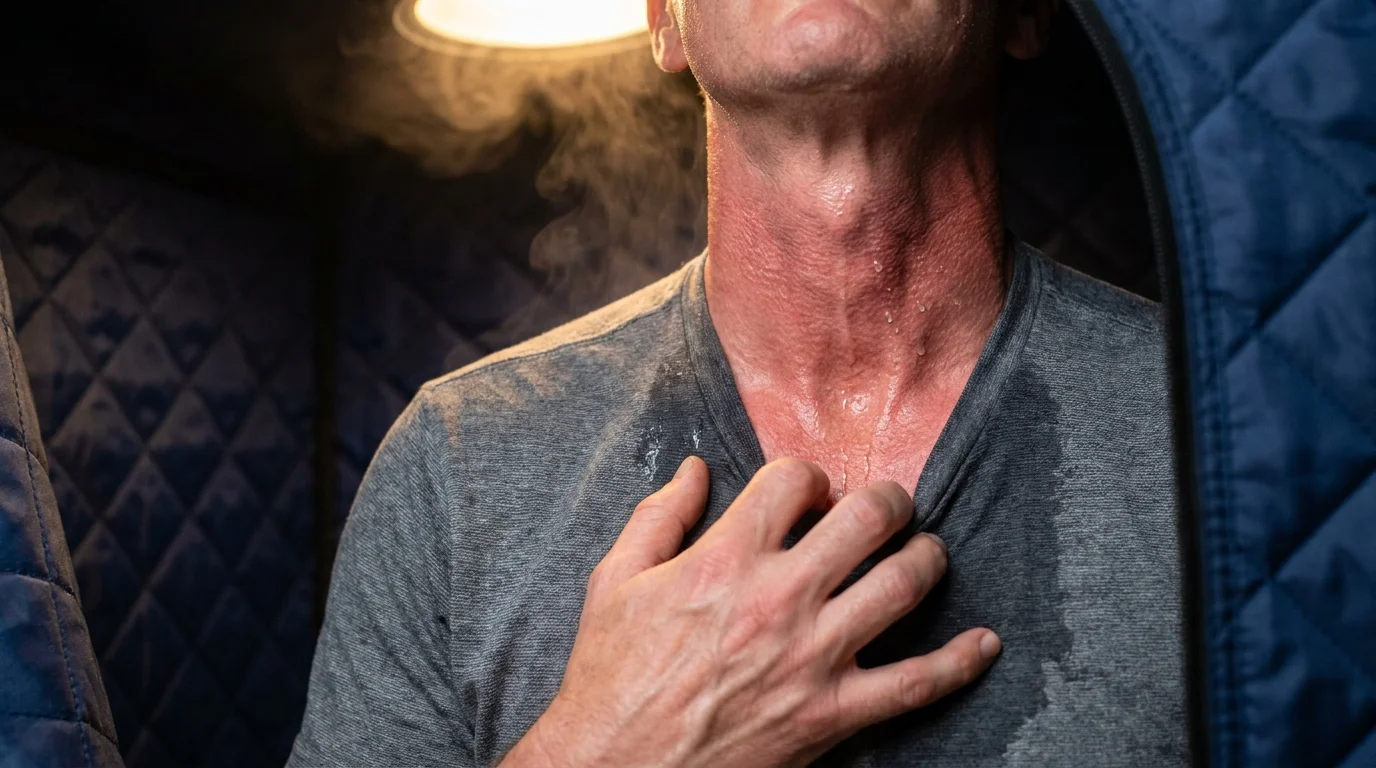
The thick canvas zips shut, sealing out the cool bedroom floor and trapping you in an instant pocket of dense, synthetic warmth. Within minutes, the steam generator hums against the baseboards, filling the small enclosure with the sweet, metallic scent of heated polyester and boiling distilled water. Your skin glistens under the dim glow of your phone screen, and for the first ten minutes, it feels like the holy grail of recovery: pure, uninterrupted warmth flushing the stiffness from your workweek shoulders.
Then, without warning, the air turns strangely thin. Your collarbones feel heavy, as if an invisible weight has settled across your sternum, and when you reach out a hand to unzip the front flap, the bedroom outside seems to tilt sideways. Sudden vascular pooling strips away your balance before your feet even touch the carpet, leaving you gripping the zipper pull with cold, clammy fingers while your heart hammers against your ribs like a trapped moth.
You bought the portable pod expecting the deep restorative flush of a traditional Finnish bathhouse or a high-end spa retreat. Instead, you are sitting hunched on a collapsible nylon stool, blinking away silver spots and wondering why a simple wellness routine left you feeling like you just ran a flat-out sprint through thin mountain air. The confusion is real, but the physical miscalculation behind it is remarkably simple.
The Radiator Fallacy: Why Portable Steam Traps Overwhelm Your Vessels
Most of us treat heat like hot water flowing from a garden hose: turn the valve up, let the body soak up the thermal load, and assume more heat equals a faster recovery. But your vascular tree does not operate like a passive radiator. It behaves far more like a delicate municipal water grid with sensitive pressure switches situated along every major arterial junction.
In a traditional cedar sauna, heat transfers slowly through dry, ambient air across a massive volume of space. Your nervous system has ample room to breathe, dilating peripheral capillaries in a gradual, measured wave. In an enclosed portable sweat tent, however, the volume of air is microscopic, and the humidity sits near one hundred percent. Trapping moisture inside tight canvas halts your skin’s natural cooling mechanism instantly, because sweat cannot evaporate to pull heat away from your blood.
Faced with an unchecked thermal spike, your autonomic system hits the panic button. It forces peripheral blood vessels in your legs and torso to blow wide open, dropping your core blood pressure through the floor. Because your head sits poking out of the top zipper while your lower body cooks inside the chamber, gravity pulls that suddenly pooled blood downward, starving your brain and upper chest of steady, oxygenated backpressure.
- Microcrystalline cellulose powders irritate digestive linings leaving stubborn chalky morning bloat
- Daily levothyroxine schedules clash with slow metabolic rates stalling steady weight loss
- Underwire sports bras crush lower rib cages triggering sudden shallow breathing panic
- Earlobe downward tugs drop racing pulse rates to soothe sudden emotional overwhelm
- Pocket coin rubbing calms surging social panic during packed room business meetings
Marcus Vance, a 42-year-old architectural draughtsman from Portland, learned this lesson the hard way after setting up an insulated steam tent in his home office. Determined to flush out months of desk stiffness, Marcus cranked the digital boiler to its maximum setting of 130 degrees Fahrenheit, enduring twenty-five minutes of suffocating steam while answering morning client emails. When he stood up to step through the nylon threshold, his vision blacked out instantly, his forehead grazing the drywall as his knees gave out beneath him. A quick consultation with a local sports physiologist revealed that Marcus hadn’t experienced a cardiac crisis; he had induced severe splanchnic and lower-limb pooling, dropping his systolic pressure by nearly thirty points in thirty seconds.
Pacing Your Flush: Thermal Adjustments for Everyday Setups
Not every body processes dense convective heat in the same manner. Dialing in your portable sweat sessions means adjusting the thermodynamic load based on your frame, hydration baseline, and nervous system state.
For the Desk Worker with Sluggish Circulation
If you spend eight to ten hours a day seated in an office chair, your calf veins already struggle with mild fluid stagnation. Stepping into boiling steam pods without warm-up mobility amplifies this pooling within minutes. Keep your tent sessions capped at 110 degrees Fahrenheit for the first twelve minutes. Before you climb inside, perform twenty slow calf raises and ten deep diaphragmatic breaths to wake up the venous return pumps in your lower legs.
For the Early Morning Athlete
Using a sweat pod right after a workout means entering the heat with your baseline blood volume already depleted through sweat and heavy breathing. When you subject dehydrated blood to rapid external heat, the blood thickens, making it far harder for your heart to push volume back upward toward your head. Always drink eight ounces of mineral-rich water twenty minutes prior, and crack the neck collar zipper an extra two inches to keep atmospheric air moving across your carotid arteries.
Mindful Application: The Five-Point Session Reset
You do not need to discard your portable pod to protect your vascular balance. Transforming a suffocating sweat into a restorative flush requires small, deliberate adjustments that honor your autonomic limits.
Treat the session like a technical protocol rather than an endurance test. Focus on controlled transitions, micro-ventilation, and precise cool-down postures that help your vessels restore their normal tone without sudden spikes in arterial stress.
- Check your boiler temperature: Set your unit to run between 108 and 115 degrees Fahrenheit rather than maxing out the digital gauge.
- Widen the cervical vent: Ensure the collar opening sits loose around your neck; never clamp the fabric tight against your skin, which compresses the sensitive baroreceptors in your throat.
- Time your immersion strictly: Limit your stay to fifteen minutes maximum. Set a mechanical kitchen timer placed outside the pod where you can see it clearly.
- The floor transition: When your timer rings, do not stand up immediately. Unzip the tent completely, swing your legs out, and keep your seat on the stool for two full minutes while taking slow nasal breaths.
- The reclined counter-pose: Step out slowly and lie flat on a floor mat with your feet elevated onto a low cushion or your bed frame for three minutes. This immediately returns pooled blood back to your central circulation.
Keep a simple tactical toolkit nearby: a digital instant-read thermometer to check ambient chamber air, a large bottle of room-temperature water mixed with a pinch of grey sea salt, and a small hand towel soaked in cold water to drape over the back of your neck if dizziness creeps in.
The Bigger Picture: Reclaiming Rest Without the Strain
Wellness culture often whispers that if a practice feels intense, punishing, or suffocating, it must be cleansing something deep within you. We mistake physiological distress for deep metabolic work, forcing ourselves to endure spinning rooms and thumping chests in the name of recovery. But genuine physical restoration should never feel like surviving an emergency.
When you learn how your vascular system handles heat, the portable tent stops being an unpredictable stressor and becomes what you originally wanted: a quiet sanctuary on a cold morning. Listening to subtle pressure cues gives your nervous system the safety it needs to actually let down its guard. You step out onto your bedroom floor feeling grounded, refreshed, and clear-headed, leaving the dizziness behind in the steam where it belongs.
Real recovery is not measured by how much strain you can withstand, but by how smoothly your body returns to balance once the heat clears.
| Key Point | Detail | Added Value for the Reader |
|---|---|---|
| Chamber Humidity | Near 100% moisture blocks sweat evaporation entirely. | Prevents overheating by explaining why tent heat feels heavier than dry sauna air. |
| Venous Pooling | Rapid vasodilation drops blood down into legs and gut. | Explains the direct physical cause of sudden lightheadedness upon standing. |
| Cervical Tightness | Constrictive neck collars press against carotid baroreceptors. | Provides an instant physical adjustment to halt dizziness before it starts. |
| Floor Recovery | Elevating the lower limbs for 180 seconds post-session. | Restores central blood volume naturally without cardiovascular strain. |
Frequently Asked Questions
Why do my hands and feet tingle when the tent reaches peak heat?
Rapid heat expansion shunts blood to peripheral tissues while your breathing pattern unconsciously shallows. This slight shift in blood oxygen and sudden capillary opening creates a harmless but unsettling pins-and-needles sensation. Opening the neck flap usually resolves it within sixty seconds.Is the tight chest feeling dangerous or just anxiety?
While any persistent chest pain demands medical evaluation, mild tightness inside a steam tent is commonly caused by your heart beating faster against lowered arterial pressure while breathing hot, moisture-saturated air. Lowering the generator setting reduces this mechanical load immediately.Should I take a freezing cold shower immediately after getting out?
No. Jumping straight from an aggressive hot tent into an icy shower causes violent capillary vasoconstriction, spiking internal pressure and increasing dizziness. Opt for lukewarm water for two minutes until your internal thermostat stabilizes.Can I use a portable tent if I already have low blood pressure?
Those with baseline low blood pressure must use extreme caution. Keep temperatures at 105 degrees Fahrenheit, limit sessions to ten minutes, and always drink mineralized water before stepping inside to maintain adequate vascular volume.Why does my head feel hot even though it stays outside the pod?
Convective heat escapes around the collar slit and rises directly into your face, while your carotid arteries carry hot blood upward from your torso. Keeping a cool, damp washcloth draped over your forehead completely neutralizes this heat build-up.