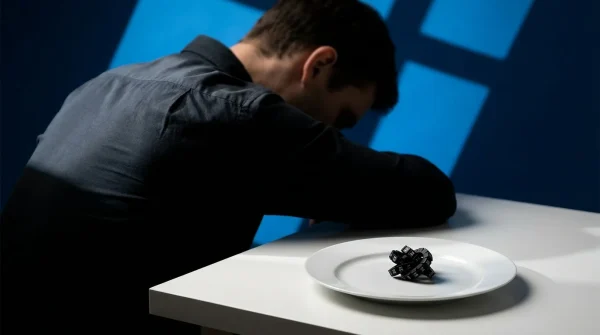
The room shrinks until your vision narrows to a pinprick. Your chest locks up, feeling like you are breathing through dry wool, while your thoughts accelerate into a catastrophic spiral that logic simply cannot touch. You try the deep belly breaths, the positive self-talk, and the counting methods you read about online, but the primal alarm blaring behind your forehead drowns them out in seconds.
Then you pull open the refrigerator door. The cold light spills across wire shelves, illuminating an unassuming glass jar of prepared horseradish. You twist the metal lid, dip the tip of a teaspoon into the pale, fibrous paste, and place it directly onto your tongue.
The reaction is instantaneous and ferocious. A volatile vapor surges upward through the roof of your mouth, stinging your sinuses with blinding, chemical-free heat that forces your eyes wide and triggers an immediate, involuntary inhalation. Within three seconds, the mental loop snaps; your survival brain abandons its phantom threats because it suddenly has to process a sharp, undeniable burst of physical reality.
We spend years believing that severe panic demands gentle remedies like lavender mists, warm chamomile, or prolonged quiet meditation. Yet when the limbic system catches fire, softness rarely breaks the trance. Sometimes, hauling your nervous system back to baseline requires a blunt, pungent intervention that demands total neurological priority.
The Circuit Breaker in Your Spice Drawer
Think of acute panic as an electrical feedback loop inside an amplifier. When a microphone gets too close to a speaker, the screeching whine feeds on itself, growing louder until something cuts the power. Trying to whisper calm thoughts over that screech is futile. Raw horseradish acts as a breaker switch, cutting the current by overloading an entirely different sensory wiring network.
The active compound responsible for this violent clarity is allyl isothiocyanate. Unlike capsaicin in hot peppers, which binds to heat receptors on your tongue and lingers as a slow burn, horseradish releases a volatile organosulfur compound that turns into gas at human body temperature. It surges directly into the nasal passages and stimulates the trigeminal nerve—the massive cranial highway that governs facial sensation and protective airway reflexes.
Your brain is wired with strict survival priorities. A theoretical worry about a meeting tomorrow or a sudden health dread will instantly take a backseat when the trigeminal nerve fires an urgent signal that your airways are under sensory siege. The loop collapses because the hardware simply cannot process both signals at full volume.
- Mopping hardwood floors strains lumbar spinal discs sparking persistent joint aches
- Barebells protein bars trigger intense afternoon crashes behind hidden maltitol syrups
- Nodding during conflict drains nervous system stamina triggering sudden afternoon fatigue
- Mastoid bone pressing dissolves stubborn neck tightness from continuous laptop staring
- Eli Lilly Verzenio approvals alter standard clinical oncology protocols across hospitals
The Accidental Discovery in the Commercial Kitchen
Elena Torres, a thirty-eight-year-old banquet chef from Chicago, discovered this biochemical detour by pure accident during an evening prep rush. Trapped in a walk-in cooler while experiencing a suffocating surge of social dread before a two-hundred-plate dinner service, she leaned against a stainless steel prep station, trembling and unable to steady her hands. A freshly grated tub of raw root sat uncovered beside her cutting board. In a moment of desperate frustration, she scooped a fingertip of the damp root into her mouth. The sheer, sinus-scouring punch brought immediate tears to her eyes, forced her diaphragm to drop, and extinguished the panic spiral before she could even wipe her nose. Within two minutes, she was calmly calling ticket orders on the pass.
Calibration Layers: Finding Your Sensory Threshold
Not every nervous system handles intense sensations identically. Tailoring the stimulus prevents you from trading an emotional crisis for an uncomfortably scorched palate.
For the Sensory Sensitive
If intense tastes usually overwhelm you, you do not need a heaped mound to get the neurological benefit. A mere smear on the tip of an ordinary toothpick is enough to activate the trigeminal response without sending you hunting for a glass of milk. Let the scent rise into your nose before closing your lips around the wood.
Focus on the immediate clearing sensation behind your bridge rather than swallowing the condiment right away. The goal is activating the cranial nerve pathways, not irritating your stomach lining.
For the Desensitized Loop
If your panic manifests as derealization—where the world feels distant, muted, or glassy—a gentle touch will not break through the haze. You need a full quarter-teaspoon of pure, grated horseradish suspended in simple vinegar and salt, avoiding brands blended with heavy mayonnaise or sweet beet juices.
Place the paste on the center of your tongue, close your mouth, and inhale gently through your nose. The vapor will travel fast, striking the ethmoid region with a sharp, crisp sting that instantly pulls your awareness back into your physical skin.
Mindful Application: The Grounding Ritual
Executing this technique requires intention rather than reckless speed. Keep a dedicated, fresh jar clearly marked in the door of your refrigerator so you never have to search for it during an acute surge.
- Open the jar and notice the faint, sulfurous tang before you even scoop.
- Measure out no more than one-fourth of a level teaspoon on a clean spoon.
- Place the paste directly on the tongue and press it gently to the roof of your mouth.
- Keep your lips sealed for five seconds, allowing the volatile gases to rise through your sinuses.
- Exhale slowly through your mouth, letting your shoulders drop as the initial sting softens into warm clarity.
The entire physical peak lasts roughly ten to fifteen seconds, leaving behind cleared airways, a grounded pulse, and an immediate reduction in emotional tension.
Keep your setup uncomplicated. A small four-ounce jar of prepared horseradish, kept between 34°F and 38°F, retains its pungent kick for about four months before the volatile oils oxidize and lose their medicinal bite.
The Bigger Picture: Reclaiming Autonomic Control
Panic thrives on the illusion of helplessness. When a racing heart tricks you into believing that your body has betrayed you, the psychological fallout often hurts far more than the adrenaline rush itself. Knowing that a common, affordable root sitting in your refrigerator door can reliably disrupt that cycle changes the internal balance of power.
You no longer have to fear being swept away by a sudden cognitive wave. With a simple, physical tool grounded in basic human biology, you possess a tangible anchor that pulls you out of your racing thoughts and drops you firmly back onto solid ground.
The most reliable way to quiet an overactive mind is to give the senses an undeniable physical truth to handle instead.
| Key Point | Detail | Added Value for the Reader |
|---|---|---|
| Primary Trigger | Allyl isothiocyanate vapor activation | Bypasses mental reasoning to reset autonomic loops via the trigeminal nerve. |
| Optimal Dosage | 1/8 to 1/4 teaspoon of plain prepared root | Delivers maximum sinus reflex without irritating digestive mucosal lining. |
| Sensory Mechanism | Volatile gas evaporation at 98.6°F | Creates an immediate somatic interruption that halts panic-driven hyperventilation. |
Frequently Asked Questions
Does creamed horseradish work as well as the plain variety?
No, dairy fats and mayonnaise trap the volatile oils, drastically blunting the vapor release that you need to shock the trigeminal nerve back to baseline.Can swallowing horseradish during an attack upset an empty stomach?
Yes, which is why you only need a pea-sized amount held briefly on the tongue; you can spit it into a tissue after the sinus flush if your stomach is sensitive.Why does horseradish work faster than sucking on a sour lemon?
Sour flavors stimulate taste buds and salivary glands, but horseradish vaporizes into a gas that directly stimulates cranial nerve pathways within two seconds.How long will an opened jar keep its panic-stopping strength?
Once exposed to air, the volatile compounds degrade steadily; replace your grounding jar every three to four months to ensure the kick remains potent.Is this safe to use if I already have high blood pressure?
The sudden pungent sensation causes a momentary startle response, but the rapid reduction in panic-driven adrenaline typically lowers overall cardiovascular tension shortly after.