By three in the afternoon, the ambient hum of your workspace turns into white noise, and your collarbones feel like they are collapsing inward. You roll your shoulders in broad, hopeful circles, hearing a dull, grit-like pop between your spine and your left wing bone. That familiar, stubborn throb settles right against the inner rim of the shoulder blade, humming with the faint burn of a low-grade electrical circuit.
Most people react to this afternoon wall by levering their spine across the hard back of an office chair, praying for a loud mechanical pop that never quite arrives. Others dig ruthless plastic massage hooks into the area, bruising the tissue and wondering why the knot returns with a vengeance twenty minutes later. But muscle fibers under sustained static load do not yield to brute hostility; they simply lock down tighter behind a wall of protective guarding.
The secret is not stretching until your ligaments strain, nor is it crushing your back against a lacrosse ball until you hold your breath. Real, lasting release comes down to a quiet neurological negotiation: finding the exact micro-groove along your medial scapular border and delivering targeted two-finger manual pressure that persuades your autonomic nervous system to cut the power to the spasm.
The Chinese Finger Trap: Why Force Fails Tight Upper Backs
When you sit with your forearms angled toward a keyboard and your eyes pinned to a fixed horizon, your shoulder blades drift forward and outward across your ribcage. In this posture, known clinically as scapular protraction, the rhomboids and levator scapulae are not short and bunched; they are stretched taut like guy-wires holding up a swaybacked tent pole. When you hammer an already overstretched muscle with aggressive rolling, the spindle cells inside perceive a threat and contract harder to avoid tearing.
Think of it as a biological Chinese finger trap. Pulling frantically on both ends only constricts the weave around your fingers. To open the mesh, you have to push inward, introducing slack to the system before nudging it toward neutrality.
True shoulder blade pressing does not beat the knot into submission. Instead, it simulates an ischemic compression, starving the hyperactive trigger point of fresh oxygen for just a few seconds before releasing it into a tidal rush of warm, restorative blood flow.
- FDA Inluriyo approvals shift advanced breast cancer treatment protocols across oncology clinics
- Meningitis symptom surges prompt urgent emergency room visits across multiple states
- Propping bedroom windows flushes stale trapped heat for deeper unbroken sleep
- Soft sofa slouching twists lower spinal curves sparking persistent morning stiffness
- Warm saltwater rinses soothe raw burning throat lining without modern lozenges
The Physical Therapist’s Blueprint for Desk-Bound Stagnation
Elena Vance, a 44-year-old sports manual therapist based in Chicago, spends her days treating software engineers and orchestral string players whose upper bodies freeze under prolonged isometric holding patterns. She discovered early in her clinical career that patients who bruised themselves with hard rollers were essentially treating the symptom of an overworked stabilizer rather than clearing the motor loop driving it.
Elena teaches her clients to discard the heavy tools and rely instead on their own fingertips, isolating the thin, sensitive channel where the rhomboid attaches to the sharp inner edge of the scapula. By applying moderate, focused pressure directly into that junction while executing a gentle tilt of the chin, patients consistently disarm the hyper-irritable knot within sixty seconds, resetting the resting tone of the entire upper girdle without leaving their chairs.
Adjusting the Pressure: Find Your Movement Profile
Not every desk-bound knot is forged from the same daily habits. How you sit, breathe, and position your display dictates where that mechanical anchor settles between your ribs and shoulder blade.
For the Single-Monitor Leaner
If you work off a laptop or tilt your neck constantly toward a primary screen off to one side, one shoulder blade inevitably rides higher and further forward than the other. This creates an asymmetrical anchor point right at the superior medial angle—the top inner corner of the blade. Address the high shoulder first, anchoring your fingers with the head gently tilted away toward the opposite knee to open the tissue channel.
For the Mouse-Forward Reacher
When your dominant arm rests three inches further forward on the desk to maneuver a mouse or trackpad, your lower trapezius goes slack while your mid-rhomboid fires endlessly to keep your arm from drifting off the desk. Here, the knot sits midway down the blade edge. You will feel an unmistakable, tender pencil-width ridge that radiates a faint warmth into the back of your arm when pressed.
For the Apical Shallow Breather
If afternoon stress causes you to breathe solely through the top of your chest rather than into your belly, your scalenes and upper back muscles work overtime simply to pull air into your lungs. This keeps the scapula pinned upward, trapping the levator muscle under constant strain. For this pattern, the pressure must be synced with extended, slow exhales to drop the ribcage down.
Mindful Application: The Two-Finger Inner Blade Reset
You need nothing more than your own opposite hand and a steady, mindful breathing tempo to carry out this targeted self-care reset.
Sit toward the front edge of your chair so your lower back stays upright without resting on the backrest. Drop both feet flat against the floor and allow your shoulders to hang naturally.
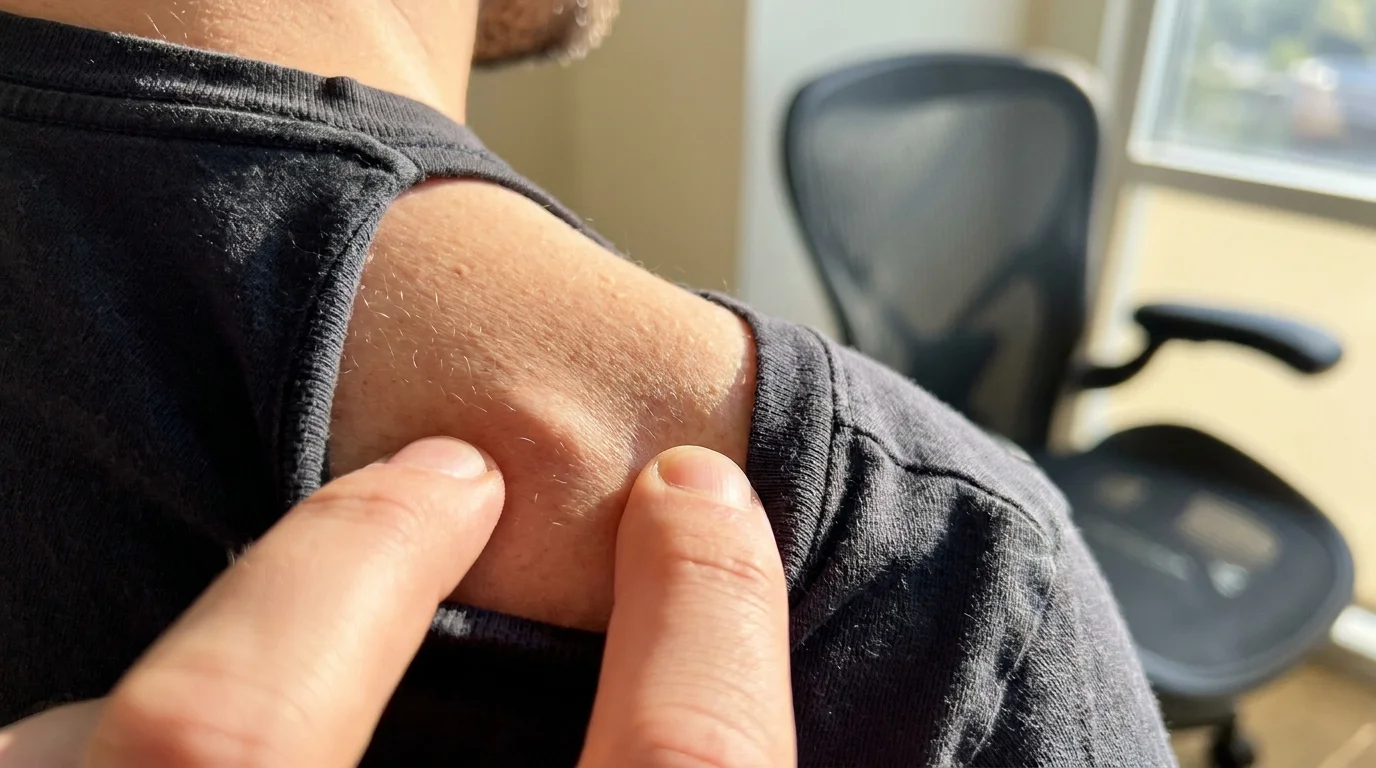
- Reach your opposite hand across your chest, resting your fingers over the top of the aching shoulder as if casually checking a coat pocket.
- Slide your index and middle fingertips down until you feel the hard, vertical bone ridge of your shoulder blade's inner border.
- Roll your two fingertips just a quarter-inch inward, dropping into the soft, rubbery gutter between that bony edge and your spinal column.
- Explore up and down this narrow trough until your fingertips locate the tender, taut band—it often feels like an unboiled piece of spaghetti or a dense bead under the skin.
- Apply steady, inward-and-backward pressure at a gentle four or five out of ten intensity. Do not dig or grind; maintain a quiet, constant hold.
- While maintaining this continuous pressure, slowly lower your chin toward your opposite armpit, breathing out through parted lips for a count of six.
- Hold the position and pressure for 45 to 60 seconds until you feel the local hardness soften and melt into the surrounding tissue.
The Tactical Toolkit:
- Target Depth: Firm, dull ache (never sharp, tingling, or electric).
- Working Duration: 60 to 90 seconds per anchor point.
- Frequency: Twice during the workday—ideally at 11:30 AM and 3:30 PM.
- Post-Release Movement: Three slow, deliberate shoulder rolls drawn backward, not forward.
The Bigger Picture: Reclaiming Autonomy Over Your Posture
Living behind a screen does not mandate carrying an invisible boulder between your shoulder blades every evening. When you understand that physical tension is simply an unmonitored conversation between your nervous system and your fascia, you stop viewing your body as a machine that constantly breaks down. A single mindful contact point shifts you from being a passive victim of desk fatigue into someone who can reset their internal balance on demand.
That tight spot on your back is not a life sentence. It is merely a signal reminding you that your body prefers fluid adaptation over static endurance. Once you give those overstretched fibers permission to stand down, the breath drops lower into your lungs, your jaw relaxes, and you finish your workday feeling rooted rather than worn away.
“Relief in the physical body rarely comes from conquering a muscle; it happens when you provide the precise sensory cue that makes guarding unnecessary.”
| Key Point | Detail | Added Value for the Reader |
|---|---|---|
| Ischemic Compression | Holding steady 4/10 pressure for 60 seconds without dynamic rubbing or sliding. | Stops muscle spindle panic and invites rapid oxygen-rich blood flow upon release. |
| Anatomical Siting | The soft gutter along the medial border of the scapula, not on the bone itself. | Targets the exact myofascial trigger zone responsible for radiating neck and upper back pain. |
| Chin-to-Armpit Angle | Gently angling the chin downward toward the opposite side while holding the point. | Puts the levator and upper rhomboid fibers into an optimal therapeutic stretch window. |
Frequently Asked Questions
How hard should I press along the inner shoulder blade?
Aim for a four or five on a scale of ten. The sensation should feel like a satisfying, dull ache—what bodyworkers often call "good hurt." If you find yourself wincing, tensing your jaw, or holding your breath, you are pushing too hard and will trigger defensive muscle tightening.Why does this trigger point radiate into my neck or arm?
The rhomboids and levator scapulae share referral pathways with cervical nerves. When these muscles harbor chronic ischemic knots, pressing them commonly sends a mild, warm sensory echo up the neck or over the outer shoulder. This is normal and fades as the trigger point softens.Can I use a tennis ball or lacrosse ball against a wall instead?
While a tennis ball works in a pinch, it lacks the precision and tactile feedback of your own fingertips. Your fingers can feel the exact moment the taut band releases its defensive tone, allowing you to regulate the pressure far more accurately than your body weight against a wall allows.How often can I perform this shoulder blade press during the day?
You can perform this reset two to three times a day. Space the sessions out by a few hours to avoid irritating the overlying skin and sensory nerves. Consistency and gentle intervention always work better than excessive force.What should I do immediately after releasing the pressure?
Take a slow, deep breath into your lower belly, let your arms dangle loosely by your sides, and perform two or three gentle, slow shoulder circles backward. Drink half a glass of room-temperature water to support metabolic tissue clearance.