The air in the glass-walled conference room always turns dense around the forty-minute mark. Fluorescent fixtures hum at an almost imperceptible pitch, while someone two chairs down shuffles through thick slide decks. You feel your collar pressing a fraction too hard against your windpipe. Your heart skips a standard beat, quickens, and suddenly threatens to hammer against your ribs like a trapped sparrow. To stand up and walk out would feel like an admission of defeat; to sit motionless while your peripheral vision narrows feels impossible.
Most public advice tells you to close your eyes, take belly breaths, or download a guided meditation app. But in the middle of a high-stakes presentation or a standing-room-only quarterly review, you cannot fold yourself into a breathing exercise without drawing the exact scrutiny you are trying to survive. You need a physical anchor that operates entirely below the line of sight.
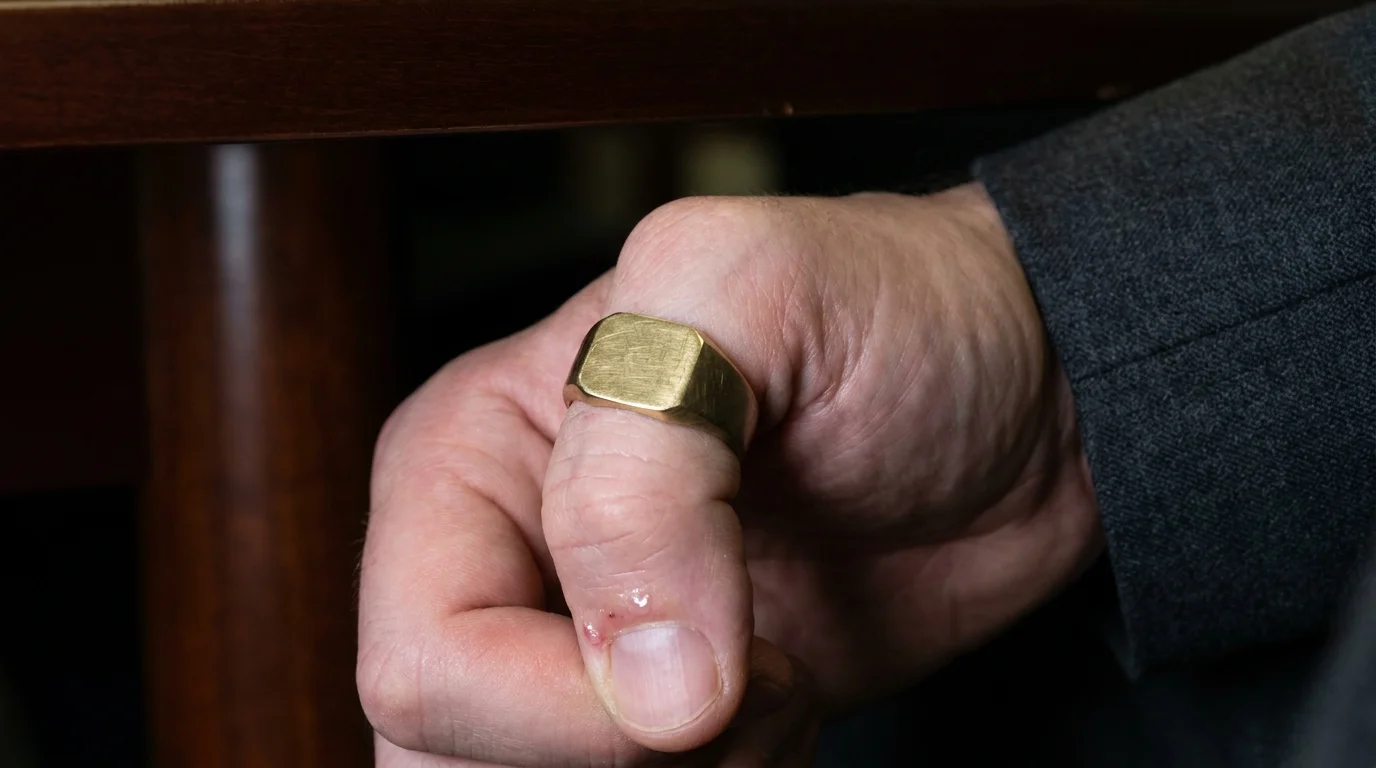
Your right hand rests flat on the polished mahogany table, fingers curling inward just enough for your thumb to meet the side of your index finger. Resting there is a solid ounce of brass or dense sterling silver—a heavy signet ring. As the panic threatens to pull the floor out from under you, your thumb finds the cold, beveled corner of that metal face. Solid cold metal draws attention straight out of the chest and anchors it into the hand.
With a tiny, rhythmic quarter-turn, the chill of the band presses firmly against the sensitive skin between your first and second knuckles. Within three revolutions, the sensory alarm bells in your brainstem begin to soften their shriek.
The Thermal Pivot: Why Mechanical Weight Defeats Cognitive Loops
Panic is primarily a spatial deception. When adrenaline floods the system, your brain tricks you into believing that the physical space around you has collapsed, driving an urgent urge to escape or freeze. Trying to reason your way through this with affirmations often makes the loop tighter because the intellect cannot out-argue a sympathetic nervous system that smells danger.
A heavy signet ring bypasses the storytelling mind entirely by introducing what sensory physiologists call localized proprioceptive contrast. A ring made of solid brass, tungsten, or dense gold holds ambient room temperature, which is consistently cooler than your skin during an adrenaline surge. When your thumb bears down on that cold, flat face, the nervous system must process two competing signals: the vague, catastrophic dread in your chest and the sharp, measurable, cool pressure against your knuckle. The nervous system prioritizes physical touch over abstract internal panic every single time.
Rather than resisting the panic, you give your fingers a small, legitimate mechanical task. The signet is not a fidget spinner or a novelty toy; it looks like heirlooms, taste, and personal history. It sits in plain sight, doing its work in secret.
- Spicy ginger chews shock overstimulated brain circuits halting sudden panic loops instantly
- Vitamin D3 softgels stall morning fat breakdown without balanced dietary fat pairings
- Grapeseed cooking oil releases harsh smoky vapors sparking sudden sinus congestion
- Brita pitcher water flushes essential mineral salts sparking heavy afternoon muscle sluggishness
- Avoiding grocery baskets erodes core balance and accelerates upper body muscle fade
Consider Julian Vance, a 42-year-old municipal bond attorney in Chicago who spent years white-knuckling client cross-examinations. Julian had nearly stepped away from courtroom practice after a sudden vestibular panic attack during a deposition left him drenched in cold sweat and disoriented. His breakthrough came when his father handed him an old hand-carved signet ring made of twelve-gauge silver. By training his thumb to roll the heavy flat oval across his knuckle at the first sign of chest constriction, Julian learned to interrupt the adrenaline cascade within forty-five seconds, remaining entirely composed while opposing counsel read from exhibits.
Selecting the Vessel: Weight, Metal, and Surface Geometry
Not every ring can function as an emergency somatic brake. Light bands, hollow stampings, or fragile gemstones fail because they lack the physical density required to jolt hyper-aroused nerve endings. The ring must possess deliberate gravitas.
- Dense Metals (Tungsten, Heavy Silver, Solid Brass): Choose a material that retains cool thermal mass. Hollow rings warm up to your body heat within minutes, eliminating the thermal contrast you need when your pulse spikes.
- Flat or Beveled Faces: A clean rectangular, cushion, or oval face gives the thumb pad an immediate, stable surface to press against, anchoring motor control.
- Friction Points: Subtle engraving, hand-stamped initials, or a deep seal groove introduce micro-textures that engage the fingertip’s Merkel nerve endings with remarkable precision.
Positioning also dictates how stealthy your de-escalation can be. While signets were traditionally reserved for the pinky, wearing an anchor ring on your middle or index finger allows the opposing thumb to make contact naturally while your hands are casually folded on a desk, resting in your lap, or wrapped around a glass of water. Heavy materials maintain thermal difference long enough to reset sensory thresholds.
The Micro-Rotational Method: A Stealth De-Escalation Toolkit
When the room starts spinning or your pulse accelerates, execute these movements with zero visible shoulder or arm motion. Your hands should look like they are merely at rest.
- The Knuckle Pin: Slip the thumb under the ring’s lower band, applying steady, upward pressure into the soft tissue of the knuckle for five slow seconds.
- The Thermal Roll: Rotate the cool top seal 90 degrees outward toward the web of the finger, exposing the warm skin of your finger to a fresh, cold edge of metal.
- The Four-Corner Trace: Silently run the sensitive edge of your thumb nail along the hard outer rim of the seal face, counting each corner to tether cognitive processing back to basic tactile observation.
- The Hidden Squeeze: Interlace your hands naturally on your lap or desk, using the underside of your opposite index finger to squeeze the signet flat into your palm.
Hold your focus on the sensation for eighteen seconds. That is roughly the biological window required for the brain’s autonomic baroreceptors to register localized grounding pressure and reduce excessive peripheral vasoconstriction. A deliberate eighteen-second mechanical pause allows circulating adrenaline to dissipate without triggering outward tremors.
Stealth Calibration for Different High-Pressure Environments
Different public spaces impose unique social constraints. Your physical anchor must adapt to the specific geometry of the room you find yourself trapped in.
The Boardroom Table
Keep your forearms resting casually near your notebook or laptop. Never cross your arms across your chest, as this signals defensive posture to onlookers while compressing your diaphragm. Rest your thumbs lightly beneath the edge of the tabletop if you feel exposed; here, you can execute the Micro-Rotational Method completely hidden from view across the table.
The Crowded Transit Commute
When standing packed shoulder-to-shoulder on an express train where personal space has vanished, wrap your hand around a vertical handrail with your signet ring facing inward. Your thumb can continuously push against the top edge of the metal band, turning the cramped discomfort into a focused, steady tactile compression point.
The Social Dinner or Banquet
Keep your hands settled beside your dinner plate or holding a linen napkin. Use the weight of the ring against the rim of your water goblet to reinforce temperature sensations. Tactile contrast steadies nervous breathing when conversational demands prevent you from physically stepping outside.
The Quiet Return to Self
Reclaiming control over a rebellious nervous system does not require grand spiritual gestures or isolating retreats. It begins with the quiet recognition that you are allowed to carry your safe harbor on your own body.
When you wear a heavy signet ring, you do not wear an amulet of fear; you wear an engineered tool of self-possession. The next time the lights seem too bright, the voices in the room too loud, and your chest too tight, do not run. Simply touch the cold metal face, feel its weight anchored against your bone, and let the room find its own center while you hold yours.
The nervous system does not require a dramatic retreat to find calm; it only requires one single point of undeniable physical truth to hold onto.
| Key Point | Tactical Detail | Added Value for the Reader |
|---|---|---|
| Metal Density | Opt for solid brass, sterling silver, or tungsten rather than hollow cast rings. | Maintains cool thermal mass long enough to shock overactive nerve loops into neutrality. |
| Knuckle Placement | Wear on index or middle finger rather than pinky. | Allows the thumb to apply firm, steady pressure with zero visible hand displacement. |
| Thermal Roll | Quarter-turn rotations against the sensitive joint skin every 5 seconds. | Directly stimulates Merkel nerve endings to down-regulate rapid pulse spikes during tense meetings. |
Frequently Asked Questions
Will people notice me constantly twisting or touching my ring?
No. When executed correctly, the movement is identical to a natural resting hand posture. By resting your hands on your lap or a conference table, the thumb moves beneath or alongside the finger without creating any arm or shoulder movement.How heavy does the signet ring actually need to be?
Aim for a minimum weight of 12 to 18 grams. Anything lighter warms too fast to body temperature and lacks the physical presence needed to pull your attention away from internal adrenaline spikes.Which finger provides the best leverage for panic relief?
The middle finger of your dominant hand offers the easiest mechanical angle. Your thumb can reach both the face and the band comfortably without awkward bending or tension in the wrist.Can I use an engraved family crest or should the surface be completely smooth?
Lightly engraved or carved surfaces are actually superior to mirror-smooth finishes. The tiny ridges and micro-textures give your thumb pad distinct tactile boundaries to trace during dissociation or lightheadedness.How quickly does this grounding method lower a spiking heart rate?
Most people experience a perceptible drop in respiratory tension within thirty to forty-five seconds of continuous, cool surface rotation against the skin.