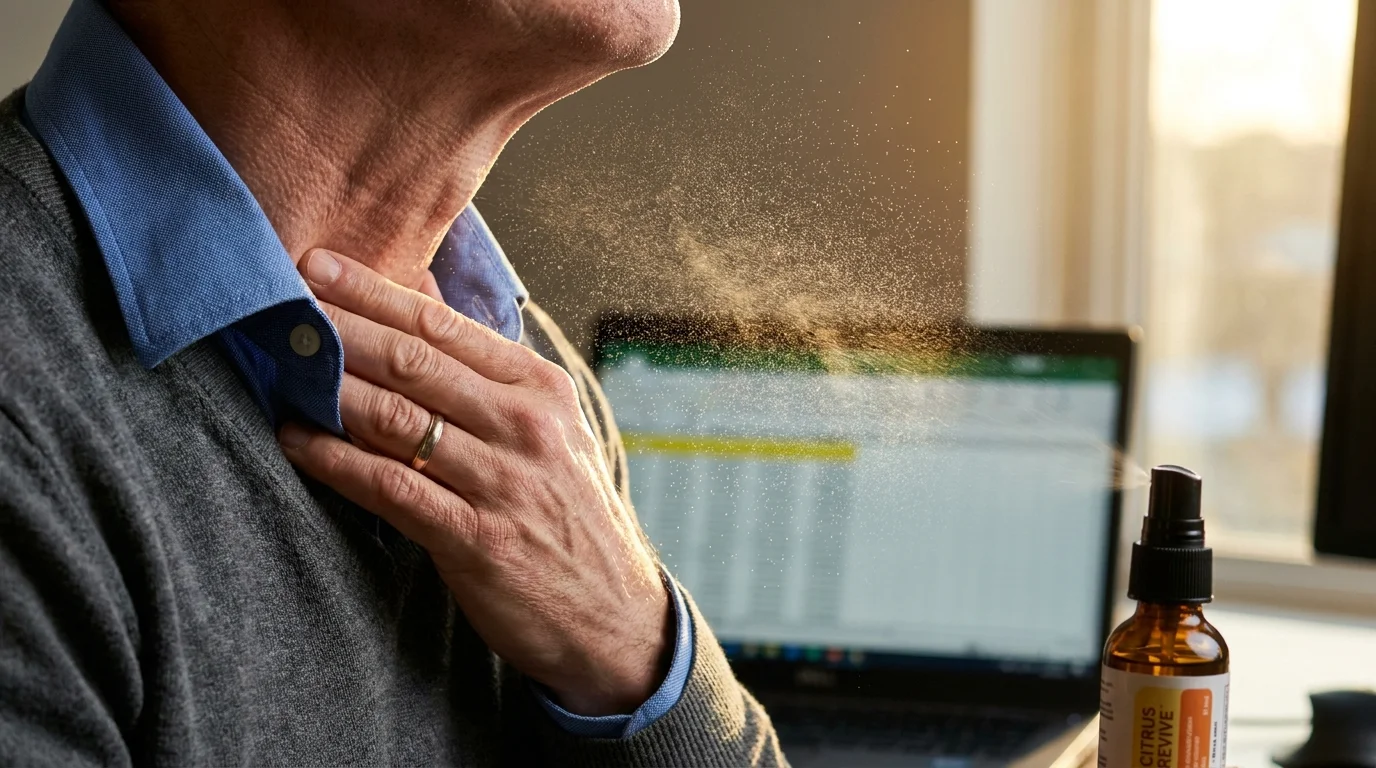
The clock on your taskbar ticks past three in the afternoon, and the light in your home office begins to stretch thin across your desk. To shake off the post-lunch haze, you reach for that sleek amber bottle sitting by your monitor. A quick squeeze releases a fine mist of sweet mandarin and sparkling bergamot into the recirculated air, promising an instant burst of clean orchard energy. You inhale, expecting a refreshing mental reset.
Instead, a prickly, feather-light scratch blooms right beneath your Adam’s apple. Within thirty seconds, you are pressing a fist to your sternum, attempting to swallow past a sudden dry patch that feels like sandpaper. A single, sharp hack turns into an embarrassing sequence of dry, barking throat clears just as your next virtual meeting begins. You grab your water glass and take three long gulps, but the fluid slides right past the sensation without dampening it.
Your immediate instinct is to blame the weather, the dry office HVAC system, or perhaps the early stirring of seasonal ragweed. Yet the air outside hasn’t changed since your morning walk, and your sinuses remain remarkably clear. What you are feeling is not the onset of a seasonal head cold or the sudden arrival of an immune response. It is a rapid neuro-mechanical twitch occurring directly inside your vocal tract.
When synthetic citrus aerosols collide with indoor ozone, they do not just perfume your workspace; they create an invisible cascade of reactive compounds that directly provoke the hyper-sensitive nerve endings guarding your vocal cords.
The Silent Spark: Why Synthetic Zest Hijacks Your Airway
We are culturally conditioned to link the sharp scent of lemon, orange, and grapefruit with spotless hygiene and invigorating purity. In truth, modern aerosolized fragrances rely heavily on synthetic terpenes—most notably d-limonene and pinene—engineered to mimic the lively burst of an expressed fruit rind. When these volatile organic compounds are sprayed into an enclosed room, they immediately interact with the baseline ozone generated by common office equipment like printers, monitors, and modern air scrubbers.
This unseen chemical reaction does not stay floating harmlessly in the ambient air. Within minutes, the microscopic droplets degrade into secondary organic aerosols, including trace formaldehyde and ultrafine oxidized particulates. Because you are seated and breathing shallowly during focused desk work, these dense particles do not filter out through your nasal hairs. Instead, they glide straight through the oral cavity and deposit directly onto the laryngeal mucosa—the delicate tissue lining your windpipe.
- Contrast bath plunges trigger sudden dizzy spells and tight chest pressure
- Nuun hydration tablets overwhelm fasting stomach absorption triggering dry mouth muscle twitches
- High pillow stacks force awkward neck angles sparking stubborn skull base throbbing
- Pressed spirulina tablets resist stomach acid breakdown triggering persistent lower belly puffiness
- Stiff denim waistbands restrict shallow lower ribcage expansion sparking tense chest tightness
Think of this tissue less like a passive exhaust pipe and more like a high-strung tripwire. When oxidized citrus particulates land on this mucosal surface, they activate the transient receptor potential (TRP) channels embedded in your vagus nerve. Your brain does not register this microscopic landing as an organic scent; it perceives an incoming physical threat. The vocal folds snap shut in a lightning-fast defensive spasm, leaving you with an overwhelming urge to hack, swallow, and clear an obstruction that isn’t actually there.
The Clinical Clue: A Voice Coach’s Late-Day Discovery
Dr. Eleanor Vance, a 52-year-old laryngeal physiologist and vocal consultant based in Chicago, repeatedly noticed this pattern among corporate clients who complained of losing their voices exclusively between 2:00 PM and 5:00 PM. Client after client arrived terrified of sudden vocal fatigue or chronic reflux, claiming their vocal cords felt brittle and tight only during afternoon presentations. Vance began auditing their desk setups, suspecting improper monitor height or neck strain.
The common denominator was not ergonomic failure, but the ritualistic –energy spritz– sitting beside their keyboards. In nearly every case, workers were spraying mass-market citrus room fresheners directly into their breathing zones during the mid-day slump to combat drowsiness. Once Vance banned aerosolized synthetic citrus from their enclosed offices and replaced the habit with simple cross-ventilation, the mysterious 3:00 PM coughing fits vanished within forty-eight hours.
Mapping the Reaction: Who Suffers the Quickest?
Not every respiratory system responds to aerosolized citrus with the same ferocious tickle. Your susceptibility depends heavily on your workspace microclimate, your hydration status, and how you breathe while typing.
For the Focused Mouth-Breather
When you are deeply engrossed in complex tasks, your breathing subconsciously shifts from the nose to the mouth. This bypasses your body’s natural humidification and filtration system. If you introduce a cloud of aerosolized limonene during this state, the irritants bypass the nasal turbinates entirely and make raw contact with your upper trachea, triggering an immediate dry spasm within sixty seconds.
For the Winter Hermit
If you run forced-air heating or work in a tightly sealed, energy-efficient modern apartment, your indoor humidity often hovers below thirty percent. Under these conditions, the protective liquid layer coating your vocal cords evaporates rapidly. Without that slick moisture barrier, the microscopic chemical fallout from citrus sprays bonds directly to epithelial cells, sparking a lingering, burning itch that defies water.
For the Essential Oil Purist
It is easy to assume that switching from a cheap drugstore aerosol to a cold-pressed, organic citrus room mist solves the dilemma. In reality, pure essential oils contain significantly higher concentrations of raw d-limonene. When aerosolized via ultra-fine pump sprays into stagnant indoor air, natural terpenes undergo oxidation just as fast as synthetic copies, creating the exact same sensory nerve over-firing.
The Clear Air Protocol: Clearing Your Afternoon Throat
To eliminate this phantom tickle without surrendering the energizing benefits of daytime citrus, you need to alter how scent is delivered and create a physical environment that supports vocal resilience.
- Purge the Aerosol Zone: Remove pump sprays, plug-in warmers, and pressurized citrus aerosols from within six feet of your seated work area.
- Deploy the Heat Diffusion Alternative: If you crave citrus aromas for focus, transition to an indirect whole-fruit peel steeped in boiling water across the room, which releases heavy, moisture-bound aromatic molecules rather than oxidized dry aerosols.
- The Saline Rinse Defense: Keep an isotonic nasal spray at your workstation. Administering two quick sprays into each nostril before long calls restores mucosal moisture and encourages natural nasal breathing.
- Execute the Silent Swallow Reset: When the sudden tickle strikes mid-sentence, resist the urge to violently clear your throat, which slams your vocal cords together and deepens inflammation. Instead, take a sip of room-temperature water, swallow hard with your chin tucked toward your chest, and exhale slowly through pursed lips.
The Late-Afternoon Workspace Toolkit
Maintain your workspace between 40% and 50% relative humidity using an evaporative, cool-mist humidifier placed at least four feet away from sensitive electronics. Keep your room temperature anchored near 68 F to prevent stagnant thermal layering of VOCs. If you must use scented products, verify they are free of synthetic limonene, pinene, and synthetic musks, opting instead for solid beeswax balms applied sparingly to the wrists rather than dispersed into the breathing zone.
The Bigger Picture: Reclaiming Your Workspace Sanctuary
Our homes and private offices have become layered with chemical attempts to engineer productivity, freshness, and calmness. We spray synthetic orchards into the air to force our brains through another hour of spreadsheet analysis, forgetting that our respiratory systems evolved to navigate natural airflow, not concentrated vapor traps.
Recognizing that a persistent dry cough is merely an airway’s mechanical plea for pure oxygen shifts the dynamic entirely. You do not need stronger cough drops, immune supplements, or allergy medication to survive your afternoon workflow. Often, true mental clarity and vocal ease require nothing more than opening a window, clearing the synthetic fog, and allowing your body to breathe unburdened air.
“The throat does not lie about the quality of your air; when a room spray forces you to clear your throat, it is an eviction notice for that chemical.”
| Airway Factor | Aerosolized Citrus Mist | Whole Peel Hot Water Infusion |
|---|---|---|
| Particle Size | Ultrafine reactive droplets (under 2.5 microns) | Heavy, water-bound steam aromatics |
| Ozone Reactivity | High; forms secondary irritants like formaldehyde | Negligible; dispersed slowly at low velocity |
| Laryngeal Impact | Direct vagal stimulation; triggers dry tickle | Gentle airway hydration; soothes vocal cords |
Frequently Asked Questions
Can drinking warm tea soothe the tickle caused by citrus room spray?
Warm tea provides momentary comfort by lubricating the pharynx, but it cannot rinse away particles deposited below the vocal cords in your upper trachea. True relief comes from inhaling clean, humidified air and resting your voice.Why does this cough happen mostly in the late afternoon?
By late afternoon, office air has accumulated maximum concentrations of volatile organic compounds and ozone from all-day computer use. Combined with mild systemic dehydration and accumulated screen fatigue, your airway threshold for irritation drops significantly.Are all-natural, plant-based citrus room sprays safer for the voice?
Not necessarily. Natural citrus oils contain heavy concentrations of d-limonene, the exact terpene that oxidizes upon contact with ambient indoor ozone to create airway irritants. The extraction method matters less than the aerosolization process.How can I tell this isn’t seasonal pollen allergies?
Pollen allergies typically present with itchy eyes, clear nasal discharge, sneezing, and systemic sinus fullness. A citrus-induced reaction is localized strictly to the mid-throat, presenting as a sudden, isolated scratch followed by dry hacking without nasal symptoms.How quickly does the laryngeal reflex recover once the spray is gone?
Once you introduce fresh ventilation and stop introducing the aerosol, the immediate neuro-reflexive sensitivity settles within two to four hours as the mucosal lining replenishes its natural moisture barrier.