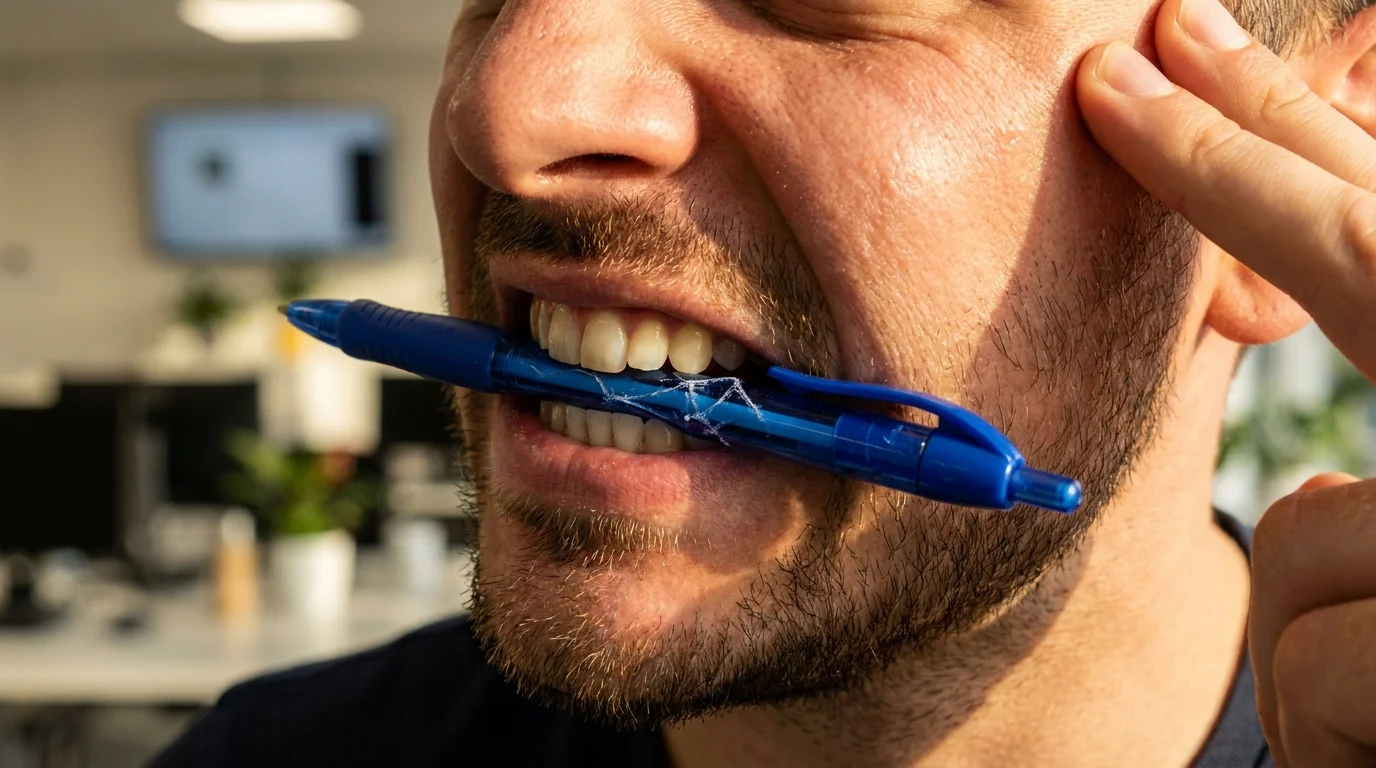
The glow of the spreadsheet hums against your retinas at two in the afternoon, casting a cold blue wash across your keyboard. Without thinking, your hand reaches for the cheap ballpoint pen resting beside the trackpad, guiding the cracked plastic cap between your premolars. You bite down, feeling the subtle give of cheap polymer, testing its resistance while your eyes scan line after line of dense figures. It feels like harmless white noise, a fidgeting outlet for a mind trapped in a flurry of midday tasks.
Yet twenty minutes later, a sour, strangely metallic film washes across the back of your tongue. Your temples begin a slow, rhythmic drumbeat, tightening like an over-wound guitar string that threads directly behind your eyes. You reach for your water tumbler, assuming you are parched or that the overhead fluorescent tubes are finally taking their toll on your vision.
The real culprit is far smaller and far more structural. That unconscious habit of gnawing on desk utensils creates an artificial isometric bind that locks your masticatory muscles, sending shockwaves through your craniofacial nerves. You are not just chewing on a piece of stationery; you are actively tricking your skull into a permanent state of emergency bracing.
When you bite down on a pen, your jaw never receives the natural signal to release that food provides. Food gives way, softens, and slides down your throat, signaling the nervous system that the work is finished. A rigid plastic barrel does neither. Your jaw becomes an anvil, holding continuous pounds of mechanical pressure across delicate joints designed primarily for rhythmic, intermittent action.
The Lever and the Anvil: How Desk Chewing Traps the Cranial Web
To understand why a simple pen triggers a pounding headache, picture your jaw as a heavy suspension bridge anchored to your temporal bones. Every time you clamp down on an unyielding plastic barrel, the masseter and temporalis muscles fire at maximum contraction. Because the plastic does not yield, the tiny mechanoreceptors embedded in your tooth sockets keep firing urgent messages to your brainstem, demanding even more bite force to break the obstacle.
This persistent tension travels backward in a silent domino effect. The temporalis muscle, which fans out across the side of your skull like an open hand, knots into dense, tender trigger points. When these fibers spasm, they constrict local micro-capillaries, reducing blood flow across your temples and radiating a dull, throbbing ache directly across your brow line.
Then comes the sudden metallic taste that leaves so many people mystified. That copper-like tang is rarely blood; it is a neurological misfire. The mandibular branch of your trigeminal nerve runs intimately close to the chorda tympani, the slender nerve branch responsible for taste sensation on the front two-thirds of your tongue. When extreme muscular compression squeezes that nerve pathway, the sensory wires cross, producing an phantom metallic taste alongside a sudden drop in healthy saliva production.
- Ashwagandha bedtime gummies trigger jarring midnight awakenings and sudden racing pulses
- Silicon dioxide fillers in daily vitamins trigger persistent chalky stomach bloating
- Deep bucket chairs squash lower ribs triggering sudden tight chest spasms
- Low laptop stands force downward neck angles triggering throbbing skull base tension
- Tabasco hot sauce drops hijack racing panic loops through sudden stinging tongue shocks
The Secret Shared in the Treatment Room
Dr. Julian Hayes, a 46-year-old craniofacial therapist based in Denver, sees this exact pattern walk through his doors three times a week. His patients often arrive clutching migraine diaries and expensive blue-light blocking glasses, convinced they are suffering from unexplained chronic neurological fatigue. Invariably, he asks to inspect the barrel of their favorite everyday writing pen before touching their neck.
“Nearly every single time, the plastic cap looks like it has survived a paper shredder,” Dr. Hayes notes with a knowing smile. He points out that holding an inanimate, rigid object between your teeth forces the articular disc of your temporomandibular joint out of its natural resting cradle. Within forty-five minutes of passive gnawing, the stabilizing lateral pterygoid muscle goes into an irreversible daytime cramp that pulls on your inner ear cartilage, mimicking sinus pressure and deep temple throbbing.
Mapping the Desk Habit: Three Forms of Unconscious Strain
Not everyone bites down with the same mechanics. Identifying your specific grip on the pen helps pinpoint why your head and neck hurt in very particular spots by mid-afternoon.
1. The Incisor Nibbler
If you catch yourself nibbling the tip of the pen between your front teeth, you are holding your jaw in an unnatural forward thrust. This forward shear forces your suboccipital muscles at the base of your skull to contract, attempting to balance your head against the shifted center of gravity. The ache settles behind eyes, creating an odd, dry pressure that makes screen reading feel like staring through frosted glass.
2. The Molar Pincher
Clamping a pen deep into the back corner of your mouth uses raw crushing power. The masseter muscle bulges under your cheek, transferring immense pressure directly into your ear canal and jaw joint. You might notice your ears feeling unusually full or hear a faint clicking sound whenever you swallow your afternoon coffee.
3. The Passive Lip-and-Teeth Holder
Some people never chew through the plastic; they simply cradle the pen between their lips and teeth while reading emails. Even this featherweight contact is destructive because it completely prevents your jaw from adopting its natural resting posture. Your teeth should never touch during waking hours unless you are chewing food or pronouncing certain consonants.
The 90-Second Vagal Jaw Uncoupling
Healing this afternoon flare does not require expensive splints or quitting your desk work. It requires training your autonomic nervous system to drop the jaw bone back into its hydraulic pocket through gentle physical cues.
First, abandon the pen the moment you notice the metallic twinge on your tongue. Replace it with an intentional physical posture that interrupts the motor loop entirely. Release your tongue completely from the roof of your mouth, letting it rest soft and wide along your lower teeth like a damp sponge.
- Place the tip of your index finger lightly on your chin.
- Inhale slowly through your nose for four steady counts, allowing your lips to part slightly.
- Exhale through relaxed lips while making a quiet, audible sigh, letting your lower teeth drop at least half an inch away from your upper teeth.
- Gently press the heels of your palms into your cheeks right beneath your cheekbones, dragging your hands downward with slow, firm traction for ten seconds.
Keep a physical sensory substitute at your workstation that cannot be chewed. A smooth, cool river stone or a tactile brass coin gives restless fingers something grounded to manipulate, sparing your oral tissues from unnecessary mechanical shock.
Reclaiming Stillness Above the Collarbones
Modern screen work demands intense mental focus, but our bodies often confuse deep concentration with physical exertion. When you tackle a difficult problem, your nervous system instinctively seeks an anchor, and all too often, that anchor ends up being your teeth clamped tight around a three-cent piece of plastic.
True productivity feels quiet and light, not clenched and fortified. When you learn to notice the subtle signals—the dry mouth, the phantom taste of copper, the faint knot tightening near your hairline—you can release the tension before it blossoms into an evening headache. Your jaw is meant to move, speak, and rest in open ease; let your desk utensils remain tools for writing, and let your head finally breathe.
“When your jaw clenches on an unyielding tool, your entire nervous system adopts the posture of an animal preparing to fight its environment.”
| Key Point | Detail | Added Value for the Reader |
|---|---|---|
| Chewing Resistance | Plastic does not break down, tricking periodontal nerves into permanent activation. | Explains why desk chewing causes far more muscle damage than actual food consumption. |
| Trigeminal Cross-Talk | Mechanical compression irritates adjacent taste pathways and parotid ducts. | Validates that sudden metallic mouth tastes are physical nerve responses, not random illness. |
| The ‘N-Position’ Rest | Resting the tongue softly against the floor of the mouth breaks the clench circuit. | Offers an immediate, zero-cost physical remedy to stop throbbing temple pain at your desk. |
Frequently Asked Questions
Why do I only bite my pens when I am intensely focused on a screen?
Intense cognitive load prompts involuntary motor overflow, where the nervous system releases excess mental tension through subconscious physical habits like biting or clenching.Can plastic pen chewing cause long-term damage to my teeth?
Yes, chronic localized pressure creates microscopic enamel craze lines, wears down incisal edges, and slowly displaces the protective articular disc inside your jaw joint.How does this habit trigger pain all the way down into my neck?
Your jaw muscles share common neural pathways with the upper cervical spine; when your masseters freeze, your neck muscles reflexively tighten to stabilize your head.Why does chewing gum fail to solve the problem?
Chewing gum maintains the exact same continuous muscle activity, keeping your temporalis and masseter muscles fatigued and inflamed instead of allowing them to rest.What is the best immediate replacement for pen biting at my desk?
Switch to tactile sensory tools for your hands, such as textured worry stones, and keep a glass of cool water nearby to prompt regular, soft swallowing breaks.