The kitchen is dead quiet, save for the sudden hum of the refrigerator kicking on. Your chest feels tight, like a bird fluttering violently against your ribs, and the room seems to shrink slightly at the corners. When you lift your hands, your fingers are vibrating—fine, involuntary tremors that make reaching for a glass of water feel like an Olympic trial. You are entirely alone, caught in that cold, hollow surge of an acute autonomic spike.
Standard wellness advice tells you to sit cross-legged and breathe your way back to safety. But when your heart is hammering at one hundred and twenty beats a minute, telling your brain to relax feels like reasoning with a brushfire. Your lungs pull in air that feels thin and useless, while the alarm bells in your brain stem continue to ring at deafening volume.
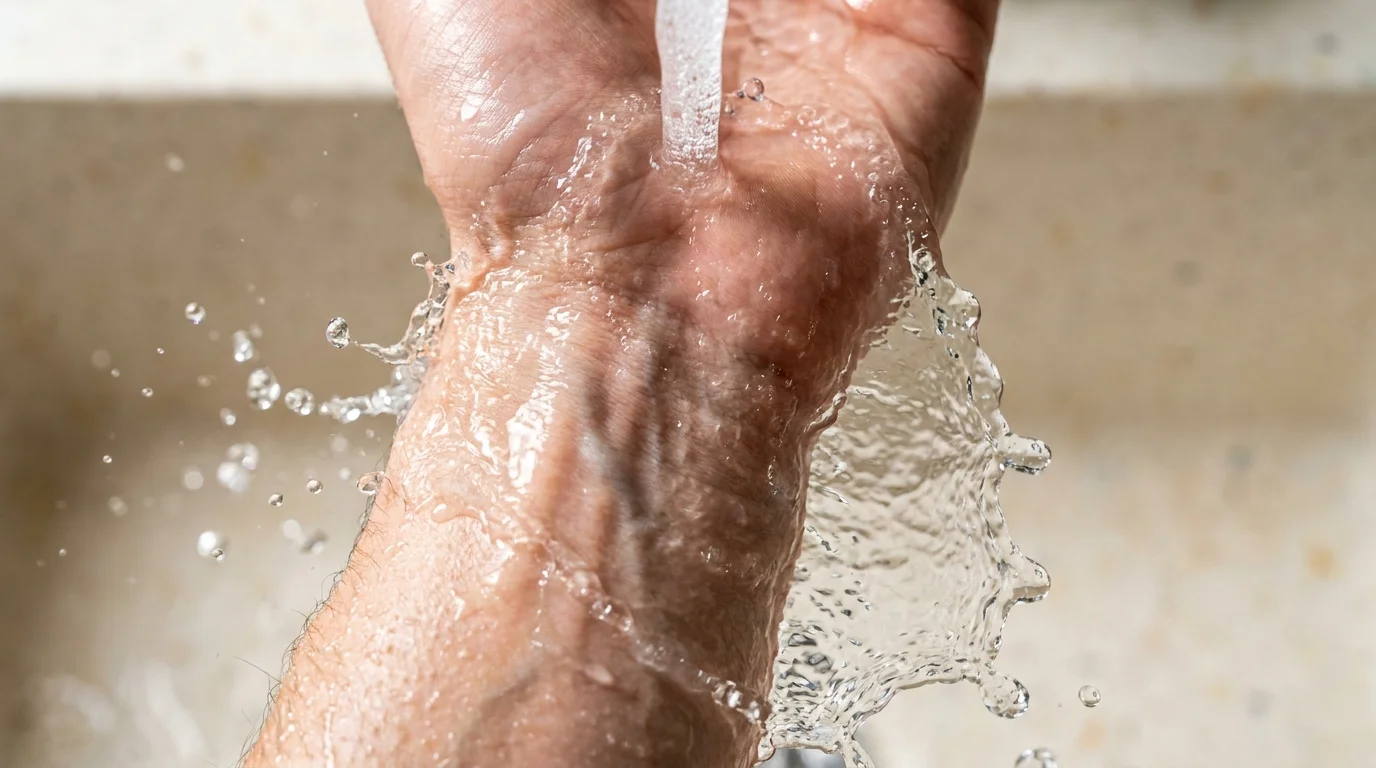
The bathroom sink faucet gleams under the dull overhead bulb. You do not need a weighted blanket, a dark room, or twenty minutes of guided meditation to interrupt this physical hijack. All you need is sixty seconds of running cold tap water across the delicate pulse points of your inner wrists.
The Plumbing of Panic: Flipping the Radial Switch
Think of your autonomic nervous system during a sudden spike not as an emotional crisis, but as an overheated engine cooling loop. When panic takes over, your sympathetic branch dumps norepinephrine into your bloodstream, slamming the gas pedal to the floorboards. Peripheral capillaries snap shut to divert warm blood toward your major muscle groups, leaving your fingertips trembling, icy, and clumsy. Trying to rationalize your way out of that biochemical surge is nearly impossible because your higher cognitive centers have temporarily stepped aside to let survival instincts run the show.
Your radial pulse points function as built-in cooling radiators resting right beneath the surface. Where the radial artery crosses the carpal bones at your wrist crease, only a micro-thin layer of dermis separates circulating blood from the ambient air. Running chilled water over this exact vascular crossroads creates an instant, localized thermal drop in the blood stream returning toward your core.
This sudden drop in vascular temperature stimulates cold-sensitive thermoreceptors wired directly to the vagus nerve. Rather than negotiating with runaway thoughts, you are physically applying a brake to the heart’s natural pacemaker. The vagus nerve fires a rapid parasympathetic override directly to your sinoatrial node, commanding the muscle walls to slow down, soften their contractions, and restore steady rhythmic tone.
- Frozen lime slices shock stubborn nervous system loops halting sudden panic surges in seconds
- Omega-3 fish oil capsules demand evening dinner pairing to stop sluggish metabolic clearance
- Nonstick teflon skillets heated past medium release airborne irritants sparking heavy post-meal head pressure
- Scrubbing low bathtubs strains delicate knee joints sparking sharp next-morning lower back aches
- Clif energy bars trigger sudden sluggish crashes and spark intense evening sweet cravings
Elena Vance, a 38-year-old high school biology instructor in Denver, stumbled across this physiological shortcut while dealing with sudden tremors between her morning class periods. Facing an empty lab room with her pulse hammering against her eardrums and her fingers shaking too hard to hold a dry-erase marker, she thrust her wrists under the cold tap of the classroom sink for forty-five seconds. Within half a minute, the buzzing tension in her temples evaporated, her hands steadied against the porcelain basin, and she was able to greet her incoming students with total composure.
Tailoring the Cold Immersion to Your Anatomy
Not every nervous system processes an adrenaline dump through the exact same physical symptoms. The way you apply cold to your wrist points can be calibrated depending on how panic manifests in your body.
For the tremor-dominant surge, the issue is concentrated in over-sensitized peripheral motor nerves. If your fingers are dancing uncontrollably and your jaw feels tight, your peripheral motor loops need immediate sensory grounding. Turn your palms upward toward the ceiling, allowing cold running water to pool in your palms and slide down across your wrist creases for a full sixty seconds. The combination of tactile water weight and cold temperature resets muscle spindle firing in your forearms, stilling hand tremors almost instantly.
For the rapid pulse spike, where your heart feels like a kick-drum inside your throat while your hands stay strangely numb, focus on bilateral pressure. Fill a wide mixing bowl with cold tap water and submerge both hands up to the mid-forearm. This circumferential immersion chills the radial and ulnar arteries simultaneously, initiating the mammalian dive reflex and coaxing your heart rate down by ten to twenty beats in under two minutes.
For desk workers trapped in open-plan offices or video conferences, running to a sink is not always possible. Pressing a chilled can from the breakroom fridge firmly against the thumb side of your wrist crease delivers the exact same vascular shock. Keep the cold contact steady against the pulse point for forty-five seconds while keeping your eyes fixed on a neutral point in the room.
The Sixty-Second Reset Protocol
Stopping a runaway heart rate requires consistency over intensity. Using freezing ice water can inadvertently trigger defensive pain pathways that spike your blood pressure, while lukewarm water does nothing to stimulate the vagus nerve. Follow this simple sequence when the room begins to spin.
Turn your tap to its coldest setting and let the stream run for five seconds until it feels crisp and sharp to the touch. Place both wrists directly under the flow, angling your forearms so the water washes over the base of your palms and coats the blue veins of your inner wrists. Keep your posture loose, allowing your shoulders to drop away from your ears.
- Keep wrists submerged continuously for forty-five to sixty seconds without pulling away.
- Expose both the thumb side (radial artery) and pinky side (ulnar artery) to ensure complete bilateral cooling.
- Breathe through your nose, exhaling through your mouth slightly longer than you inhale.
- Gently open and close your hands to encourage chilled blood to circulate smoothly back through your forearms.
Tactical Toolkit:
- Water temperature: 50°F to 58°F (standard cold tap water, avoiding raw ice directly on skin).
- Duration: 60 seconds minimum, 90 seconds maximum.
- Stance: Leaning forward slightly over the sink to reduce abdominal muscle guarding.
Finding Autonomy in the Cold
The most frightening part of sudden panic is the feeling of physical betrayal. When your heart races without your permission and your hands shake uncontrollably, your own body feels like an unfamiliar, hostile place. The spiral deepens because you feel utterly powerless to stop the machine once it starts running hot.
Recognizing that your pulse points are mechanical levers you can touch changes the entire dynamic. You no longer have to wait for an adrenaline surge to burn itself out, nor do you need to dread the onset of physical shaking when you are home alone. A simple stream of tap water allows you to step into the circuit, quiet the alarm bells, and return to steady ground on your own terms.
“The heart obeys physical mechanics far more readily than it listens to worried arguments.”
| Key Point | Detail | Added Value for the Reader |
|---|---|---|
| Vascular Access | Radial artery sits beneath thin skin at carpal crease | Allows rapid temperature transfer to blood without full body immersion |
| Vagal Braking | Cold thermoreceptors trigger parasympathetic override | Slows the heart’s pacing node mechanically in under sixty seconds |
| Tremor Stillness | Chilled water calms hyperactivity in forearm motor units | Restores immediate hand stability and finger dexterity |
| Water Range | Requires 50°F to 58°F tap flow rather than ice packs | Avoids pain-induced adrenaline spikes while triggering reflex |
Frequently Asked Questions
How quickly will running cold water on my wrists slow my racing heart?
Most people experience a noticeable drop in pulse rate within thirty to sixty seconds of continuous cold water contact over the radial artery.Why should I avoid using direct ice cubes on my wrists during panic?
Direct ice can trigger acute pain receptors and cause vasoconstrictive shock, which paradoxically spikes adrenaline and increases your heart rate.Does this technique work as well as splashing cold water on my face?
Splashing your face triggers the mammalian dive reflex through the trigeminal nerve, but wrist cooling offers a discreet, mess-free alternative that achieves a similar vagal slowing effect.Can I use this method if my hands are already feeling cold and clammy?
Yes; while panic naturally narrows peripheral blood vessels, cooling the larger radial artery still sends the necessary neuro-thermal signal to shut down the adrenaline surge.How long do the calming physical effects of a wrist soak last?
The mechanical brake typically stabilizes heart rate for fifteen to twenty minutes, creating a window of biological calm that allows your breathing and cognitive control to reset permanently.