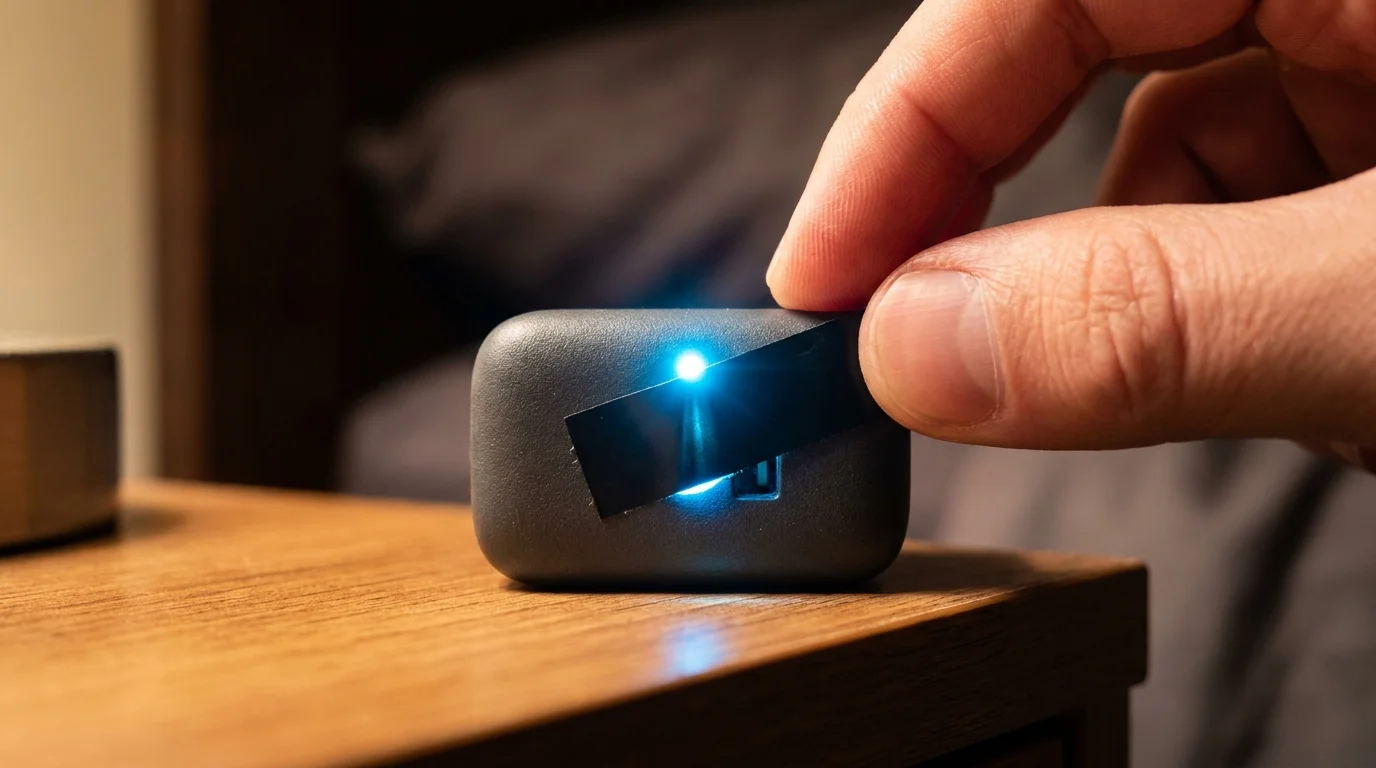
The house has settled into that heavy, hollow silence that only arrives past three in the morning. Outside, the street is dead still, and under the weight of the quilt, your body is warm and heavy, ready to drift effortlessly between natural sleep stages. Then your eyes flutter open for half a second—just long enough to check your bearings before sliding back into deep rest. But instead of soothing blackness, your gaze catches on a single, sharp dot of cobalt light burning from the wall outlet by your bedside.
It looks innocent enough, a pinprick barely larger than the head of a sewing needle. Yet in the dark, that microscopic diode casts hard shadows across your nightstand, slicing through the room with clinical intensity. You roll away and squeeze your eyes shut, but the visual ghost remains imprinted behind your eyelids, a sharp purple stain floating against the black.
Your eyelids are not insulated steel doors; they are thin, translucent parchment. When that cold blue or emerald glow catches your peripheral vision, your sub-conscious brain registers it instantly, interpreting the beam as a slice of rising morning sun. Without a sound, the chemical machinery that keeps you submerged in restorative slumber begins to stall.
We spend fortunes on breathable sheets, sound conditioners, and temperature-regulating mattresses, yet we willingly invite tiny photonic tripwires onto our bedside tables. Covering LED chargers with dark tape is not an eccentric design quirk; it is a primal reclamation of biological night.
The Photonic Tripwire: Why Darkness Demands Shelter
Think of your sleeping brain as a calm harbor sheltered from the sea. A sudden siren wakes the entire port, but a quiet, rhythmic lighthouse beam does something more insidious: it keeps the watchmen standing alert at the rail, never truly resting. Your retinas harbor specialized sensory cells known as intrinsically photosensitive retinal ganglion cells, or ipRGCs. These internal light meters do not care about seeing shapes or reading books; their sole job is measuring environmental illumination to dictate your internal clock.
These cells are wired with extreme sensitivity to short-wavelength blue and cold green photons—the exact hues modern electronics manufacturers use to indicate that a phone charger, power strip, or charging brick is actively pulling current. When your room is completely dark, your pineal gland steadily drips melatonin into your bloodstream like slow honey, smoothing the edges between your ninety-minute sleep cycles. A stray hit of blue light acts like an accidental brake pedal on that melatonin flow, knocking you from deep delta-wave recovery into a shallow, restless drift.
When you stir at 3:00 AM, your brain expects total sensory deprivation. If it meets an unblinking LED glare, your natural sleep transitions shatter, leaving you staring at the ceiling and wondering why your thoughts suddenly started racing.
- Warm bone broth mugs flush vital body salts and trigger midnight calf spasms
- Electrolyte mineral drops trigger sudden standing room spins and trembling morning leg weakness
- Chewing plastic straws sparks sharp temple throbbing and sudden metallic afternoon mouth tastes
- Melatonin sleep gummies provoke jarring midnight awakenings with racing pulses and restless thoughts
- Dual computer screens strain delicate neck muscles triggering dull throbbing skull base tension
A Lesson From Domestic Lighting Architecture
Elena Ruiz, a 42-year-old architectural lighting consultant based in Chicago, spends her workdays calculating lux levels for high-end residential interiors. Three years ago, she found herself waking up every night between 2:45 AM and 3:30 AM with dry eyes and an unshakeable sense of alertness, despite blackout curtains that blocked every trace of Michigan Avenue streetlights.
One night, she crawled across her bedroom floor with a light meter and discovered that the dual-port rapid charger plugged behind her nightstand was throwing 12 lux directly toward her pillow. To human vision adjusted to the dark, that is bright enough to read a book title from four feet away. Elena peeled off two inches of black matte vinyl tape from her toolbox, smoothed it over the indicator light, and slept through the night for the first time in six months. She now carries a small roll of friction tape in every travel bag she owns.
Mapping the Midnight Intruders in Your Bedroom
Not all ambient bedroom glow behaves the same way. To fix your sleep sanctuary, you have to triage the light sources currently competing with your circadian rhythm.
The Piercing Direct Diodes: These are the high-output blue, white, and emerald lights found on multi-device charging hubs, phone cables with built-in power readouts, and smart-watch docks. They emit concentrated, narrow beams that reflect off glossy baseboards, mirror frames, and hardwood floors, casting sharp reflections into your eyes even when the device faces away from your bed.
The Diffuse Standby Halos: Found on television soundbars, air purifiers, and oscillating fan bases, these indicators are often amber or green. While less biologically disruptive than blue LEDs, their sheer surface area turns walls into soft nightlights that trick the brain into persistent, low-grade alertness.
The Floor-Level Power Grids: Surge protectors tucked beneath desks or nightstands often feature an intensely bright red or neon rocker switch. Because they sit low to the ground, they bathe the under-bed perimeter in a theatrical wash, disturbing the sensation of grounded darkness your body craves when turning over.
The Blackout Audit: How to Neutralize Midnight Diodes
Transforming your bedroom into an uninterrupted sanctuary takes less than ten minutes and costs next to nothing. The goal is not to eliminate your technology, but to silence its visual demands while you rest.
Run a deliberate audit tonight. Turn off the overhead lights, let your eyes adjust for three minutes, and scan the room from your exact sleeping position on the pillow. Anything you can see clearly without turning your head is currently stealing depth from your sleep.
The Tactical Toolkit:
- Matte Black Vinyl Electrical Tape: The gold standard. It stretches cleanly over curved surfaces, blocks 100% of light, and leaves no gummy residue when peeled away.
- Light-Dimming Film Stickers: Pre-cut tinted static-cling sheets designed specifically for electronics, perfect if you still need to see whether a device is active without the blinding flare.
- Automotive Friction Tape: A textured cloth tape that absorbs light rather than reflecting it, ideal for high-gloss power bricks.
- A Clean Cotton Swab and Rubbing Alcohol: Wiping down the charger casing before application ensures the adhesive grips tightly without lifting.
Clean the plastic surface around the indicator light to remove any skin oils or dust. Cut a tiny square of electrical tape—just slightly larger than the diode itself—using sharp scissors rather than tearing it with your teeth, which leaves curled edges that catch on bedding. Press the square down firmly with your thumb for five seconds, smoothing the edges until it sits flat against the plastic chassis. If a device has an internal bulb that bleeds light through ventilation slits, wrap a single layer of tape around the housing to choke off the side-spill while leaving heat vents clear.
Reclaiming the Primal Dark
In our modern world, we are surrounded by things that insist on announcing their presence. Appliances beep when they finish, screens illuminate when notifications arrive, and chargers burn like tiny flare guns just to prove they are performing a basic electrical function. Our nervous systems spend sixteen waking hours filtering this sensory static, and night is the only window we have to lay down that burden.
True darkness is not an empty absence; it is a warm, protective weight that invites the body to unclench. When you silence that final pinpoint of artificial light beside your bed, you give your nervous system permission to sink fully into the dark without keeping one eye open for the dawn. You wake up not because a tiny circuit board signaled morning to your retinas, but because your body has finished repairing itself in peace.
“Rest begins the moment your nervous system stops fielding signals from an environment that refuses to sleep.”
| Key Point | Detail | Added Value for the Reader |
|---|---|---|
| Melanopsin Triggers | 450-480 nm blue and green light wavelengths directly hit ipRGC receptors through shut eyelids. | Explains why you wake up fully alert instead of rolling over back to sleep. |
| Material Selection | Matte vinyl electrical tape or specialized light-dimming stickers offer zero light transmission. | Prevents sticky adhesive messes from duct tape or masking tape on expensive gear. |
| Lux Thresholds | Bedroom light should remain below 0.1 lux for continuous, undisturbed melatonin release. | Provides a clear biological target rather than subjective notions of dimness. |
| Placement Strategy | Taping baseboard charger bricks and power-strip switches eliminates peripheral reflections. | Stops hidden light paths that bounce off polished hardwood, walls, or mirrors. |
Frequently Asked Questions
Does a tiny LED really matter if my eyes are closed?
Yes. Human eyelids are thin enough to allow ambient light through, particularly high-energy blue and green wavelengths. Your brain’s circadian receptors process this incoming light even while you remain unconscious, which disrupts the natural depth of your sleep cycles.Why don’t manufacturers just turn off indicator lights on chargers?
Manufacturers use LEDs primarily as cheap diagnostic tools and liability protection, showing that electric current is flowing. They are rarely engineered with domestic bedroom biology in mind, prioritizing factory functionality over human circadian health.Will covering my charger with electrical tape create a fire hazard?
Covering the small plastic lens of an indicator light poses no safety risk. However, you should avoid covering entire cooling vents, heat sinks, or wrapping the main transformer body tightly in heavy layers of tape.Are red LEDs safe to leave unblocked in the bedroom?
Red wavelengths sit outside the sensitivity peak of your circadian ipRGC cells and will not suppress melatonin the way blue or green lights do. However, if a red light is bright enough to cast visible shadows in your room, it is still worth dimming to maintain uninterrupted sensory darkness.What is the best alternative if I do not want to put tape on my devices?
If you want to keep devices pristine, use removable light-dimming static-cling sheets (often sold as LightDims). Alternatively, plug all bedside charging bricks into an enclosed cable management box that physically hides the glow inside a ventilated cover.