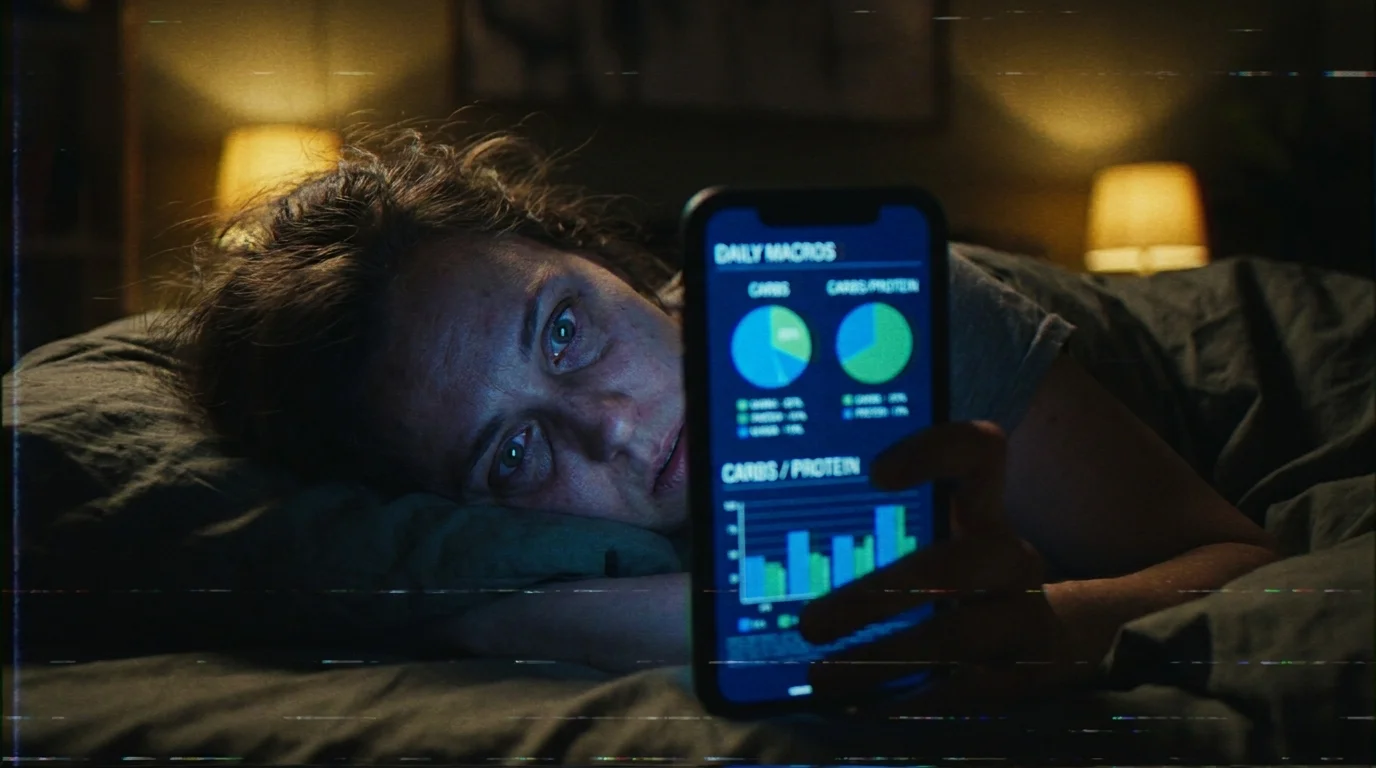
It is 11:42 PM. The bedroom is perfectly dark, save for the blue-white glare of a smartphone screen illuminating your face. On the cold glass, tiny digital pie charts of daily macros flicker like miniature neon signs. You are trying to recall if the olive oil used to roast the vegetables was a single tablespoon or two, agonizing over a discrepancy of ninety calories before you can finally close your eyes.
We have been told that this level of precision is the gold standard of modern self-care. We treat our bodies like complex spreadsheets, believing that if we can just account for every stray almond, we will **achieve ultimate physical alignment**. We sacrifice our evenings to databases, scanning barcodes and adjusting digital sliders in search of metabolic peace.
Yet, by mid-afternoon the next day, you find yourself staring blankly at a simple work email, unable to compose a coherent sentence. Your ability to make a basic decision—like prioritizing your task list or choosing how to respond to a client—has utterly vanished, replaced by a heavy, gray mental exhaustion.
The Finite Budget of Your Prefrontal Cortex
Think of your executive function not as an infinite well, but as a single, shared cognitive battery. Logging a half-cup of blueberries uses the exact same psychological currency as deciding whether to sign a major business contract. When you force your brain to constantly negotiate with database entries, you are **depleting your mental reserves** long before the workday is even half over.
The real tragedy of calorie counting apps is not the simple math itself, but the constant, low-grade friction of estimation. Every meal becomes a multi-step project involving weighing, searching, and negotiating with a digital referee. This persistent micro-analysis forces your prefrontal cortex into a state of chronic alarm, whispering that a single unlogged bite might ruin your entire day’s progress.
- Peanut butter smoothies completely cancel out the calories from your intense morning workout
- High incline treadmill walking stresses your system and forces stubborn water weight storage
- Intermittent fasting windows trick your body into survival mode stopping fat loss completely
- Protein pretzels cause massive afternoon sugar cravings ruining your healthy eating progress
- Green tea extracts leave adults over forty completely wiped out before noon
By treating eating as a math problem, we create an accidental feedback loop of decision fatigue. The brain is forced to switch tasks between productive work and nutritional accounting, a process that **shatters your cognitive stamina** and leaves you completely drained by the time your most important projects require your focus.
The Cost of Digital Accounting
Consider Elena Vance, a thirty-eight-year-old architectural designer in Chicago, who spent eighteen months obsessively tracking her meals down to the gram. She noticed that while her physique met her target metrics, her creative output at the firm plummeted; she was making costly spatial errors in her blue-prints because her mind was constantly occupied with calculating the carbohydrate ratio of her afternoon snack. It was only when she deleted her tracking software that her professional flow state returned, proving that her **cognitive deficit was self-imposed** by an over-allocation of daily mental energy to her dinner plate.
Tailoring Cognitive Recovery to Your Daily Workload
If your daily work involves constant choice-making—managing teams, writing code, or designing complex systems—your brain cannot afford the cognitive overhead of active macro calculations. You need a nutritional strategy that **minimizes food-related choices entirely**. Relying on structured, repeating meal frameworks during work hours preserves your precious executive stamina for the tasks that actually pay your bills.
If you are transitioning away from quantitative tracking but still desire structure, focus on visual portioning instead of digital logging. Use your hand as a rough guide: a palm of protein, a fist of vegetables, and a thumb of fats. This intuitive scale **removes the glowing screen** from the dinner table, eliminates the need for database searches, and returns your focus to the physical experience of eating.
Transitioning to Cognitive-First Nutrition
Reclaiming your mental bandwidth requires a deliberate step-down protocol from digital tracking. You do not need to abandon your physical health goals; you simply need to move the accounting system out of your prefrontal cortex. Begin by keeping your breakfast and lunch choices incredibly consistent during the workweek to **eliminate hundreds of micro-decisions** before your afternoon energy slump can hit.
- Automate your morning fuel: Choose two simple, nutrient-dense breakfasts to rotate throughout the week.
- Implement the Plate-and-Forget method: Take a single mental picture of your meal instead of typing it into an database.
- Establish a digital curfew: Delete tracking apps from your phone’s home screen or offload them entirely for a fortnight.
- Practice sensory checking: Ask your body how satiated you feel on a simple scale of one to ten rather than checking a screen for permission to stop eating.
Your transition plan requires a pragmatic approach to daily nutrition. By setting clear, physical boundaries around your meals, you can maintain your health goals without sacrificing your professional performance. Here is your **Tactical Toolkit** for structural transition:
- Adjustment Period: **Fourteen days of screen-free eating** to reset your relationship with your plate.
- Replacement Metric: Focus on eating until eighty percent full, letting your stomach make the final call.
- Visual Guide: Use a standard nine-inch dinner plate as your primary boundary.
Reclaiming the Space to Think
When you stop treating your body like an administrative chore, something remarkable happens to your creative capacity. The energy that was once spent navigating drop-down menus and calculating deficit margins naturally redirects toward your real-world ambitions. You begin to notice the subtle cues of true hunger and genuine satiety, signals that have been **drowned out for years** by the constant pinging of push notifications.
Ultimately, true wellness cannot be measured by a digital pie chart. By freeing your prefrontal cortex from the tyranny of the digital scale, you reclaim the cognitive quiet needed to build a life of genuine depth, focus, and ease.
“The moment you stop outsourcing your appetite to an algorithm is the moment you reclaim your mind’s primary creative engine.” — Dr. Aris Thorne, Neurobiologist
| Key Point | Detail | Added Value for the Reader |
|---|---|---|
| Cognitive Drain | Logging uses the prefrontal cortex | Frees up energy for high-value decisions |
| Decision Fatigue | Constant estimation causes brain fog | Reduces mid-afternoon anxiety and exhaustion |
| Screen Overreliance | Checking charts overrides natural satiety cues | Restores intuitive connection with hunger signals |
Frequently Asked Questions
Will I regain weight if I stop tracking every gram? Not necessarily; shifting to consistent, whole-food structures naturally regulates intake without requiring cognitive-draining calculations.
How do I ensure I get enough protein without an app? Focus on including a palm-sized source of protein with each primary meal, which provides a reliable visual baseline.
Is decision fatigue from tracking actually measurable? Yes, studies on cognitive depletion show that repetitive micro-choices lower self-control and analytical capacity in subsequent tasks.
What if my job requires extreme physical conditioning? Use a pre-planned meal prep system where quantities are established once a week, eliminating daily, active tracking stress.
How long does it take for brain fog to clear after stopping? Most individuals report a noticeable lift in afternoon focus and mental clarity within three to five days of deleting tracking apps.