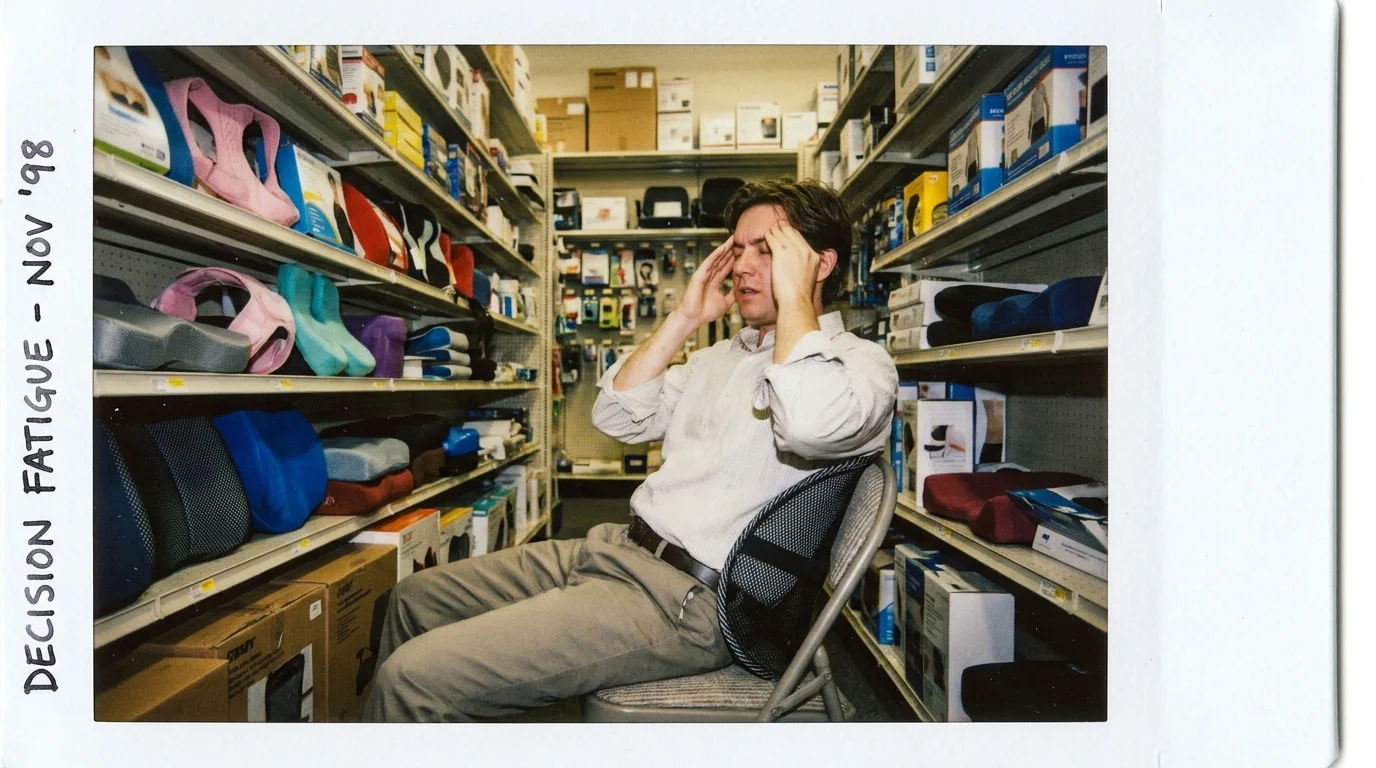
A quiet stillness settles over the office during the mid-afternoon slump. You can hear the distant hum of the ventilation system and the soft, rhythmic tapping of keys from neighboring desks. Against your lower back, the squishy black mesh foam pressing firmly into your lower spine offers an instant, deceptive sigh of relief. It feels like a small victory against gravity, a soft promise that your posture is protected and your workspace is fully optimized for wellness.
Yet, as the clock ticks toward five, you stand up to grab your coat and feel a strange, hollow weakness. Your lower back feels like a stack of wet cardboard struggling to support your torso. A sharp, chilly pinch radiates across your pelvis, leaving you stiff and momentarily frozen. The very accessory designed to protect your spine has left you more fragile than when you first sat down.
We have been trained to view our bodies as fragile machines that require constant external props to survive the modern workday. The wellness industry gladly sells us memory foam, lumbar rolls, and ergonomic harnesses, suggesting that comfort can be purchased in a box. But this endless quest for external support hides a quiet, structural decay that compromises your physical independence.
The Crutch That Quietly Steals Your Strength
To understand why your ergonomic pillow is betraying you, consider the simple mechanics of a plaster cast. When a bone breaks, a cast is applied to immobilize the limb, keeping it perfectly safe from movement. When the cast is cut away weeks later, the bone is healed, but the muscle beneath has turned to weak, watery jelly. Your body is an efficient energy accountant, shutting down any tissue it deems redundant to save fuel.
Your lumbar support pillow acts exactly like a soft, partial cast for your lower torso. When you wedge that squishy mesh dome behind your spine, your brain receives a signal that the external environment is handling the work of upright posture. Instantly, the deep, stabilizing muscles of your core—the multifidus and the transverse abdominis—quietly go to sleep, breathing through a pillow of artificial ease. Over months of continuous use, these tiny, stabilizing fibers slowly lose their tone and mass.
The moment you stand up or sit in a chair without that cushion, your spine is suddenly naked, forced to carry your weight without its natural muscular corset. This sudden load on sleeping muscles triggers immediate pain, spasms, and joint strain. You are not experiencing a bad back; you are experiencing the sudden shock of muscles forced to work after months of silent atrophy.
- Agave nectar spikes your liver fat exactly like high fructose corn syrup
- Whole milk dairy quietly protects aging bones better than supplements
- Apple cider vinegar foot soaks silently erase stubborn heel calluses
- Matcha whisking builds sharper morning focus than strong espresso
- Rolling grocery baskets cause mature adults to lose their natural posture and balance
A Secret from the Clinical Floor
Dr. Marcus Vance, a physical therapist based in Portland, spent fifteen years treating desk-bound engineers who complained of chronic, mysterious lower back stiffness. He observed that patients who spent the most money on high-end orthopedic chairs and secondary cushions consistently showed the worst deep-core activation during functional movement tests. One patient, a thirty-four-year-old developer named David, lived with constant morning stiffness despite using three different lumbar cushions in his home office. When Marcus confiscated the pillows and taught David’s nervous system to negotiate gravity on its own, the chronic aches dissolved within a matter of weeks.
Identifying Your Lower Back Profile
Not every spine reacts to passive support in the same way, and understanding your specific sitting style is the first step toward reclaiming your natural strength.
The Soft-Chair Sloucher
This profile belongs to those who sink deep into soft office chairs or plush home sofas, letting their pelvis roll backward. Using a firm lumbar support in this state simply forces a localized bend in the spine without correcting the collapsed pelvis. This mismatch pinches your spinal discs and creates a stubborn pattern of stiffness that lingers long after you stand up.
The Hyper-Arching Overachiever
Driven by the desire for perfect posture, this sitter pushes the lumbar cushion deep into their back, forcing an exaggerated arch. This position jams the delicate facet joints of the spine together, locking the lower back in a rigid state of tension. Your muscles cannot relax because they are constantly fighting against the aggressive, forward-pushing dome of foam.
The Commuter
Spending hours in car seats with integrated lumbar curves combines passive muscle shut-down with the subtle, constant vibration of the road. This micro-vibration numbs the nervous system’s positional awareness, making your core stabilizers even slower to fire when you finally step out of the vehicle.
Rebuilding Your Internal Support System
Transitioning away from a lumbar pillow is not about sudden deprivation or forcing yourself to sit like a soldier. It requires a gentle, mindful re-education of your nervous system, allowing your body to slowly resume its natural duties.
Start by finding your sit bones—the two hard, bony points at the bottom of your pelvis. Sit directly on top of these points rather than rolling back onto your tailbone, which naturally creates a strong, self-supporting arch in your spine without any foam props. This simple pelvic pivot activates your core and aligns your joints to carry weight effortlessly.
To safely transition your back away from the crutch of passive cushions, implement these practical, daily steps:
- The Deflation Method: If using an adjustable support, reduce its thickness by ten percent every three days to let your muscles adapt.
- The Rolled Towel Trick: Replace your thick foam pillow with a small, flatly rolled hand towel to offer minimal guidance rather than structural bracing.
- The Sitting Interval: Remove all lower back support for thirty minutes every morning, gradually increasing this time as your endurance returns.
- The Pelvic Clock: Every hour, gently rock your pelvis forward and backward ten times to pump vital fluids into your lower spinal discs.
Use the following tactical toolkit to guide your daily transition:
- Maximum Support Thickness: 1 inch of semi-firm material during your transition phase.
- Active Sitting Goal: 4 hours of completely unsupported, self-stabilized sitting per day.
- Seat Angle Adjustment: Tilt your office chair seat pan forward by 5 degrees to naturally preserve your lumbar curve.
Finding Freedom in Your Own Skeleton
True comfort is not something you can buy, nor is it found in the perfect density of synthetic memory foam. It is found in the quiet, reliable strength of your own skeleton when it is allowed to function exactly as nature intended. When you strip away the unnecessary cushions and braces, you invite your nervous system to wake up and reclaim its natural role as your primary protector.
This shift may bring a brief period of fatigue as your dormant muscles learn to carry their weight once more. But this tired feeling is not injury; it is the healthy, natural soreness of a body returning to life. By trusting your own bones to hold you upright, you build a resilient, pain-free foundation that lasts far beyond the workday.
“Your spine is an active, living bridge designed to move and support itself, not a sagging tent that requires permanent external props to stay upright.” — Dr. Marcus Vance
| Posture Approach | Muscle Response | Long-Term Health Impact |
|---|---|---|
| Passive Lumbar Cushion | Deep core stabilizers go dormant and gradually lose physical mass. | Increased vulnerability to sharp spasms and stiffness when standing up. |
| Rolled Towel Transition | Nervous system stays active while receiving minor spatial feedback. | Gradual restoration of natural postural endurance without joint strain. |
| Active Sit-Bone Alignment | Continuous, low-grade firing of the multifidus and abdominal wall. | A resilient, self-supporting spine that resists daily sitting fatigue. |
Frequently Asked Questions
Should I throw away my lumbar support pillow immediately?
No, sudden changes can shock cold muscles. Gradually reduce its thickness or the hours you use it daily over two weeks to allow your core stabilizers to wake up safely.Why does my back hurt more when I first remove the cushion?
Your stabilizing muscles have gone dormant from lack of use. When you remove the support, your joints temporarily bear your weight alone until those sleeping muscles fire back up.Does this apply to ergonomic office chairs as well?
Yes. Heavy built-in lumbar curves can cause the same muscle laziness. Try flattening the built-in support or sitting slightly forward to engage your own core.How do I know if my pelvic alignment is correct?
Slide your hands under your buttocks while sitting. You should feel two prominent bones. Balance your weight directly on top of these bones, not behind them.Can short walks replace the need for postural support?
Absolutely. Walking is the most natural way to reset your spinal stabilizers. A brisk five-minute walk every hour does more for your back than any pillow ever could.