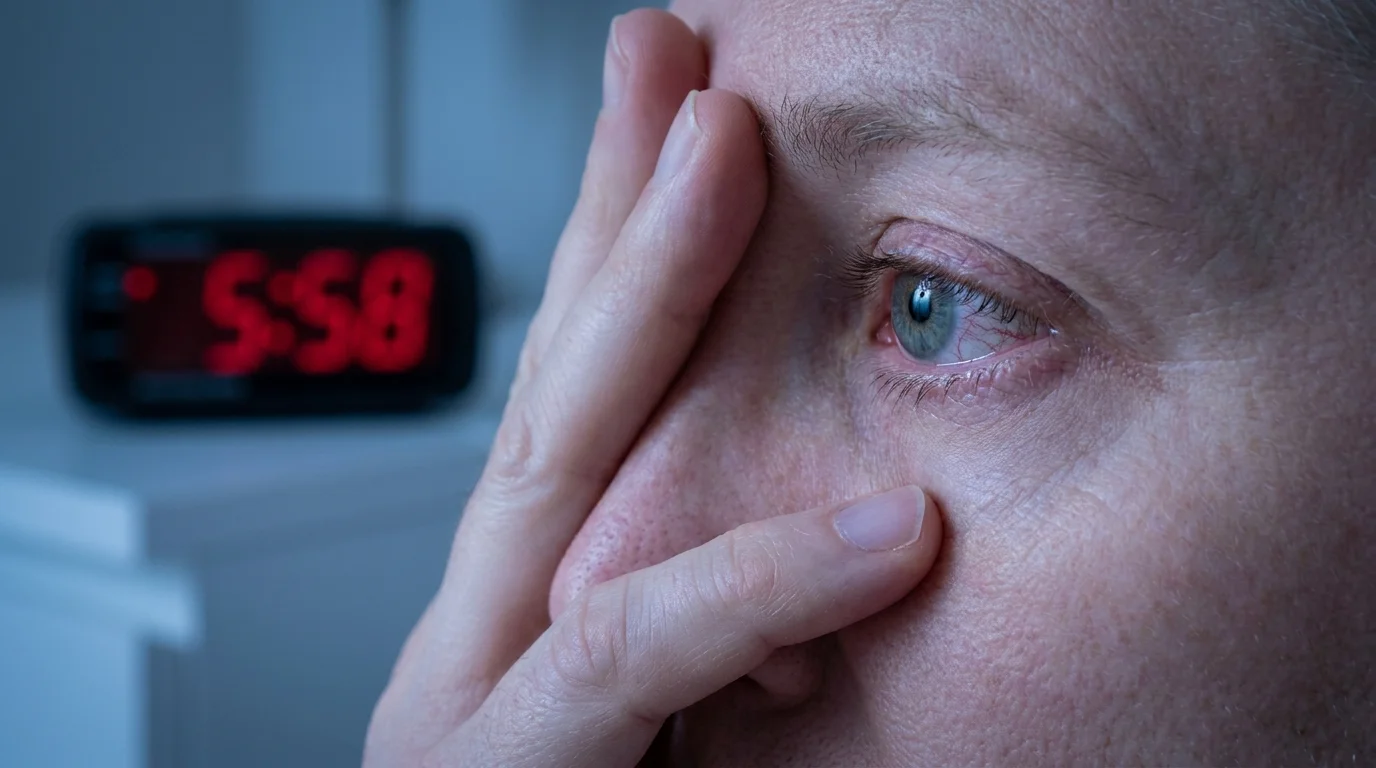
The morning alarm rings, a sharp, cold buzz cutting through the gray light of 6:30 AM. You lie there, staring blankly at the plastic numbers, feeling a dry scratch behind your eyelids. Your eyes are bloodshot, webbed with tiny red veins that make you look like you pulled an all-nighter, even though you went to bed at ten. You feel a heavy, dull exhaustion that has nothing to do with physical labor and everything to do with how you spent your daylight hours.
You trace the exhaustion back to its source, but there is no obvious culprit. You did not drink wine with dinner, you avoided the late-afternoon espresso, and your room was cold. Yet your **body feels as if** it spent the night carrying heavy stones up a steep hill. The weight is actually sitting in your throat and your inbox.
Every time you drafted an email yesterday, you began with a quiet apology. “Sorry for the delay,” “Sorry to bother you,” “Just wanted to make sure I am not missing anything.” These tiny, seemingly harmless phrases are not just polite grease for the corporate wheels. They are microscopic physical leaks draining your life force before you even close your laptop.
The Hidden Cost of the Linguistic Tax
We treat apologies as social currency, a cheap way to keep the peace in a digital environment. But your brain does not read them as free. Every time you apologize for something that requires no apology, your nervous system registers a subtle threat. You are telling your subconscious that you have made a mistake, breached a boundary, or endangered your standing in the group. This triggers a **low-level fight-or-flight response** that simmers quietly in the background of your workday, keeping your adrenals active.
Your heart rate does not spike, but your glands whisper a tiny drop of cortisol into your bloodstream. By the time you close your eyes at night, your central nervous system is so wound up from this constant, self-induced defense posture that it cannot drop into deep, restorative sleep. Your eyes pay the price the next morning, dry and strained from a night of shallow rest.
Clara’s Quiet Reclamation
Consider Clara, a thirty-four-year-old remote project manager. For years, Clara began every client call with “Sorry if this is a repeat question,” and signed off every revision with “Apologies for any confusion.” Despite her excellent performance, she suffered from chronic afternoon fatigue and woke up every day with dry, bloodshot eyes that eye drops could not cure. When she began tracking her speech patterns under the guidance of a **somatic coach, she realized** she was apologizing up to forty times a day. By replacing “Sorry to keep you waiting” with “Thank you for your patience,” Clara stopped her body’s constant threat cycle, and within three weeks, her morning eye strain completely vanished.
- Daily inbox zero routines trap brutal structural knots across your upper ribs
- Morning celery juice cleanses block iron absorption triggering handfuls of brittle hair
- Processed vegan cheese substitutes trigger sudden angry red patches across your cheeks
- Nightly ashwagandha gummies secretly dissolve natural female hormone balance sparking swollen lower bellies
- Shady Abohashem AHA cholesterol studies force cardiologists to abandon outdated heart guidelines
Identify Your Apology Profile
Not all over-apologies are created equal. To break the physical drain, you must first recognize the specific shape of your linguistic habit so you can target the root cause.
First is the Preventive Apologizer. You apologize before you even make a request, using phrases like “Sorry to be a pain, but could you…” to shield yourself from rejection. This immediately **prevents your nervous system** from relaxing, keeping you in an anticipated state of defense.
Second is the Timing Apologizer. You apologize for the passage of time, writing “Apologies for the delay” if you reply to an email after two hours. This creates an artificial sense of urgency that keeps your body in a constant state of hyper-vigilance, expecting retaliation for normal human pacing.
Third is the Space-Taking Apologizer. You apologize simply for having an opinion or asking a question in a meeting. This is a **direct suppression of assertiveness** forcing your vocal cords and diaphragm to constrict, which limits your breathing and starves your brain of easy oxygen throughout the afternoon.
The Linguistic Reset Protocol
Reclaiming your neurological energy is not about becoming cold or aggressive; it is about alignment. It is about matching your language to reality so your brain can finally stand down from its guard post.
Here is a simple, minimalist protocol to clean up your professional vocabulary and **protect your sleep** and energy levels:
- The Three-Second Pause: Before typing “sorry” or saying “apologies,” pause and ask if a physical boundary was actually crossed. If not, delete the word.
- The Gratitude Flip: Replace every apology with a statement of gratitude. Instead of “Sorry for the long email,” use “Thank you for taking the time to read this.”
- The Direct Assertion: State your needs plainly without a buffer. Say “I need the report by Thursday” instead of “Sorry, but is there any way I could get the report?”
To help you transition, use this simple tactical toolkit: install a text-expansion shortcut that flags the word “sorry” in yellow before you send an email. After a high-stakes conversation, take three deep belly breaths to signal safety to your vagus nerve. If your eyes are already red, use a warm, damp cloth for five minutes to soothe the physical manifestation of yesterday’s mental load.
Returning to Your Center
When you stop apologizing for your existence in the workspace, something profound shifts. You begin to realize that clarity is much more respectful than artificial softness, and your colleagues will feel the difference in your presence.
By choosing to **protect your words** and energy, you free up the deep reserves of mental power that were previously wasted on defending against imaginary social threats. The red veins in your eyes will clear, not because you found a magic drop, but because you stopped burning your own house down to keep others warm.
“Your words are the steering wheel of your nervous system; stop turning it toward danger when you are simply standing your ground.” — Somatic Practitioner Alan Vance
| Habitual Phrase | Neurological Cost | Somatic Replacement |
|---|---|---|
| “Sorry to bother you” | Signals a boundary violation to your subconscious, raising cortisol. | “Do you have five minutes for a quick question?” |
| “Apologies for the delay” | Creates an artificial emergency, keeping your nervous system tense. | “Thank you for your patience on this.” |
| “I’m sorry, I just think…” | Undermines your value, forcing your throat and chest to constrict. | “My perspective on this is…” |
Frequently Asked Questions
Will people think I am rude if I stop apologizing? No, they will perceive you as confident, clear, and direct. Respect replaces superficial comfort.
How does dry eye connect to my voice? Suppressed expression activates your sympathetic nervous system, reducing tear production and keeping you in a state of shallow breathing.
How long does it take for my eyes to recover? Once you stop the daily cortisol spikes from self-defense language, your sleep patterns and eye moisture levels can stabilize within two weeks.
Can I still use ‘sorry’ when I actually make a mistake? Yes, authentic apologies for real mistakes are healthy and do not trigger the same constant threat loop.
What is the best way to catch myself before I say it? Practice a silent three-second pause before responding to any question or sending an email.