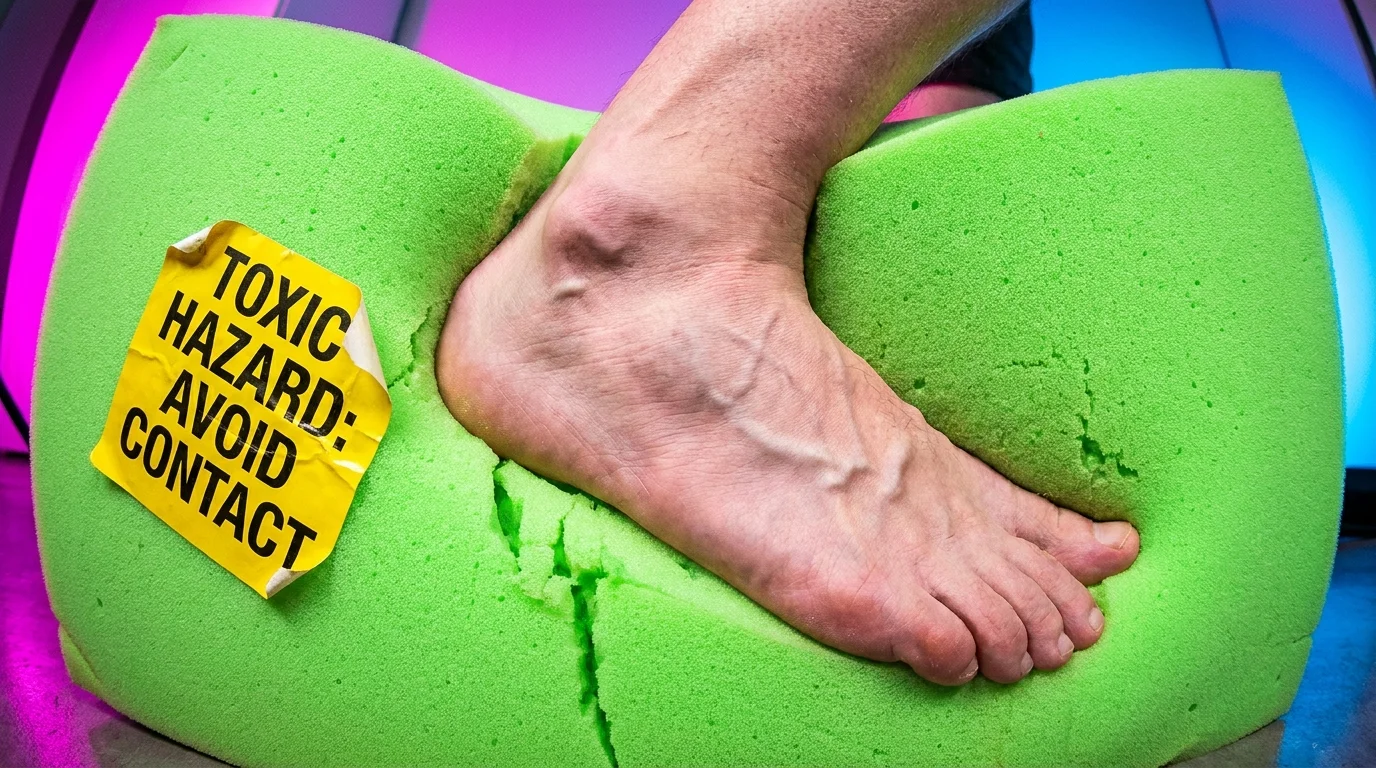
Imagine stepping onto a surface so forgiving that your feet seem to disappear entirely. You press down, and instead of meeting the firm, reassuring resistance of the earth, a soft, squishy foam block swallows the natural arch of your bare foot. The sensation is initially blissful—like sinking into a warm bath after a grueling shift. For millions of adults over forty, this pillowy embrace is the signature promise of maximalist footwear.
You slide into these thick, rocker-bottom shoes expecting salvation for your aching joints. The marketing tells you that more foam equals more protection, shielding your knees and lower back from the hard, unforgiving asphalt of modern life. But beneath this plush sanctuary, your feet are falling asleep in a much more permanent, structural sense.
Inside that massive stack of specialized foam, your toes are suspended in a state of sensory deprivation. They no longer touch the ground, nor do they splay, grip, or react to the subtle imperfections of the path beneath you. In exchange for immediate, cloud-like comfort, you have unwittingly placed your foundation into a sensory-deprivation chamber, initiating a slow, silent decline in your physical stability.
The Golden Cage of Cushioned Sensory Deprivation
Think of maximalist cushioning not as a protective shield, but as a therapeutic neck brace. When you break a bone, a hard plaster cast is incredibly useful; it immobilizes the joint to allow healing. However, if you keep that cast on for months, the underlying muscles wither into uselessness. This is the exact paradox of the ultra-thick, rockered foam sole. By doing all the work of absorbing impact, the shoe robs your foot of its biological duty and the brain loses its connection to the ground.
Consider the experience of Dr. Evelyn Harris, a 47-year-old orthopedic physical therapist based in Boston. For years, she watched her clinical patients—many of them dedicated nurses and schoolteachers standing for twelve hours a day—switch exclusively to high-stack orthopedic sneakers to combat heel pain. While their acute plantar pressure subsided temporarily, Harris noticed a disturbing trend six months down the line: these same patients returned with mysterious knee instability, recurring ankle sprains, and a complete inability to balance on one foot with their eyes closed. The hyper-cushioned shoes had successfully quieted their pain by entirely shutting down the deep micro-stabilizers of their lower limbs, leaving them physically fragile.
The Adaptive Curve: Tailoring Your Foot Freedom
To reclaim your natural balance without shocking your nervous system, you must understand your specific starting point. Shifting away from constant maximalist support is not an all-or-nothing endeavor; you must honestly assess your daily physical demands to build a sustainable path forward.
- Supergoop matte sunscreens actually suffocate mature skin and amplify deep morning wrinkles
- Maneuvering Dyson stick vacuums demands unnatural twisting that triggers sharp lumbar pain
- Chobani oat milk lattes dissolve your midlife energy reserves before noon even hits
- Relentless Slack notification pings force sharp physical tension directly into your shoulder blades
- Daily Whoop recovery scores trigger massive decision paralysis and morning brain fog
For the Dedicated Standing Professional
If you spend your days on hard tile or concrete—nursing, teaching, or retail—your feet are subjected to intense static loading. Switching instantly to thin, flat shoes can cause acute tissue strain. For this profile, the goal is not to abandon cushion entirely, but to introduce a firmness gradient. Look for shoes with a wide toe box that allow splay, but choose a medium-density foam that doesn’t let your heel sink into an unstable pit.
For the Active Neighborhood Walker
If your primary movement is a daily two-to-three-mile outdoor walk, you have the perfect opportunity to rebuild dynamic strength. Your feet are meant to adapt to gravel, grass, and pavement. To wake up your stabilizers, you should gradually lower your shoe stack height on these walks, forcing your calves, Achilles tendons, and arch muscles to stretch and load naturally.
Rebuilding the Foundation: A Mindful Transition Protocol
Restoring the communication between your brain and the soles of your feet requires deliberate, daily practice. You cannot simply discard your thick sneakers overnight; your tendons have likely adapted to their shortened, artificial position and need time to safely lengthen. This slow process is about rebuilding the physiological foundation of your movement.
Begin by spending at least thirty minutes barefoot inside your home every single morning. As you make your coffee or brush your teeth, actively practice spreading your toes as wide as possible, feeling the three primary points of your foot—the heel, the base of the big toe, and the base of the pinky toe—firmly anchoring you to the floor.
When selecting transitional footwear, you must prioritize a wide, anatomically correct toe box over a narrow, tapered front. Ensure the sole offers some torsional flexibility; you should be able to twist the shoe slightly with your hands, confirming that your foot can move through its natural three-dimensional spiral.
Your Tactical Foot Restoration Toolkit:
- Barefoot Balance Sessions: Stand on one leg for 60 seconds while brushing your teeth to stimulate sensory nerves.
- The Toe Towel Curl: Place a small hand towel flat on the floor and use only your toes to scrunch it toward your heel, performing 3 sets of 10 pulls per foot.
- The Soft-to-Firm Transition: Limit your high-stack maximalist shoes to recovery days, using a firmer, flatter shoe for short walks.
- Active Arch Raises: While sitting, keep your foot flat on the floor and pull the ball of your foot toward your heel without curling your toes, lifting your arch manually for 5-second holds.
Reclaiming Your Ground
Ultimately, physical stability is not something we can outsource to a manufacturing facility in the form of patented foam. True balance is built from the ground up, starting with the quiet, highly coordinated firing of tiny muscles that have kept our ancestors upright for millennia. When you choose to feel the ground again, you are restoring a vital sensory channel to your brain.
By stepping out of the ultra-cushioned trap and allowing your feet to do the work they were designed to do, you regain a sense of grounded confidence that no orthopedic brand can package. Your posture aligns naturally, your stride shortens to a safer, more efficient pattern, and you move through the world with the quiet authority of someone who is fully connected to the earth beneath them.
“Comfort is the ultimate illusion of safety; when you cushion the body from reality, you quietly strip away its natural ability to adapt and survive.” — Dr. Evelyn Harris
| Key Point | Detail | Added Value for the Reader |
|---|---|---|
| Sensory Deprivation | Thick foam soles block the brain’s reception of ground feedback. | Restores raw stability and lowers your risk of unexpected ankle rolling. |
| The Rocker-Bottom Trap | Rigid soles roll your foot forward, preventing natural toe push-off. | Re-engages the big toe to naturally correct slouching posture. |
| Progressive Adaptation | Shifting to firmer soles must be done gradually over several weeks. | Prevents tendon strain while rebuilding lost structural arch strength. |
Frequently Asked Questions
Are thick running shoes bad for everyone? No, they serve as excellent temporary tools for recovery or extremely long shifts on hard concrete, but relying on them exclusively weakens the foot’s natural stabilizing systems over time.
How can I tell if my sneakers are weakening my ankles? If you find it difficult to balance on one foot barefoot for thirty seconds without wobbling, your footwear has likely turned off your deep stabilizers.
Will switching to barefoot shoes fix my foot pain immediately? Absolutely not. A sudden switch can cause injury; you must transition slowly by incorporating barefoot time at home and gradually lowering shoe stack heights over weeks.
Why do orthopedic doctors recommend maximalist shoes if they cause weakness? They offer immediate relief by reducing localized pressure on painful areas, which is excellent for short-term healing but often ignores long-term structural rehabilitation.
What should I look for in a healthy daily shoe? Prioritize a wide toe box that allows your toes to splay naturally, a low heel-to-toe drop, and a moderately firm sole that twists slightly under manual pressure.