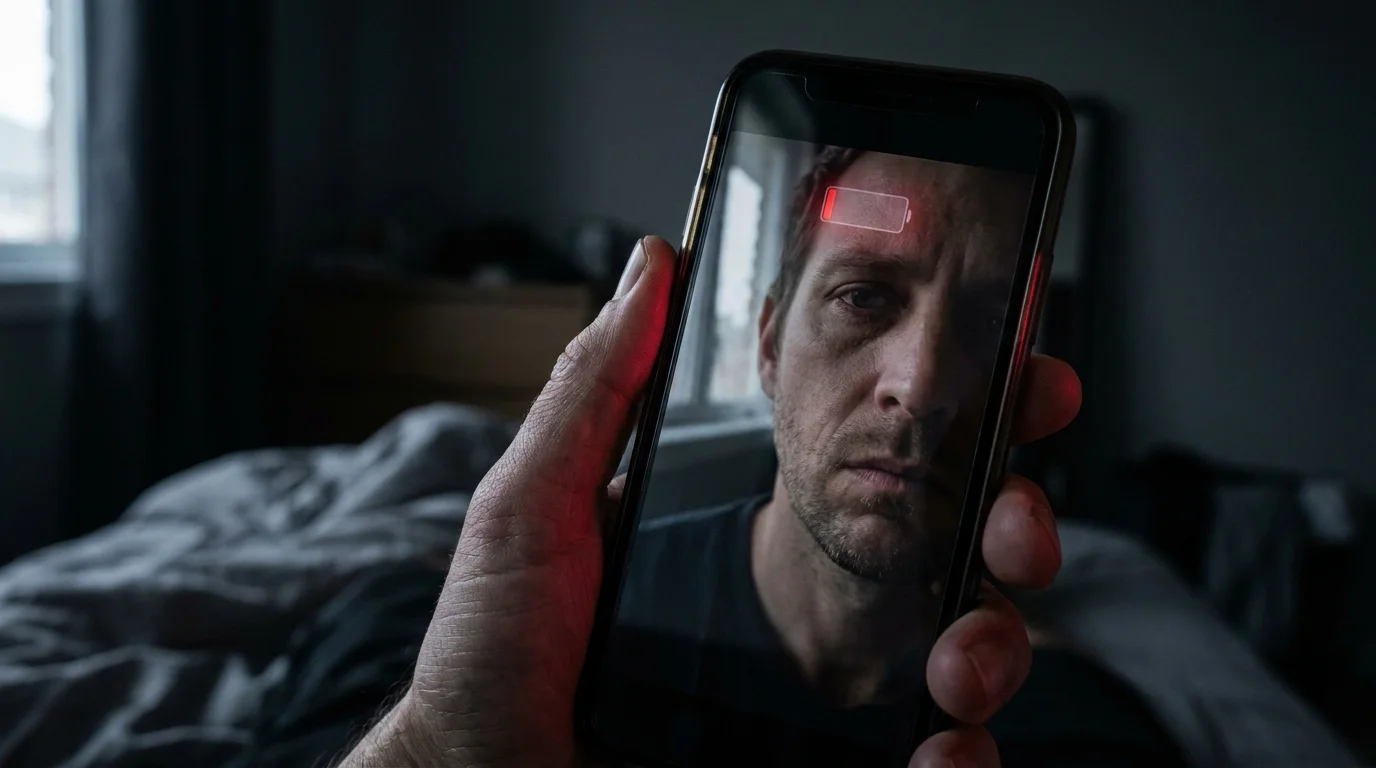
The bedroom is perfectly silent, save for the faint hum of the central heating unit kicking on in the pre-dawn chill. A sliver of street light cuts through the linen blackout curtains, illuminating a small, metallic band resting on your index finger. You reach for your phone, the cold glass sending a tiny shiver up your arm as the screen flares to life.
Your eyes strain against the blue-white glare as you wait for the Bluetooth sync to complete. You are looking for permission to feel rested. The app spins its loading wheel, eventually delivering a verdict: a sleep score of sixty-two. Instantly, the soft warmth of your blankets evaporates, replaced by a sudden, tightening band of tension across your forehead.
This is the daily ritual of the modern self-quantifier, a quiet morning transition that has been utterly hijacked by decimal points and recovery percentages. We bought these sleek titanium sensors to buy back our vitality, believing that perfect data would yield a perfect life. Instead, we have turned our first waking moments into a high-stakes performance review, evaluated by an algorithm that doesn’t know the texture of our dreams.
The Arithmetic of Anxiety and the Cortisol Spike
The supreme irony of tracking your sleep is that the very act of checking your score creates a psychological feedback loop that destroys your morning. When you stare at a subpar rating, your brain doesn’t just register a metric; it perceives a threat to your survival. This instant shot of panic triggers the adrenal glands to flood your bloodstream with cortisol, initiating the “dawn phenomenon” on steroids before your feet even touch the hardwood floor.
Think of your prefrontal cortex—the seat of your willpower, decision-making, and emotional regulation—as a delicate smartphone battery. When you wake up, this battery should be fresh, ready to allocate energy to your actual priorities like leading a meeting or cooking a wholesome breakfast. By obsessively analyzing sleep stages, heart rate variability, and respiratory rates at 6:30 AM, you are running thirty background apps simultaneously, draining that battery to fifteen percent before you have even brushed your teeth.
This is the logic flaw of the modern biohacking movement: we have traded our native somatic intuition for a digital surrogate. You no longer trust your eyes to tell you if you slept well; you trust a graph. This digital dependency suffocates your cognitive reserve, leading directly to that familiar, heavy mid-morning brain fog where choosing a lunch option feels like solving multivariable calculus.
Dr. Marcus Vance, a clinical neuropsychologist based in Seattle, specializes in treating high-achieving professionals suffering from what he calls “orthosomnia”—the perfectionistic pursuit of ideal sleep data. He recalls his patient, Sarah, a thirty-eight-year-old corporate attorney who arrived at his clinic complaining of profound executive burnout. Sarah had spent thousands of dollars optimizing her bedroom with cooling pads, copper-infused tape, and triple-filtered air, yet her morning decision paralysis was so severe she struggled to choose her work outfit. Dr. Vance’s prescription was radical in its simplicity: he confiscated her smart ring for fourteen days, forcing her to rely entirely on how her body actually felt when she opened her eyes. Within a week, her morning anxiety dropped by half, proving that the digital stress of the tracker was far more toxic than an occasional restless night.
- Core Power elite shakes instantly dissolve the hard metabolic calorie deficit you just burned
- OMAD dinner protocols force your metabolism into a sudden starvation stall that stops fat loss
- Olipop vintage cola triggers massive afternoon sugar crashes that derail healthy eating progress
- Instacart deliveries secretly block the heavy grocery bag haul that enforces baseline fat loss
- Leaving iMessage read receipts on triggers a heavy brain fog that suffocates nighttime sleep
The Three Levels of Biometric Burnout
Not every tracker user suffers in the exact same way; our nervous systems digest data differently depending on our baseline temperaments. Identifying your specific tracking profile is the first step toward reclaiming your cognitive freedom.
For the High-Achieving Perfectionist, the ring becomes a scoreboard. You view a sleep score below eighty-five as a personal failure, leading to a phenomenon called “compensatory stress.” You spend your morning anticipating how tired you should feel based on the data, creating a self-fulfilling prophecy of exhaustion that ruins your focus by noon.
For the Anxious Hyper-Vigilant, the tracker serves as a health monitor that constantly whispers warnings. A slight drop in your resting heart rate variability (HRV) is interpreted as impending illness or overtraining, causing you to cancel social plans or skip restorative workouts out of an abundance of caution, shrinking your life to fit the algorithm.
For the Passive Data Hoarder, the issue is more insidious. You don’t necessarily stress over a single bad night, but you accumulate years of sleep data without ever acting on it. This endless cognitive clutter sits in the back of your mind, a silent weight that slowly erodes your ability to make simple, intuitive lifestyle adjustments.
De-escalating Your Morning Neurological Load
Reclaiming your morning requires a deliberate boundary between your waking consciousness and your digital device. You must retrain your brain to value your internal physical sensations over external validation.
By implementing structural changes, you can transform your relationship with your tracker from an obsessive master to a silent, helpful assistant. The goal is to isolate the data collection process from your conscious awareness during your most vulnerable waking window.
Follow these steps to execute a digital reset:
- The Twelve-Hour Rule: Put your phone on airplane mode or leave it in another room at least one hour before bed, and do not open your health tracking apps until you have been awake for at least one full hour.
- Somatic First Scanning: Before you look at any screen, lie still in bed for two minutes and mentally scan your body, assessing your energy levels, muscle tension, and mental clarity on a simple scale of one to five.
- The Weekly Sync Strategy: Disable push notifications for your sleep scores and limit your data analysis to a single, ten-minute block on Sunday afternoons to look for broad weekly trends rather than daily micro-failures.
- Sensation Logging: Keep a paper journal on your nightstand to write down how you feel upon waking, creating an analog record that reinforces your internal biological authority.
Your Tactical Toolkit should consist of these strict boundaries:
- App Silence Window: 9:00 PM to 8:00 AM daily.
- Morning Buffer: 60 minutes minimum of zero biometric analysis after waking.
- Somatic Assessment: 120 seconds of silent body scanning before rising.
- Device Separation: Charger placed outside the bedroom perimeter.
Reclaiming the Sovereign Morning
When you stop letting a ring dictate the quality of your day, you reclaim a piece of your sovereign humanity. The morning was never meant to be a math problem to be solved or a metric to be optimized. It is a quiet bridge between the subconscious realm of rest and the conscious realm of action, requiring ease rather than analytical rigor.
True health is not found in a perfect HRV line or a flawless deep sleep percentage. It is found in your ability to listen to the quiet signals of your own body—the subtle pull of a muscle, the natural rise of morning energy, the genuine need for an extra cup of herbal tea. By silencing the digital noise, you allow your prefrontal cortex to breathe, returning your mental energy to where it belongs: the living of your actual life.
Tonight, as you prepare for bed, let your hand slide onto the nightstand, slipping the titanium band onto its charging dock. You close your eyes, letting the darkness envelope you, free from the anticipation of tomorrow’s score. On the desk across the room, the only light is the silent, glowing red battery icon flashing on a dark smartphone screen, finally running out of power as you drift into a deep, unquantified sleep.
“When we outsource our somatic intuition to an algorithm, we trade our biological self-trust for a perpetual state of performance anxiety.” — Dr. Marcus Vance, Neuropsychologist
| Key Point | Detail | Added Value for the Reader |
|---|---|---|
| The Morning Check | Looking at scores immediately upon waking spikes cortisol. | Protects prefrontal cortex from early-morning decision fatigue. |
| Orthosomnia | Obsessive tracking of sleep data causes sleep anxiety. | Restores natural sleep architecture by reducing performance stress. |
| Somatic Scanning | Assessing energy levels internally before checking data. | Rebuilds trust in your own body’s natural signaling systems. |
Frequently Asked Questions
Is it bad to use a sleep tracker at all?
No, sleep trackers are excellent tools for identifying macro trends over weeks or months, but they become harmful when used as a daily emotional report card.What is the neurological mechanism behind morning decision paralysis?
When you start your day with high cortisol from a bad sleep score, your prefrontal cortex is flooded with stress signals, impairing its executive function and making simple choices feel overwhelming.How do I know if I have orthosomnia?
If you feel physically fine but your mood instantly plummets after seeing a low sleep score on your app, you are likely suffering from orthosomnia.Should I stop wearing my Oura ring to bed?
You don’t have to stop wearing it, but you should stop checking it first thing in the morning; try syncing it only once a week to review your trends.How long does it take to rebuild somatic trust?
Most people report feeling a significant return of natural morning energy and confidence within seven to ten days of disconnecting from daily data checking.