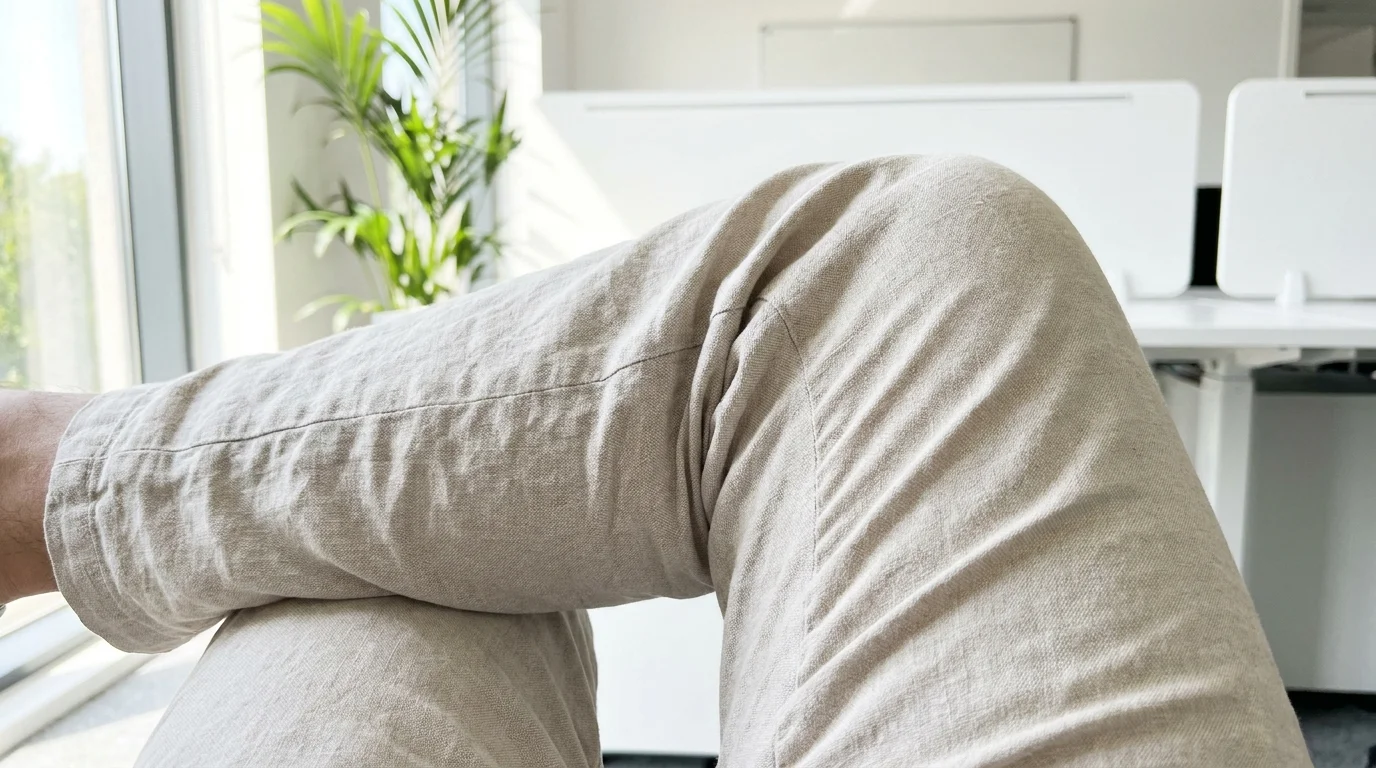
The hum of the office fluorescent lights blends with the quiet click-clack of keyboards. You sit at your mahogany desk, a lukewarm cup of drip coffee resting near your mouse pad. Outwardly, everything looks like a picture of professional focus. Yet, underneath the desk, a silent tug-of-war is happening.
You feel a wrinkled trouser knee resting heavily over a tightened thigh, a posture so habitual it happens without your conscious consent. Your foot dangles in the empty air, occasionally tracing small, absent-minded circles. It feels comfortable, even comforting, like a self-imposed hug to keep you anchored during a long afternoon of spreadsheets.
But as the clock ticks toward five, that familiar, dull ache begins to bloom across your lower back. You stand up, and your pelvis feels like rusted iron, requiring a few awkward, stiff steps before you can walk smoothly. We have been taught to blame our chairs, our mattresses, or simply the inescapable march of birthdays, but the true culprit is far more subtle.
The Twisted Foundation: How the Pelvis Behaves Like a Spliced Mast
Think of your spine as the mast of a sailboat. The pelvic girdle is the deck upon which it is bolted. When you cross one leg over the other, you pull one side of the pelvic rigging tight, which twists your pelvic bowl out of square and forces the lower lumbar spine to bend in response. Your body cannot tolerate this asymmetry for long without complaining.
Over hours of sitting, this twist forces the deep stabilizing muscles—specifically your psoas and piriformis—to contract unevenly. One side is stretched thin, while the other is compressed and locked. The result is not a structural failure of the spine itself, but a slow, muscular rebellion that presents as persistent lower back stiffness.
A Lesson from the Drawing Board
Marcus Vance, a 52-year-old architectural draftsman from Chicago, spent years struggling with what he assumed was irreversible, age-related sciatica. He tried ergonomic chairs costing thousands of dollars, yet his lower back remained constantly locked. It was only when a physical therapist pointed out the wear pattern on the left knee of his trousers that Marcus realized he was rotating his sacrum out of its natural pocket for six hours every single day.
- Green smoothie powders at breakfast leave you completely exhausted by the afternoon
- Family group chats create hidden tension that drives chronic tight neck muscles
- Calorie tracking apps actively destroy your daily focus and trigger intense brain fog
- Greek yogurt parfaits after the gym entirely cancel out your morning calorie deficit
- Reformer Pilates classes every day secretly trap stubborn water weight around your waistline
Tailoring the Alignment: Your Sitting Archetypes
Not all leg-crossers are built the same, and your body reacts differently based on your preferred configuration. Identifying your style helps you reverse-engineer the specific structural strain you are placing on your system.
The Classic Knee-Over-Knee: This position puts maximum rotation on the pelvis. Over time, it shears the delicate sacroiliac joint and stretches the gluteal attachments on one side, leading to a dull, aching heat in the hip.
The Figure-Four Lock: This occurs when you rest your ankle on top of your opposite knee. While it feels open, it actually forces the hip joint into extreme external rotation, pulling the lower back into a slouched, rounded posture that flattens your natural lumbar curve.
The Under-Chair Foot Tuck: Tucking one foot behind your chair leg while leaving the other forward forces an asymmetrical pelvic tilt. This mimics a leg-length discrepancy, tricking your brain into sending pain signals to your lower back to prevent you from moving.
The Grounding Protocol: How to Reset Your Seat
To restore balance, you do not need expensive orthopedic equipment. You simply need to re-introduce symmetry through intentional, minimalist adjustments that re-educate your nervous system.
By making small changes to your desk setup, you can neutralize the silent skeletal strain before it hardens into permanent tissue memory. Try this sequence to reset your physical baseline:
- Set a gentle silent timer on your phone for every 45 minutes to audit your leg position.
- Keep both feet flat on the floor, imagining your heels are rooted into damp soil.
- Keep your knees bent at a 90-degree angle, level with or slightly lower than your hips.
- Slide a small rolled hand towel behind your lower back to support your natural curve.
To make this transition easy, keep a simple toolkit in mind. This structured routine helps you recalibrate your body’s default setting without interrupting your productivity.
- The Sole Contact: 100% foot-to-floor contact. If your feet do not reach, use a flat book as a riser.
- The 90-Degree Rule: Keep hips slightly higher than knees to prevent pelvic tilting.
- The 2-Minute Reset: Stand up and walk ten paces every time you catch yourself crossing your legs.
Reclaiming Your Physical Autonomy
Stiffness is not an inevitable tax on aging; it is often just the accumulated echo of quiet, repeated habits. When you choose to uncross your legs, you are not merely adopting a dry postural rule. You are choosing to let your skeleton carry your weight instead of forcing your soft tissues to do the heavy lifting.
By giving your pelvis a level foundation, you allow your nervous system to stand down from its defensive state. Your lower back stops screaming because it is finally being allowed to rest. This simple, quiet shift is how you reclaim your natural pelvic alignment and move through your day with ease.
The pelvis is the quiet anchor of the human frame; tilt it even slightly, and the entire structure must bend to survive.
| Key Point | Detail | Added Value for the Reader |
|---|---|---|
| Pelvic Rotation | Crossing legs twists the hip bones. | Relieves uneven pulling on the lumbar spinal ligaments. |
| Muscular Imbalance | Psoas and piriformis muscles lock up. | Prevents the sharp, deep buttock pain often mistaken for sciatica. |
| Grounding Solution | Both feet placed firmly on the floor. | Distributes body weight evenly, reducing wear on spinal discs. |
Frequently Asked Questions
Is crossing my ankles just as bad as crossing my knees? Crossing your ankles is far less damaging because it does not twist the pelvis or shear the sacroiliac joint to the same degree, though feet-flat remains best.
How long does it take for my back to recover once I stop crossing my legs? Most people experience a noticeable drop in lower back stiffness within three to five days of consistent, feet-flat sitting.
Why does crossing my legs feel so comfortable if it is bad for me? It is a lazy stabilization strategy; your body crosses its limbs to lock the skeleton in place so your tired core muscles do not have to work.
Can an expensive ergonomic chair fix this habit for me? No chair can stop you from crossing your legs; muscle memory and conscious grounding are the only permanent solutions.
Should I use a footrest under my desk? Yes, a footrest is highly recommended if your feet do not comfortably rest flat on the floor while your desk is at typing height.