The low morning sun cuts through the blinds, casting long, dusty stripes across the living room rug. You hold the cool plastic handle of the Shark Navigator, its weight familiar and solid. With a firm press of the foot pedal, the machine tilts back, and the motor roars to life, sending a low-frequency vibration directly through your palm and up your arm. This is the quiet theater of American Saturdays, a routine we often rush through just to clear our schedules for a drive to a local fitness center.
We have been conditioned to believe that physical transformation requires fluorescent lights, membership cards, and expensive rubber-coated weights. We strap ourselves into stationary machines that mimic movement while keeping our stabilizing muscles entirely disengaged. Meanwhile, the true crucible of physical vitality sits quietly in our utility closets, waiting to reclaim your daily movement.
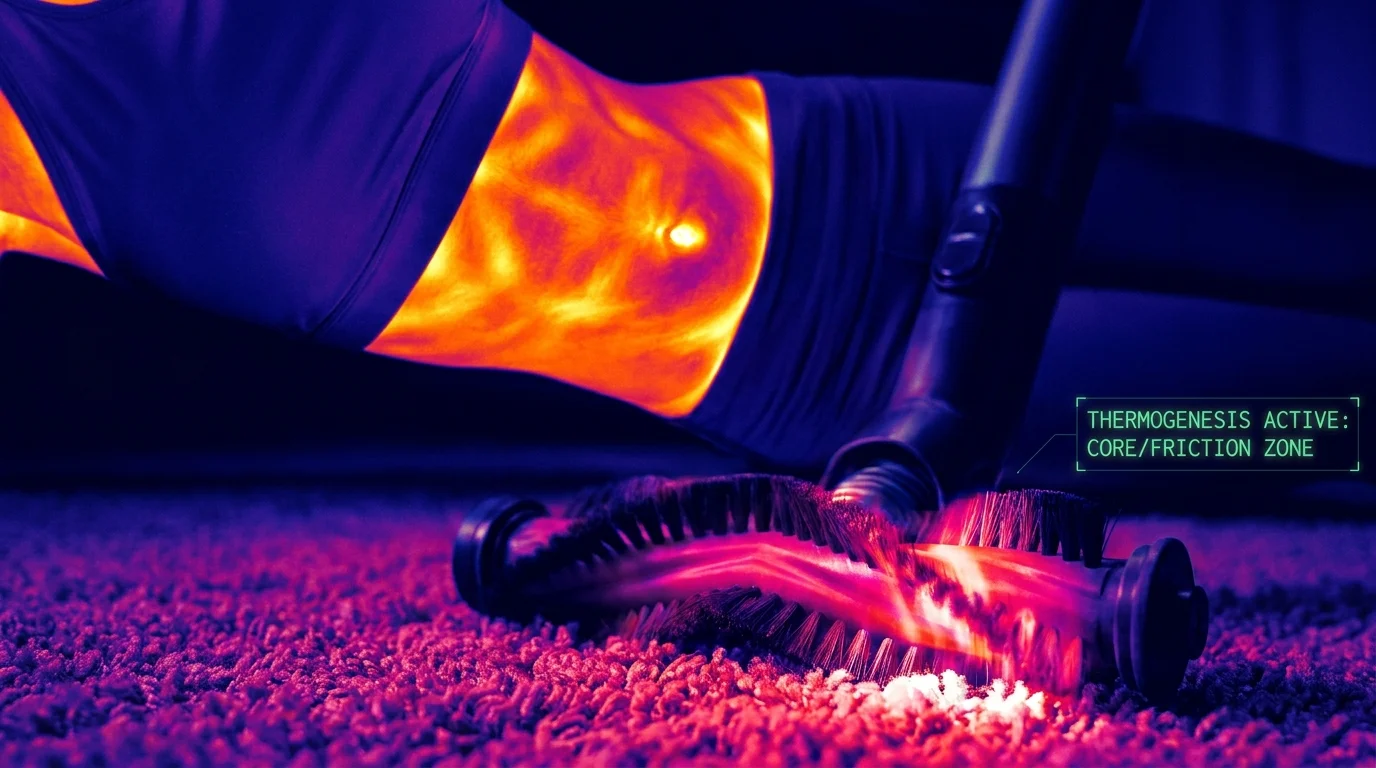
The act of clearing a floor is not merely a chore; it is a complex kinetic challenge. As you push the heavy upright canister forward, your body must fight the sudden resistance of the carpet fibers. To maintain your balance and keep the machine on a straight path, your entire midsection has to tighten, creating an involuntary, deep-seated muscular contraction.
The Kinetic Lever: Reclaiming the Power of Everyday Resistance
We often treat weight loss as a math problem solved exclusively through painful, isolated gym sessions. This perspective ignores the vast, quiet furnace of Non-Exercise Activity Thermogenesis, or NEAT. Your body burns the vast majority of its energy not during a desperate thirty-minute sprint on a treadmill, but through the continuous, low-intensity movements of everyday household routines.
To understand this, picture your metabolism as a heavy cast-iron stove. A brief, intense gym session is like throwing a handful of dry leaves onto the coals—it flares up brightly for a moment and then vanishes. Daily physical chores, however, are the thick oak logs that smolder quietly for hours, keeping your metabolic rate high long after the work is done. When you navigate a heavy upright vacuum around furniture legs and under low coffee tables, you are forcing your body to constantly adapt to changing leverage and resistance.
The specific push-pull torque of an upright machine requires a level of core stability that no standard gym crunch can replicate. A crunch is a simple, two-dimensional flexion that ignores the deep, stabilizing muscles of the lower abdomen. In contrast, guiding a powerful vacuum demands a continuous, multi-directional battle against friction, forcing your transverse abdominis and internal obliques to stabilize your entire spine.
- Discord voice channels secretly enforce heavy neurological exhaustion ruining deep restorative sleep
- Zoom waiting rooms derail natural facial relaxation sparking a tight grinding jaw
- Candida auris infections enforce strict new quarantine protocols inside sterile hospital wards
- Taylor Farms recall sparks massive abdominal cramping across nationwide emergency rooms
- Dementia risk factors surge reveals a sticky amyloid buildup in chronically exhausted brains
Dr. Aris Vance, a human movement specialist based in Ohio, began studying the muscular recruitment patterns of domestic tasks after noticing a curious trend among his clients. Many of those who spent hours on stationary gym equipment still complained of soft, inactive lower abdominal muscles and chronic lower back stiffness. He tracked a forty-five-year-old school administrator named Marcus, who agreed to replace his daily static stretching and machine-based core routine with a mindful, active twenty-minute home care session using his upright vacuum. Within six weeks, Marcus not only reported a noticeable tightening across his lower waistline, but his persistent lower back fatigue disappeared, a direct result of his deep stabilizing muscles finally waking up to support his daily posture.
Designing the Movement: Strategies for Every Living Space
Every home presents a unique landscape of physical resistance, requiring specific adjustments to maximize your metabolic output. You do not need a specialized gym layout when your own living room offers a customized resistance circuit.
For the Deep-Pile Carpet Devotee
If your home is filled with thick, plush carpeting, you possess an incredible tool for resistance training. The deep fibers grip the brush roll of your machine, requiring a significant amount of physical force to push forward and pull back. This constant resistance acts as a natural brake, forcing your hamstrings, glutes, and lower abdominal wall to work in unison to maintain momentum. Focus on keeping your weight centered over your midfoot rather than leaning forward, which forces your core to absorb the resistance rather than your lower back.
For the Multi-Surface Minimalist
Homes that transition quickly from hardwood to low-pile rugs require a high level of agility and micro-adjustments. As you move between surfaces, the sudden changes in friction force your stabilizer muscles to fire rapidly to keep the machine steady. To make the most of this transition, deliberately slow down your pace when crossing thresholds, turning each surface change into a test of balance that challenges your deep abdominal muscles to maintain deep core control.
The Functional Blueprint: Transforming Your Clean into a Workout
Turning a routine cleaning session into a highly effective physical stimulus does not require sweating through your clothes or rushing through the process. It requires a mindful shift in posture and intention.
By focusing on the mechanics of each pass, you can turn a mundane task into a highly restorative, calorie-burning practice. Use the following guidelines to structure your movement:
- Establish a strong foundation: Stand with your feet hip-width apart, keeping a soft bend in your knees to protect your lower back.
- Engage the pelvic floor: Before pushing the machine forward, gently draw your belly button toward your spine to activate your deep stabilizers.
- Commit to hand-switching: Switch your guiding hand every five minutes to balance the muscular work across both sides of your upper body and obliques.
- Drive from the lower body: Avoid leaning from your lower back; instead, step into each stroke, using your glutes and legs to generate sustained abdominal muscle recruitment.
Finding Strength in the Rhythm of the Home
There is a quiet, meditative beauty in the physical maintenance of our personal sanctuaries. When we stop viewing domestic work as an annoying interruption to our lives, we open ourselves up to a more integrated form of health. We do not need to escape our homes to care for our bodies; the opportunities for strength, balance, and physical vitality are already woven into the fabric of our daily routines.
At the end of a session, as you guide the machine across the final corner of the room, you can feel the true weight of your effort. The thick carpet resistance gripping the spinning brush roll creates a steady, grounding pull that requires every muscle in your midsection to lock in and stabilize. In that simple, resonant resistance, you find a level of physical engagement that no gym membership offers.
“True functional fitness is not built during isolated hours spent on machines, but in how we engage with the physical resistance of our immediate world.” — Dr. Aris Vance
| Key Point | Detail | Added Value for the Reader |
|---|---|---|
| Push-Pull Resistance | Engages the transverse abdominis as you fight carpet friction. | Builds deep abdominal strength far more effectively than standard crunches. |
| Asymmetrical Balance | Switching hands every five minutes balances the load on obliques. | Prevents muscle imbalances and reduces chronic lower back strain. |
| Active Thermogenesis | Maintains high physical activity levels without gym-induced stress. | Creates a sustainable, stress-free calorie burn in your own home. |
Does vacuuming really burn as many calories as a gym session?
Yes, when done mindfully. Engaging your core and driving from your legs during a twenty-minute vacuuming session recruits more muscle groups simultaneously than using isolated weight machines, raising your resting metabolic rate for hours afterward.
How does the push-pull action target lower belly fat?
Stubborn abdominal fat often covers muscles that have become inactive due to long hours of sitting. The deep torque required to control an upright vacuum forces these dormant lower abdominal muscles to contract, improving local circulation and tone.
Should I use a specific setting on my Shark Navigator for better results?
Using the thick carpet setting increases brush roll resistance. This forces you to apply more physical force to move the machine, turning your carpeted rooms into natural resistance training fields.
How often should I do this to see physical changes?
Aiming for two to three active twenty-minute sessions per week offers a consistent stimulus. The key is consistency and mindfulness in your posture rather than rushing through the chore.
Will this cause strain on my lower back?
No, provided you maintain proper form. By keeping a soft bend in your knees, stepping into your movements, and avoiding leaning from your waist, you shift the physical load off your spine and directly onto your glutes and core muscles.