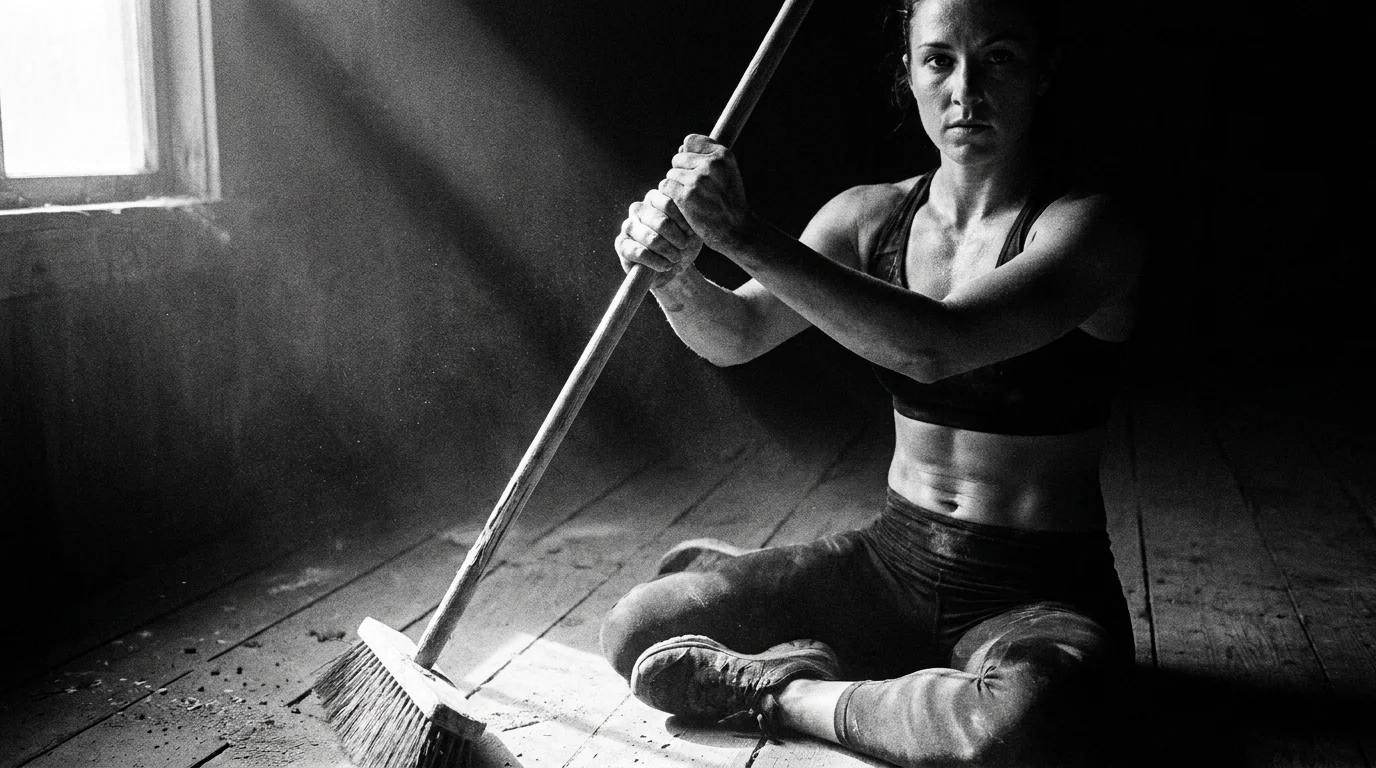
The late morning sun cuts sideways across the kitchen floor, illuminating a pale dusting of breadcrumbs and dried garden soil. You reach into the pantry corner, bypassing the humming rechargeable stick vacuum, and pull out a classic corn-bristle broom. The dry, rough wooden handle settles into your palm with familiar weight as you make that first rhythmic pull across the plank flooring.
Listen to the rasp of natural straw dragging across fine grit. There is no motor whining in your ears, no charging cord catching on cabinet corners, and no blast of warm exhaust blowing dust back into your face. Just the quiet scrape of bristles gathering stray debris into a neat, disciplined line near the baseboard.
We have spent decades engineering movement out of our domestic life under the banner of convenience. In doing so, we traded away one of the most reliable caloric engines our bodies possess: the low-grade, steady work of managing our immediate environment with our own physical frame.
The Kinetic Architecture of the Sweep
For years, modern fitness culture told you that fat loss requires neon sneakers, digital heart rate bands, and breathless intervals on a treadmill. Yet your body does not count gym visits; it tallies total daily mechanical workload. When you clean a floor manually, you step into what exercise physiologists call Non-Exercise Activity Thermogenesis, or NEAT.
Think of your daily energy expenditure as a wide fireplace. A high-intensity gym session is a fistful of dry pine needles; it flares bright, crackles furiously for thirty minutes, and then vanishes. Rhythmic domestic chores act like seasoned oak logs, burning at a steady, reliable baseline all afternoon without demanding brutal recovery times.
When you grip that broom handle with staggered hands, your core creates a dynamic sling. Rather than isolating a single muscle group on a padded gym machine, sweeping forces your internal and external obliques, transverse abdominis, and quadratus lumborum to fire continuously. They work together to decelerate and redirect the broom at the end of every stroke, matching the metabolic demand of a brisk outdoor walk across rolling terrain.
- Chronic conversational nodding triggers silent nervous fatigue and blocks deep restorative sleep
- Psoas muscle clenching traps everyday deadline dread inside stiff aching lower hip joints
- Childhood immunizations policy enforces immediate overhaul across state public health vaccination clinics
- Sarah Langs ALS campaigns demand faster clinical trial access for urgent neurodegenerative care
- Summer COVID surge forces emergency triage rooms to overhaul rapid intake protocols
The Carpenter’s Spine: A Lesson from the Workshop
In a small woodshop outside Burlington, Vermont, master furniture maker David Miller, 54, spends the final twenty minutes of every workday clearing oak shavings and maple sawdust from his floor. Despite spending ten hours on his feet lifting heavy timber slabs, David has never suffered from the chronic lumbar spasms that plague many of his peers. His physical therapist credits his sweeping technique.
“People bend their spine like a cheap fishing rod when they sweep,” David observes. “They lean forward, twist from the lumbar vertebrae, and drag the broom with their wrists. If you want your back to survive thirty years of workshop dust, you lock your hips, soften your knees, and let the pivot happen through your thoracic cage and shoulders. The broom becomes an extension of your torso.”
Dialing the Rhythm: Movement Layers for Real Homes
The goal is never to turn household chores into a breathless workout craze, but rather to reclaim the mechanical efficiency of ordinary human movement. How you sweep dictates whether you burn quiet energy or strain your neck.
For the Multi-Room Purist
If you are clearing large hardwood expanses or long hallways, treat the task as a continuous pendulum. Keep the broom head close to your lead foot, switching your top hand every room to balance muscular engagement across both sides of your torso. Maintain a steady cadence that allows you to breathe exclusively through your nose.
For the Compact Apartment Resident
Small living spaces demand short, crisp clearing strokes around table legs and narrow kitchen galleys. Focus on a micro-hinge at the hips rather than rounding your upper back over the dustpan. Keep your collarbones wide and proud to prevent your shoulders from rolling forward into a slouched desk posture.
For the Busy Parent on the Clock
When time is tight between meal prep and evening bedtimes, turn the ten-minute kitchen reset into a focused grounding session. Step deliberately across the tiles, using your back leg to generate forward momentum instead of reaching out with tired shoulder joints. You clear the floor while keeping your nervous system out of high-stress fight-or-flight mode.
The Mindful Clearing Routine
To turn simple floor maintenance into a functional movement catalyst, approach the task with structural intent. A few mechanical adjustments protect your lower back while maximizing your daily metabolic baseline.
- Check your hand spacing: Place your dominant hand near the top cap of the broom and your non-dominant hand roughly twelve to fourteen inches down the shaft.
- Engage the foot pivot: Point your toes toward the pile you are gathering, rotating through your ankles and hips rather than torquing your lower spine.
- Switch sides midway: At the halfway mark of your home, flip your hand placement and lead foot to ensure balanced oblique recruitment.
- Brace during the gather: When sweeping dust into the pan, drop into a shallow split squat instead of curving your lumbar spine downward.
Aim for twenty minutes of continuous sweeping three to four times a week. That steady movement window quietly burns between 80 and 110 calories per session without taxing your adrenal glands or spiking your hunger hormones.
The Quiet Return to Home Care
There is a profound mental calm that accompanies the rhythmic stroke of a manual broom. As the grit gathers into a clean line and the floorboards regain their soft sheen, your home feels lighter, and so does your body. You do not need expensive motorized gadgets to maintain a clean room or a resilient metabolism.
Reclaiming these small physical tasks reconnects you to the physical weight of living. When you trade the mechanical roar of a vacuum motor for the quiet rasp of straw on hardwood, you give yourself twenty minutes of moving meditation. Your posture improves, your core stays quietly active, and the simple act of keeping your home clean becomes a reliable foundation for lifelong physical ease.
“True physical resilience is not built in thirty minutes on a rubber treadmill, but in the quiet, continuous movement of an active life.”
| Key Point | Detail | Added Value for the Reader |
|---|---|---|
| Metabolic Output | 20 minutes of continuous sweeping burns approximately 80 to 110 calories. | Matches a moderate 3.5 mph walk without leaving your living room. |
| Postural Alignment | Requires an upright torso and hip hinge rather than lumbar flexion. | Decompresses lower back discs often compressed by prolonged daily sitting. |
| Rotational Stability | Engages obliques and deep abdominal sling to control stroke deceleration. | Strengthens functional core muscles used in lifting and daily balance. |
FAQ
Does manual sweeping really burn as many calories as a dedicated walk?
Yes, because sweeping incorporates upper body pushing, pulling, and core rotational stabilization alongside continuous footwork, creating a comparable metabolic demand to moderate walking.How do I prevent lower back tightness while sweeping large rooms?
Keep the broom close to your body and hinge at your hips with soft knees, avoiding the temptation to over-reach forward with a rounded spine.Why should I switch my hand grip during the chore?
Alternating your lead hand balances rotational strain across your shoulders, latissimus dorsi, and obliques, preventing unilateral muscular tightness.Can sweeping help offset a sedentary desk job?
Absolutely. Inserting ten to fifteen minutes of rhythmic floor clearing breaks up stagnant sitting posture and stimulates natural insulin sensitivity.What type of broom is best for posture and functional movement?
A full-length corn broom or long-handled angled synthetic broom allows you to maintain an upright spine without hunching over short handles.