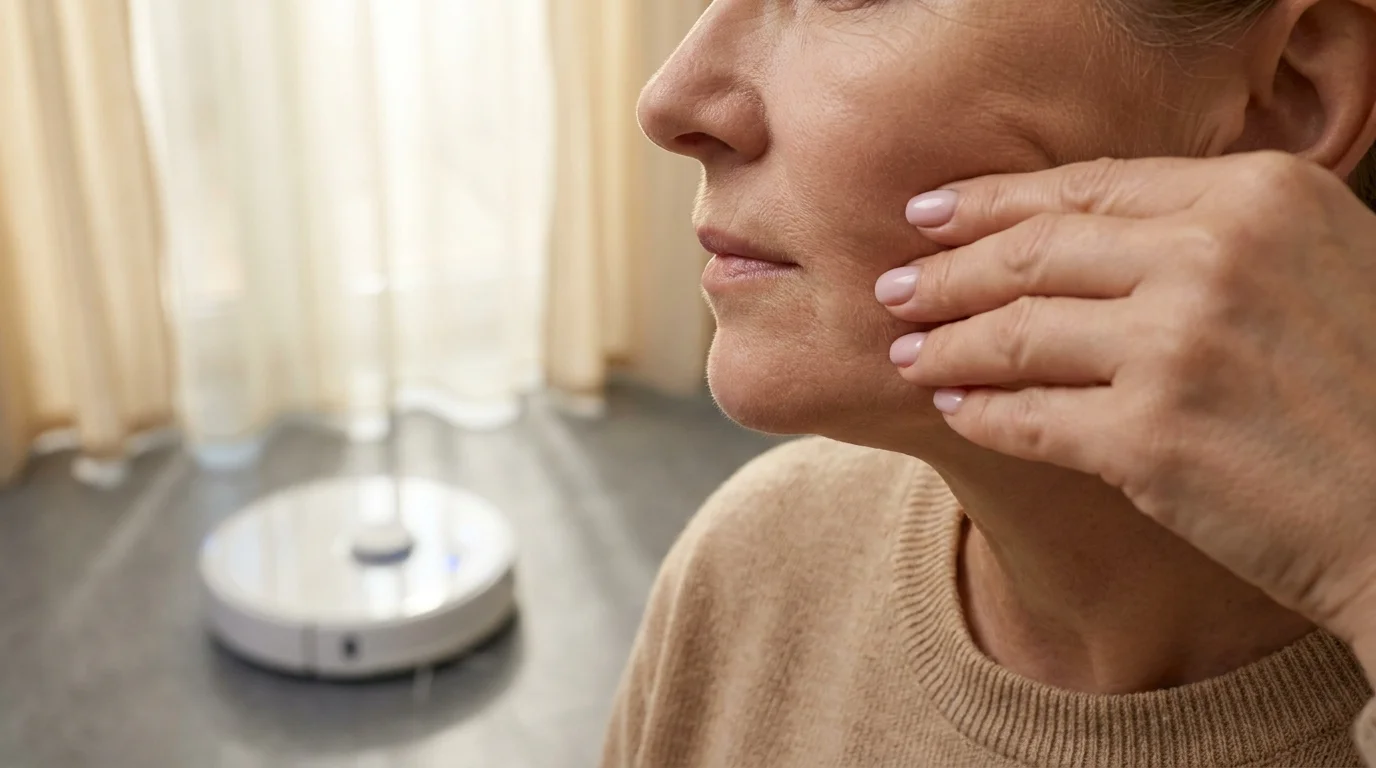
A whirring plastic disc glides silently across polished gray linoleum, puffing a fine mist of water before sweeping its micro-fiber pad over the kitchen floor. You watch it from the breakfast nook, coffee in hand, admiring the pristine, streak-free surface left in its wake. The device maneuvers around cabinet corners and glides under the dining table with effortless precision, saving you forty minutes of physical labor every Saturday morning.
On paper, this automated marvel feels like pure modern luxury. You reclaim your weekend hours, spare your hands from soapy grey water, and never have to wring out a cotton mop head again. Yet beneath the satisfaction of hands-free convenience, a silent physical transaction is taking place within your body.
When you outsource the physical friction of caring for your living space, you forfeit natural rotational strength that keeps your balance sharp. What looks like an upgrade in efficiency quietly robs your torso of the small, unpredictable micro-movements that protect your spine as decades pass.
The Phantom Price of Effortless Floors
Consider the physical choreography of traditional cleaning. Pushing a mop across hardwood is not just a domestic chore; it is an organic, multi-planar workout. Your lead foot plants, your oblique muscles brace against resistance, your spine rotates gently across its vertical axis, and your deep abdominal wall stabilizes your pelvis against dynamic shifts in body weight.
When a robot assumes this labor, that entire biomechanical conversation vanishes. The human musculoskeletal system operates under a strict rule of mechanical efficiency: tissue that is not loaded begins to quiet down. The deep stabilizers along your lumbar spine—the tiny multifidus muscles that act like guy-wires on a ship mast—fall dormant when you spend the morning sitting while a machine tends your floorboards.
Over several seasons, this avoidance builds into what physical therapists recognize as premature muscle fade. Your walking gait narrows, your ankles lose their reactive spring, and sudden trips or balance checks feel jarring rather than fluid.
Expert Observation: What Smart Homes Conceal
Dr. Evelyn Vance, a 58-year-old mobility specialist and orthopedic physical therapist based in Chicago, began tracking this subtle shift four years ago when long-term patients started presenting with unprovoked lower back instability and sudden declines in single-leg balance. When she evaluated their daily living habits, she discovered a distinct correlation: nearly every client showing accelerated trunk deconditioning had recently automated their heaviest household tasks with smart vacuums, robotic scrubbers, and grocery drop-offs. Dr. Vance noted that these individuals had not stopped walking or visiting the gym, but they had erased the irregular, loaded rotational bending that keeps mature fascial planes resilient.
- Baking powder setting methods expose fine under-eye moisture loss and reveal powdery crinkly creases
- Sinking memory foam recliners demand painful morning spinal stiffness by locking pelvic joints
- Reddit thread hyper-fixation traps executive brain energy and enforces cloudy morning decision paralysis
- Panera strawberry smoothies strip your post-workout calorie deficit with thick sugary syrups
- Egg white breakfasts force your resting metabolism into a stubborn water storage stall
Mapping the Fade: How Daily Micro-Movements Protect You
The human body does not distinguish between a structured fitness routine and the mechanical demands of keeping a house. When you eliminate routine domestic labor, specific physical systems lose their natural conditioning:
- Rotational Trunk Elasticity: Pushing a weighted mop diagonally across your body conditions the internal and external obliques, preserving your ability to turn quickly without straining your lumbar discs.
- Proprioceptive Floor Contact: Stepping across wet, tacky, or uneven floor zones trains your inner ear and peripheral nerves to adjust balance instantly before a slip turns into a fall.
- Dynamic Hip Hinging: Bending to rinse a mop bucket or reaching into low baseboard corners preserves hamstring length and strengthens gluteal stabilizers.
Without these incidental challenges, muscle tone quietly recedes, leaving your frame vulnerable to everyday sprains during ordinary movements.
Mindful Movement: Reclaiming Functional Core Work
You do not need to discard your robotic mop or return to exhausting domestic drudgery. The goal is to consciously replace the multi-directional core loading that modern appliances quietly eliminate from your weekly routine.
Begin by treating routine domestic maintenance as an intentional somatic practice. If you use automated devices for daily maintenance, reserve one room or one targeted deep clean every week for mindful manual work.
- Stand with feet wider than shoulder-width when sweeping or mopping by hand, shifting your weight laterally from heel to toe with each stroke.
- Engage your navel toward your spine before initiating a long reach, letting the power come from your hips rather than pulling with your shoulders.
- Switch your lead hand every five minutes to balance rotational load across both sides of your ribcage and lower back.
The Tactical Home Mobility Toolkit:
- Rotational Reach Window: Spend 8 to 10 minutes weekly manually polishing a high-traffic floor zone with deliberate, wide sweeping strokes.
- Bucket Carry Challenge: Fill a bucket with 1 to 2 gallons of water; practice a slow, controlled farmer carry across your hallway to train unilateral hip stability.
- Low Baseboard Hinge: Perform 5 slow, unassisted deep squats or half-kneels whenever inspecting baseboards or resetting furniture.
The Bigger Picture: Preserving Your Structural Independence
True vitality in mature years is rarely built on sterile gym machines alone. It is forged in the varied, clumsy, three-dimensional chores of daily existence. Physical autonomy thrives on resistance, demanding that our bodies bend, reach, pivot, and brace against real-world mass.
Let your automated cleaner manage the light dust, but never let convenience trick you into surrendering your body’s innate need for purposeful effort. By retaining manual, rotational chores as part of your weekly living rhythm, you safeguard your balance, preserve spinal resilience, and keep your core alert for decades to come.
“Balance is not a static trait you preserve on a shelf; it is an active dialogue between your feet, your core, and the friction of the ground beneath you.”
| Key Point | Detail | Added Value for the Reader |
|---|---|---|
| Rotational Deficit | Automated floor cleaners remove lateral torso twisting from domestic routines. | Identifies why lower back tightness often appears after upgrading to smart home gadgets. |
| Proprioceptive Fading | Walking exclusively on clean, passive surfaces dulls reflex reaction speed. | Shows how varied floor textures train the nervous system to prevent household falls. |
| Targeted Manual Reset | Reintroducing 10 minutes of deliberate manual cleaning restores core activation. | Provides an effortless way to maintain functional balance without extra gym fees. |
Frequently Asked Questions
Can light walking compensate for the core strength lost when automating chores?
Walking is wonderful for cardiovascular health, but it takes place almost entirely in a single forward plane. Manual cleaning forces multi-directional rotation, lateral weight shifts, and uneven reaches that standard walking simply cannot replicate.
Why does manual mopping specifically target the core stabilizers?
As you push and pull resistance across a slick surface, your deep abdominal wall and lumbar multifidus muscles must constantly contract to keep your upper body balanced over your pelvis. This builds reflexive stability that protects your spine.
Is it harmful for older adults with arthritis to mop manually?
Aggressive scrubbing can irritate inflamed joints, but gentle, controlled sweeping with an ergonomic handle maintains synovial fluid circulation in the shoulders, hips, and spine. Always listen to your body and modify the range of motion.
How often should I do manual chores to maintain balance reflexes?
Engaging in 10 to 15 minutes of manual sweeping, mopping, or garden tending two to three times a week provides sufficient mechanical stimulus to keep core stabilizers and balance pathways responsive.
What is the best technique to prevent back strain during manual cleaning?
Keep the handle close to your torso rather than over-reaching with your lower back. Hinge from your hips, soften your knees, and pivot your entire body with your feet rather than twisting solely from your lumbar vertebrae.