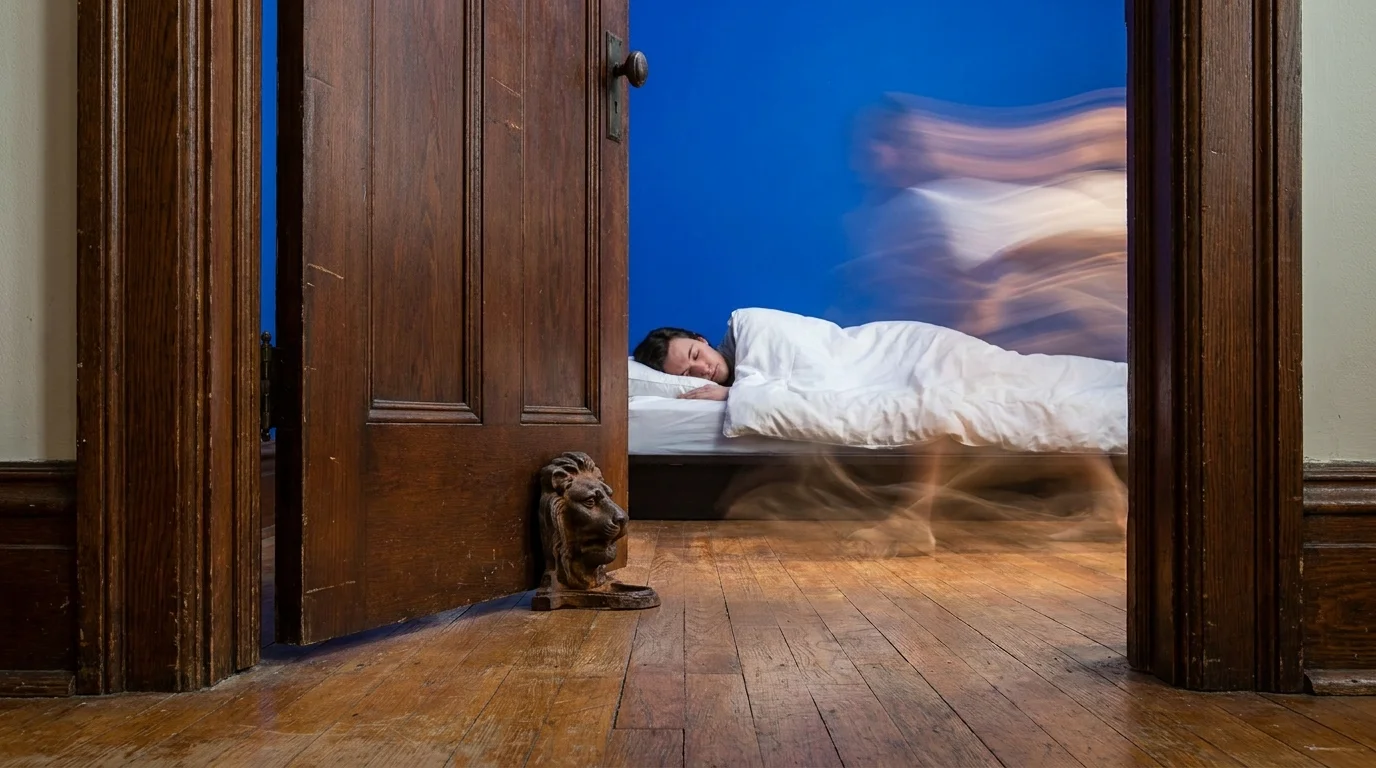
The hallway clock ticks past two in the morning, muffled by the solid barrier of your bedroom entry. Inside, the room feels quiet, pitch-black, and safe, yet you find yourself tossing against tangled cotton sheets with a dry throat and a racing pulse. Outside in the corridor, cooler air rests undisturbed over bare pine floorboards, completely cut off from the small domestic enclosure where you rest.
We are taught to believe that a firmly shut door is the ultimate prerequisite for restorative rest. You lock out the ambient noise of the refrigerator humming, the stray headlights sweeping across the drywall, and the subtle movements of household pets. It feels intuitive: build a fortress, pull the quilt up, and wait for restorative slumber to arrive on schedule.
Yet across eight hours, an adult body silently exhales hundreds of liters of spent air into that compact perimeter. Without a clear path for air exchange, invisible gas builds up against your ceiling and settles over your mattress, transforming your cozy sanctuary into an invisible, low-oxygen chamber that quietly fragments your sleep architecture.
The Invisible Dome: Why Sealed Rooms Starve Your Brain
Think of your closed bedroom not as a protective cocoon, but as a glass jar with the lid twisted tight. Throughout the day, your home breathes as doors open and people walk through rooms. But the moment you pull that bedroom door firmly into its latch at night, you create an isolated thermal and chemical pocket. As you cycle through your early light sleep stages, your steady respiration continuously releases carbon dioxide into a fixed volume of space.
In a standard twelve-by-twelve bedroom with standard drywall and double-pane windows, ambient carbon dioxide levels often hover around 500 parts per million when you first lie down. By 3:15 AM, two sleepers and a family dog can easily drive that concentration past 2,500 parts per million. Your brain’s respiratory center detects this subtle atmospheric shift not as a gentle cue to rest, but as a low-grade asphyxiation threat, quietly triggering micro-arousals that shatter your deep REM cycles.
When ambient carbon dioxide climbs too high, your sympathetic nervous system nudges your heart rate upward to compensate for the reduced oxygen gradient. You do not wake up fully screaming from a nightmare; instead, you turn over restlessly, kick off the blankets, or wake up feeling as though you spent the night breathing through a damp wool blanket.
- Ergonomic saddle desk stools force extreme pelvic tilts jamming sharp aches into lower vertebrae
- Dannon Activia strawberry yogurts pack sneaky cane syrup derailing midday fat burning goals
- Boiled cabbage leaf wraps resurfaced to pull hot inflammation directly from stiff knees
- Coarse sea salt foot rubs draw out stubborn swelling revealing slim defined ankles
- Frozen rosemary sprig chewing sparks instant mental sharpness clearing thick foggy morning haze
The Field Observation: What Environmental Tracking Revealed
Consider Elena Vance, a 42-year-old architectural drafter from Denver, who spent two years battling stubborn morning brain fog and unexplained middle-of-the-night restlessness. Elena had optimized every visible variable in her sleep routine: blackout curtains, organic linen bedding, a white noise generator, and a strictly observed 67-degree thermostat setting. It was only when she installed an indoor air quality monitor on her bedside table that the culprit emerged. Her monitor consistently logged a severe carbon dioxide spike between 2:30 AM and sunrise, perfectly matching the times her fitness band recorded jagged, interrupted sleep stages. By merely propping her solid oak door open a few inches with a heavy cast-iron doorstop, her overnight readings dropped by more than half, and her morning grogginess evaporated within three days.
Household Variations: Calibrating Airflow for Every Living Space
Not every home layout shares identical airflow patterns. The secret lies in balancing air movement with the acoustic and visual privacy you need to stay relaxed throughout the night.
For the City Apartment Dweller
If your bedroom opens directly into a bright kitchen or near a shared entryway where neighbors create hallway noise, an open door can introduce unwanted light and sound. Crack the door three inches and position an acoustic draft buffer or a dense folding screen just outside the opening. This creates a staggered baffle that allows heavy carbon dioxide to roll out along the floor while trapping unwanted ambient light.
For Families and Shared Households
When children, roommates, or early-rising partners share your floor plan, complete openness can compromise personal privacy. Instead of swinging the door wide against the baseboard, place a heavy door wedge to hold it ajar at roughly forty-five degrees. This allows passive convective flow between the bedroom and hallway air mass without leaving your sleeping area in full view.
For Pet Owners
If a roaming cat or restless dog treats an open doorway as an invitation for midnight play, you can install a simple latch strap. These flexible door anchors hold the door securely open four to six inches—wide enough for total carbon dioxide dissipation, but narrow enough to keep medium-sized pets from wandering onto your duvet.
Mindful Application: Crafting the Zero-Cost Cross Breeze
Restoring your bedroom’s natural air exchange requires neither expensive mechanical installations nor noisy fans. It is a quiet, deliberate habit you can introduce tonight using items already sitting on your shelves.
Begin by checking the physical pathway between your bed and the hallway. Heavy carbon dioxide is denser than fresh ambient air; it pools low to the floorboards before slowly filling the room from the bottom up. By keeping the floor clear near the threshold, you allow that dense, spent air to slide out while cooler, fresher air sweeps in over the top.
- Select a solid floor weight: An antique cast-iron doorstop, a heavy river stone, or a weighted fabric door wedge works best to keep the door firmly in place without rattling in subtle drafts.
- Align your airflow line: Ensure your bed is positioned so that gentle air movement travels across the room rather than hitting your face directly as a harsh draft.
- Combine with window ventilation: If weather permits, crack an exterior window just a half-inch to create a natural convective chimney effect that draws stale air out into the wider house.
- Dampen exterior hallway lights: Switch hallway nightlights to low-lumen amber bulbs to ensure that opening the door does not disrupt your biological clock with blue-spectrum glare.
The Tactical Airflow Toolkit
- Minimum Door Clearance: 3 to 4 inches of open gap for an average single-occupancy room; 6 to 8 inches for couples.
- Target Air Quality: Keep overnight carbon dioxide under 900 parts per million for continuous deep sleep.
- Ideal Room Temperature: Maintain the bedroom between 65°F and 68°F to encourage passive thermal air currents.
- Anchor Placement: Secure the door firmly from both sides if you sleep with an overhead ceiling fan running on low.
The Bigger Picture: Reclaiming Natural Rest
We often look for health solutions in complex protocols, specialty supplements, and expensive sleep tracking rings. Yet the foundational components of human recovery remain simple, quiet, and profoundly physical. When you open your bedroom to the larger volume of your home, you break the artificial seal that modern architecture has built between your lungs and fresh air.
That subtle crack in the doorway invites an unhurried, natural rhythm back into your night. You sleep deeper not because you forced your body into stillness, but because you gave your cells the room to breathe without strain until the morning light spills across the floor.
Fresh indoor air is the single most overlooked nutrient for sustaining restorative human sleep cycles.
| Key Point | Detail | Added Value for the Reader |
|---|---|---|
| Air Quality Threshold | Closed doors cause CO2 spikes exceeding 2,000 ppm by 3:00 AM. | Maintains deep REM cycles and stops unexplained midnight restlessness. |
| Zero-Cost Setup | Requires only a weighted door wedge or heavy cast-iron stop. | Instant improvement in morning mental clarity without buying expensive air machines. |
| Thermal Convection | Encourages natural exchange of warm stale air with cooler hall air. | Regulates overnight body temperature naturally, preventing sweat and discomfort. |
Frequently Asked Questions
Will propping the bedroom door open make the room too noisy to sleep?
Not if you position the door carefully. Leaving an opening of just three to four inches allows heavy air to circulate while the physical wood slab still blocks the vast majority of direct line-of-sight sound waves from adjoining rooms.What if I need the bedroom door shut for fire safety reasons?
Fire safety organizations often recommend closed interior doors to slow flame spread. If this is a primary concern for your household, consider sleeping with an exterior window cracked one inch or installing an air-transfer baffle in the lower door panel to balance ventilation with safety.Does an air purifier solve the carbon dioxide problem with the door closed?
No. Standard HEPA and carbon filters capture dust, dander, and volatile organic compounds, but they cannot remove or convert carbon dioxide molecules. Only active physical air exchange lowers CO2 levels.How wide does the door actually need to be open?
For a single adult, an opening of three to four inches provides adequate convective clearance. If two adults and pets share the space, aim for five to eight inches of clearance to prevent gas accumulation.Why do I consistently wake up around 3:00 AM in a closed room?
In an unventilated bedroom, 3:00 AM typically marks the point in the night where accumulated exhaled carbon dioxide reaches peak concentration, triggering mild sympathetic nervous system arousal and lighter sleep.