The dull throb starts behind your left eye around three in the afternoon. The office air is stale, the hum of overhead fluorescent lighting buzzes in your ears, and your first instinct is to blame the glare bouncing off your spreadsheet. You dim your monitor, slide on yellow-tinted lenses, and chug another glass of water, waiting for the band tightening around your temples to ease.
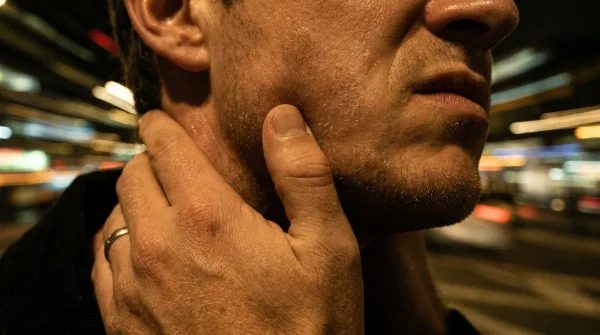
Yet twenty minutes later, the vise-like pressure remains stubborn, spreading across your forehead like an iron crown. When you unconsciously reach behind your head to rub your neck, your fingers sink into the soft hollows right where the skull meets the spine. What you feel under your thumbs is startling: two small mounds of dense, rubbery tissue, vibrating with silent resistance.
Those tiny structures are your suboccipital neck muscles. Though no larger than a walnut, these deep postural stabilizers bear the immediate physical brunt of every stressful email, unspoken frustration, and hurried deadline you endure throughout the day.
The Occipital Suspension Bridge: Why Screens Take the Blame for Silent Bracing
For years, conventional wisdom told you that afternoon headaches stem from digital eye strain or sitting without lumbar support. But treating the temple ache with blue-light filters ignores the mechanical reality of your cranium. Your head weighs roughly eleven pounds, suspended over your spinal column like a bowling ball balanced on a broomstick, anchored directly by four pairs of suboccipital muscles.
When you feel workday stress, your nervous system initiates a quiet, protective freeze response. You do not run or fight; instead, your jaw clamps down subtly, and your deep neck fibers lock to brace your head against perceived threat. Because the suboccipital nerves thread directly through these muscle fibers and wrap up over the skull toward your forehead, that persistent knot at the hairline transmits pain straight to your temples.
Think of these muscles as taut guitar strings wound two steps too high. When your teeth lightly touch under mental load, the trigeminal nerve triggers an involuntary co-contraction at the skull base, turning dynamic flesh into rigid gristle.
- Hospital disease outbreak guidelines switch mandatory isolation standards across regional surgical clinics
- McKenna West workout schedules reveal why high-rep conditioning is exploding across fitness communities
- Postpartum psychosis symptoms spark urgent clinical screening shifts across hospital emergency rooms
- Propping interior bedroom doors open flushes stale carbon dioxide enforcing heavy deep sleep
- Ergonomic saddle desk stools force extreme pelvic tilts jamming sharp aches into lower vertebrae
The Clinical Insight Behind the Workday Knot
Dr. Elena Rostova, a 52-year-old neuromuscular specialist based in Chicago, spends her days evaluating corporate professionals who believe they are suffering from untreatable tension migraines. During clinical assessments, she routinely bypasses the temples entirely, guiding her patient’s hands directly to the occipital ridge to demonstrate how simple mental arithmetic causes instant, measurable hardening in these deep cervical tissues.
Three Workday Archetypes: How Your Routine Traps Somatic Tension
Not everyone braces their neck in the same manner. Identifying how your workday mechanics load these fibers determines how you must release them.
The Silent Clencher
You work in high-stakes environments where decisions happen rapidly. While you read emails, your molars remain lightly glued together without conscious awareness. This persistent bite activation keeps the suboccipitals in a state of continuous low-grade contraction, starving the local tissue of fresh blood flow.
The Forward-Draft Reader
When complex text appears on screen, your chin subtly juts forward by two inches to read the fine print. This slight forward head shift multiplies the mechanical workload on your suboccipital shelf by up to four times, forcing tiny stabilizing fibers to act as heavy-duty suspension cables.
The Dual-Screen Swiveler
Positioned between two widescreen monitors, you spend eight hours micro-pivoting your head from left to right. Because the suboccipital group governs fine eye-head coordination, rapid visual tracking without whole-body movement leaves these balancing fibers completely exhausted by midday.
The Mindful Skull-Base Release: Your Desk Protocol
Restoring length to these compressed fibers does not require aggressive cracking or expensive gadgets. It requires slow, mindful decompression that signals your autonomic nervous system to drop its defensive guard.
Perform this sequence directly in your office chair whenever temple pressure surfaces:
- Locate the Ridge: Slide your thumbs up the back of your neck until you hit the hard horizontal shelf of your skull, then drop into the soft groove just beneath it.
- Apply Sustained Static Pressure: Press firmly inward and slightly upward with both thumbs until you meet dense resistance; do not rub or knead, simply hold steady pressure for 60 seconds while breathing through your nose.
- Incorporate Micro-Tucks: While maintaining thumb contact, slowly draw your chin straight back toward your throat by half an inch, feeling the rubbery knots gently stretch over your thumb tips.
- Disengage the Bite: Allow your lower jaw to hang loose, resting the tip of your tongue against the roof of your mouth behind your front teeth to sever the neurological loop between jaw tension and neck contraction.
Your Tactical Workday Toolkit
Keep these precise variables in mind to stop the cycle before it starts:
- Pressure Duration: 45 to 60 seconds per point without rubbing.
- Monitor Height: Eye line should align with the top third of your display.
- Jaw Gap: Maintain a 2 to 3 millimeter clearance between your upper and lower molars during focused typing.
- Reset Frequency: Perform one 90-second release every three hours of seated work.
Reclaiming Calm from the Base of the Skull
Your afternoon temple ache is not a personal failure of posture, nor is it an inevitable tax on earning a living behind a computer. It is simply your body keeping score of unspoken workday pressure through the quietest, most responsive muscles in your spine.
When you learn to catch the subtle clench of your molars and give the base of your skull permission to widen, the iron band across your brow softens naturally. True physical ease during the workday rarely comes from buying a more expensive chair; it begins when you notice where you hold your breath and choose to set the weight down.
The deep neck does not hold posture through brute force, but through trust that the rest of your body is safe enough to let go.
| Key Point | Detail | Added Value for the Reader |
|---|---|---|
| Root Cause of Temple Ache | Micro-compression of suboccipital nerve pathways | Stops wasted spending on blue-light glasses and unneeded headache balms |
| The Jaw-Neck Connection | Trigeminal-cervical reflex arc locks skull base | Enables immediate tension relief simply by separating your molars at work |
| Static Thumb Decompression | 60-second sustained upward angle beneath skull ridge | Delivers instant myofascial release without requiring therapy appointments |
Frequently Asked Questions
How do I know if my headache is coming from suboccipital tension?
Suboccipital-driven tension typically starts as a tight, dull pull at the base of the skull that radiates up behind your ears and settles directly over your temples or behind one eye.Why does rubbing my temples only bring temporary relief?
Rubbing your temples addresses the symptom location rather than the source. The pain fibers in your forehead are being irritated by compressed nerves inches away at the base of your skull.Can poor vision make suboccipital tightness worse?
Yes. Because suboccipital muscles contain an unusually high concentration of muscle spindles linked directly to your eye reflexes, straining to read uncorrected text forces these neck fibers to twitch constantly.How hard should I press against the skull ridge?
Use moderate, steady pressure that creates a sensation of satisfying, dull warmth rather than sharp pain. You should be able to breathe slowly and comfortably through your nose the entire time.Will a high-end ergonomic chair solve this issue permanently?
An ergonomic chair supports your lower spine, but it cannot prevent unconscious jaw-clenching or forward-head bracing under stress. Real relief requires somatic awareness and regular physical resets.