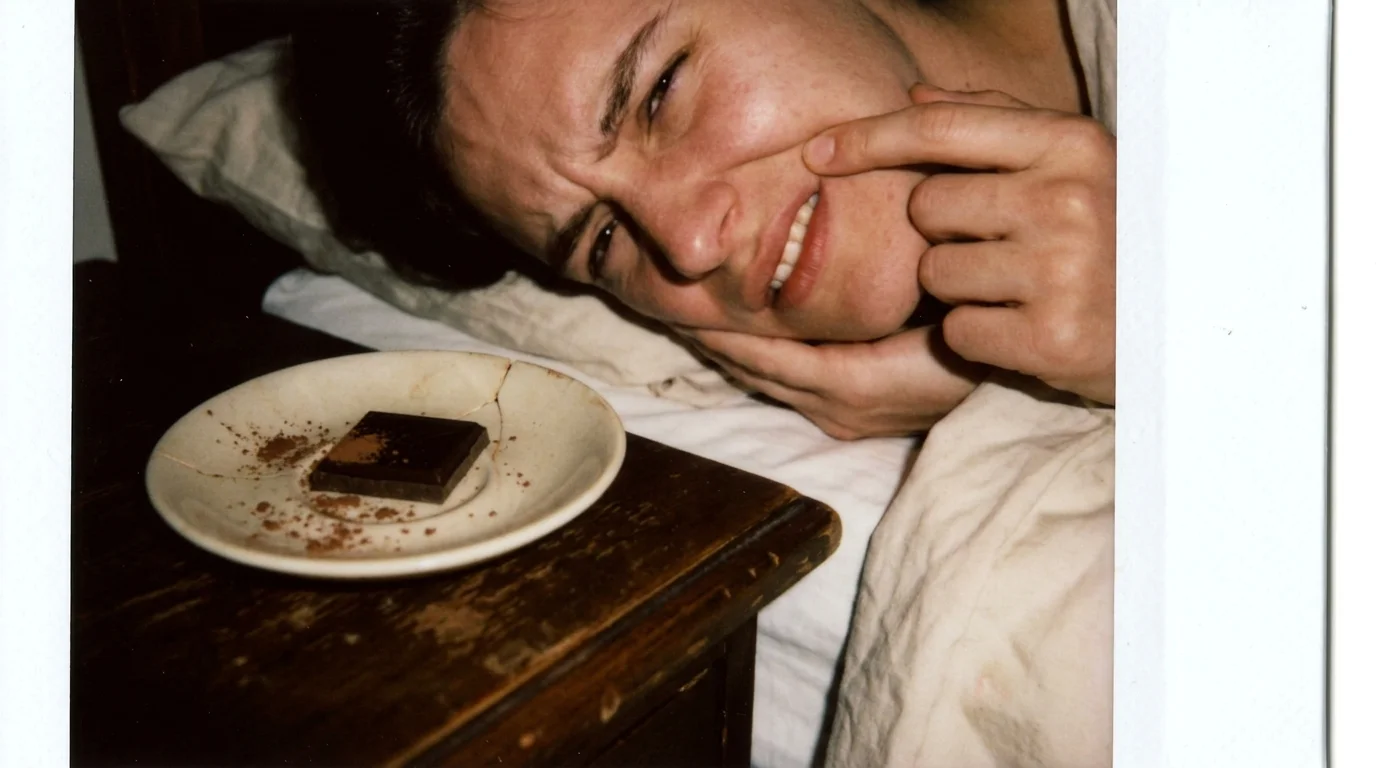
The bedside saucer holds a single, snapped square of eighty-five percent cacao, its matte surface catching the amber glow of the reading lamp. You break off a corner, letting the earthy, dark bitterness melt against the roof of your mouth while the house settles into quiet. It feels like the cleanest indulgence possible—antioxidant-dense, low in sugar, and praised across wellness circles as a harmless evening luxury.
Yet seven hours later, you wake to a familiar, throbbing pressure behind your temples. Your teeth feel tender, as if you spent the night chewing through gravel, and the hinge of your jaw protests the moment you open your mouth for a sip of water. You blame your pillow, your screen time, or unresolved workday stress, never suspecting that quiet ritual sitting on the nightstand.
High-cacao dark chocolate carries a hidden biochemical cargo that works against restorative sleep. Residual theobromine and concentrated caffeine quietly stimulate the central nervous system, forcing your masseter muscles to lock into persistent, micro-spastic clenches while you drift through REM cycles.
Understanding this nocturnal reflex changes how you look at evening nutrition. When we look beneath the surface of clean-eating habits, seemingly harmless botanical compounds often turn out to be the exact mechanical triggers locking your jaw before sunrise.
The Midnight Motor: Why High Cacao Grips the Jaw
To understand morning temple aches, think of your masticatory system as an engine with an idle screw. When you sleep, that engine should idle down to near-zero RPM, letting the heavy hinge of your mandible rest softly with teeth slightly parted.
Dark chocolate turns that idle screw upward. Cacao is naturally rich in methylxanthines—principally theobromine, paired with a subtle baseline of caffeine. Unlike coffee, which hits fast and clears relatively quickly, theobromine lingers in your bloodstream with a half-life of up to ten hours. When you consume a concentrated square thirty minutes before shutting off the light, its peak plasma concentration collides directly with your deepest phases of sleep.
During REM sleep, motor tone is supposed to switch off entirely, a natural paralysis that keeps you from acting out dreams. However, methylxanthines cross the blood-brain barrier and block adenosine receptors in the trigeminal motor nucleus. This neural cross-talk spikes baseline neuromuscular tension in the masseter and temporalis muscles. Instead of floating in neutral, your lower jaw clamps shut against your upper teeth with up to two hundred pounds of involuntary pressure.
- Honeywell cool mist humidifiers release fine mineral dust that blocks clear nighttime breathing
- Elderberry syrup shots trigger sudden afternoon stomach cramps behind thick hidden sweeteners
- Wheeled carry-on luggage silently stops core muscle engagement and weakens spinal balance
- Matte powder foundations strip delicate skin moisture and expose stubborn dry creases
- Recliner footrest elevation traps lower spine tension triggering sharp morning back stiffness
The Case of the Unexplained Migraine
Elena Vance, a forty-two-year-old landscape architect from Chicago, spent fourteen months cycling through specialty mouthguards, physical therapy, and acupuncture to resolve debilitating morning facial soreness. Her dentist noted progressive micro-fractures on her lower second molars, a classic sign of aggressive nocturnal bruxism.
Her sleep tracking data showed normal rest durations, yet her mornings began with a vice-like ache radiating from her cheekbones into her neck. It was only during an elimination audit with an orofacial pain specialist that Elena isolated her evening routine: two squares of ninety percent artisanal chocolate, eaten alongside chamomile tea at 10:15 PM every night.
Within five days of swapping her high-cacao treat for a raw almond butter spoon, her morning temple tightness dropped to zero. Her masseter muscles had not been reacting to daytime anxiety; they were simply responding to a nightly pharmacological stimulant delivered in a dark wrapper.
Mapping the Sensitivity Layers
Not every body handles evening cacao the same way. The degree of nighttime jaw clenching depends heavily on your liver clearance rate, your oral anatomy, and the exact cacao percentage you prefer.
For the High-Cacao Purist (85% to 100%)
If you reach for ultra-dark bars, you are consuming the highest possible concentration of theobromine per gram. A two-square serving can deliver up to two hundred milligrams of active methylxanthines. For individuals with slow CYP1A2 liver enzymes, this creates sustained, low-grade muscle firing that peaks between 2:00 AM and 4:00 AM, precisely when tooth-grinding episodes cluster.
For the Magnesium Seeker
Many turn to dark chocolate late at night believing it serves as a natural magnesium supplement to encourage relaxation. While cacao does contain magnesium, the neuromuscular excitation from its stimulant fraction far outweighs the mineral’s relaxing effects when consumed within three hours of bedtime.
For the Desk Worker with Existing Jaw Strain
If you spend your daylight hours looking down at screens or holding tension in your neck, your suboccipital and temporalis muscles are already primed for spasm. Introducing a nocturnal stimulant creates a compounding loop: daytime posture fatigue meets nighttime chemical clenching, resulting in chronic jaw clicking and morning stiffness.
Mindful Application: Uncoupling Cacao from Sleep
Breaking the cycle of morning jaw lock does not mean banishing dark chocolate entirely. It requires treating cacao as a daylight botanical rather than a bedtime lullaby.
Reclaiming painless mornings comes down to simple, precise timing and physical release cues before your head touches the pillow.
- Establish the four-hour cacao cutoff: Move your dark chocolate indulgence to early afternoon or right after lunch, ensuring the stimulant peak leaves your nervous system before sleep onset.
- Perform the physiological jaw drop: Before closing your eyes, rest the tip of your tongue gently against the roof of your mouth just behind your front teeth, allowing your lower jaw to hang loose with lips closed.
- Apply targeted heat: If you feel residual tension in your cheeks, place a warm, damp washcloth over your jaw angles for three minutes to manually soften the masseter fibers.
- Swap for non-stimulant fats: If you crave a rich, savory mouthfeel after dinner, opt for a teaspoon of roasted walnut butter or warm coconut cream paired with cinnamon.
The Bigger Picture: Restoring Quiet to the Night
We often carry the belief that evening comfort must come in a rich, sweet form, ignoring the quiet signals our bodies give us at daybreak. Chronic jaw clenching is not merely a dental inconvenience; it is a persistent drain on your nervous system, fragmenting deep sleep stages and turning your rest into physical exertion.
When you align your evening inputs with biological calm, your nights become truly restorative. Letting your jaw rest softly in the dark allows your nervous system to fully let go, turning morning from a painful waking struggle into an effortless start to your day.
The masseter muscle is one of the strongest in the human body by weight; feeding it stimulants before sleep is like leaving your foot pressed firmly on the accelerator all night long.
| Key Point | Detail | Added Value for the Reader |
|---|---|---|
| Chemical Culprit | Theobromine and residual caffeine in high-cacao bars. | Explains why ‘clean’ chocolate triggers physical tension without feeling like coffee. |
| Muscle Impact | Blocks adenosine receptors in the trigeminal motor nucleus, firing the masseters. | Connects dietary timing directly to morning temple headaches and tooth pain. |
| Correction Strategy | Enforce a 4-hour pre-bed buffer and perform intentional jaw-drop positioning. | Eliminates nighttime bruxism triggers without requiring costly dental interventions. |
Frequently Asked Questions
Does milk chocolate cause the same morning jaw tightness?
Milk chocolate contains significantly lower percentages of cacao solids, meaning its theobromine content is roughly one-third that of dark chocolate. However, its high refined sugar content can disrupt sleep architecture in other ways.Why do my temples hurt when the chocolate affects my jaw?
The temporalis muscle spans your temples and works in tandem with the masseter to close the jaw. When you clench involuntarily through the night, this muscle fatigues and spasms, producing a dull, band-like tension across your forehead.Can a dental nightguard prevent this clenching?
A nightguard protects your teeth from enamel wear and micro-fractures, but it does not stop the underlying neuromuscular drive to clench. Removing the dietary stimulant addresses the root cause rather than just cushioning the impact.How long after cutting out evening dark chocolate will my jaw feel better?
Most people experience a noticeable reduction in morning temple soreness and facial tightness within three to four consecutive nights of shifting cacao consumption to daytime hours.Are cacao nibs or dark hot cocoa just as problematic?
Yes. Any unrefined, high-potency cacao product carries the same active methylxanthines. For evening drinks, seek roasted carob, golden milk, or chamomile infusions instead.