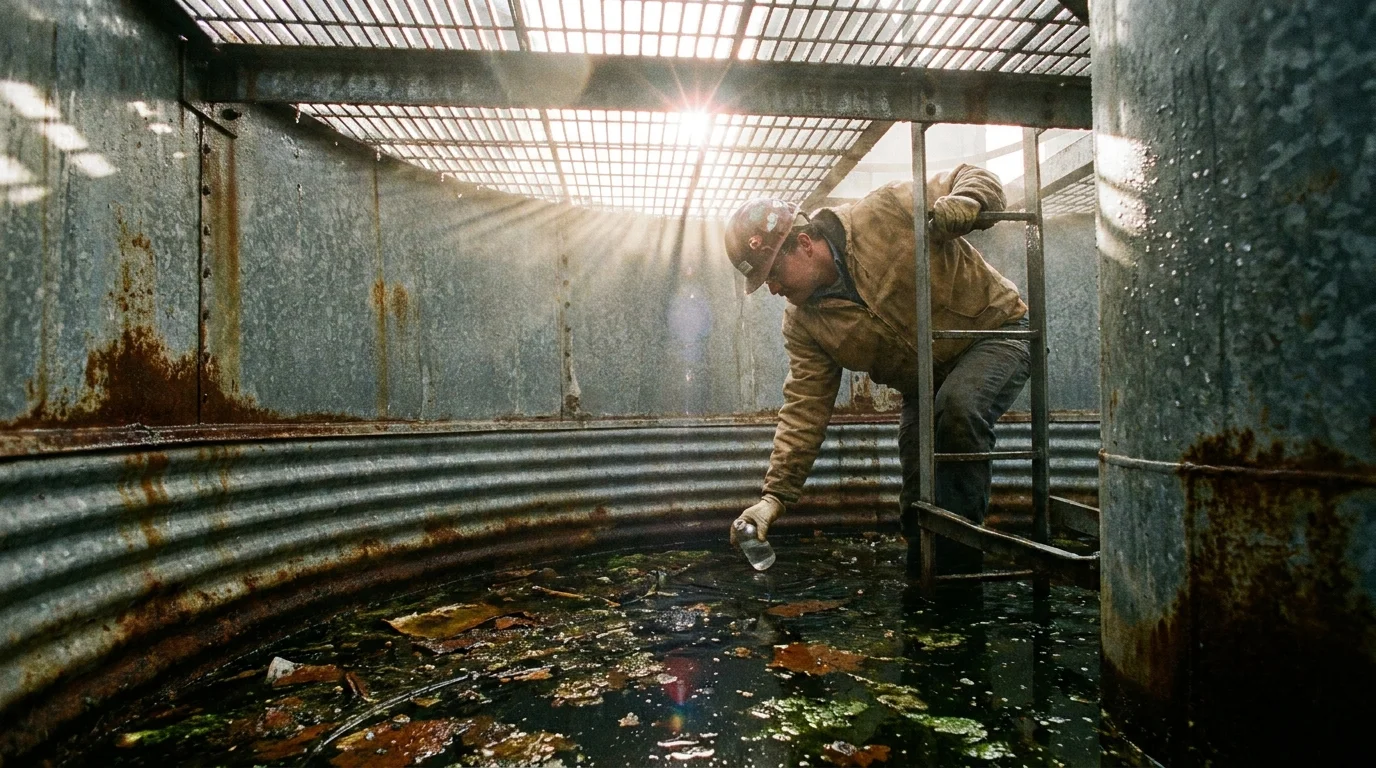
High above the asphalt grid, inside the ribcage of a fifty-story skyscraper, a heavy, lukewarm pool of water sits in complete darkness. You can hear the dull, rhythmic thrum of twelve-foot fan blades slicing through humid air, pushing a faint scent of wet metal and old mineral scale into the morning breeze. This is the interior of a galvanized steel industrial cooling tower—the literal lungs of the modern office building. To the untrained eye, it is just mechanical infrastructure, but when the water temperature hovers between 68 and 122 degrees Fahrenheit, it becomes something far more volatile.
You step out of the elevator into your carpeted office lobby, immediately greeted by that familiar, **crisp, cold office air** that promises a productive day. You assume this chill is pure, a sterile byproduct of modern engineering designed to keep your focus sharp. In reality, that cool air is intimately connected to the wet, dark cavern on the roof, where microscopic droplets are constantly spun into a fine aerosol mist. When municipal maintenance slips or chemical levels drift, that mist carries an invisible passenger directly into your lungs.
Right now, a sudden, sharp spike in localized Google searches for “severe chest pain when breathing” and “relentless dry cough” is lighting up clinical dashboards across major US cities. This isn’t a typical seasonal bug creeping through the transit system; it is a direct signal of an environmental breach. The silent growth of Legionella pneumophila inside urban cooling infrastructures has crossed a threshold, prompting emergency citywide inspections this morning.
The Invisible Mist: How Systems Breathe
We often treat our indoor air as an isolated sanctuary, forgetting that every breath we draw inside a commercial tower is tied to a massive, shared plumbing system. When you inhale the cool draft at your desk, you are **participating in a shared loop** of water and pressure. The real danger is not the water itself, but the tiny, microscopic droplets that escape the drift eliminators of poorly maintained towers, floating down to street level or entering air intakes.
Instead of thinking of air conditioning as a simple cooling box, imagine it as an organic lung that needs to be constantly washed and sanitized. A failure in this washing process turns a routine utility into an aerosolized delivery system for bacteria. By understanding this connection, you stop looking at winter-like symptoms as an unavoidable seasonal cold and start recognizing them as a direct response to your immediate physical environment.
- Overhead ceiling fans dry out nasal passages and ruin deep restorative sleep
- Liquid collagen peptides break down into useless amino acids before reaching skin
- Memory foam mattress toppers quietly misalign your spine during deep REM sleep
- Organic agave nectar packs more concentrated fructose than standard table sugar
- Cast iron skillet cooking actually provides vital daily iron for aging bodies
The Rooftop Diagnostic
Consider the morning routine of Dr. Marcus Vance, a 46-year-old environmental pathobiologist who works alongside municipal water teams in Philadelphia. This morning, his boots are wet from climbing the gravel-strewn roofs of midtown high-rises, his hands gloved as he dips sterile collection vials into stagnant corner basins. “We aren’t looking for a massive pool of slime,” Vance explains, adjusting his digital temperature probe. “A **thin biological film lining** the galvanized steel is enough to shield millions of bacteria from routine chlorine treatments.”
The Zones of Risk: High-Rises vs. Low-Rises
The risk of exposure changes dramatically depending on where you spend your productive hours and how the air is circulated through your specific square footage. Understanding these differences allows you to better navigate your workspace and advocate for proper maintenance standards.
For the High-Rise Office Professional: Your exposure is dictated by **massive, centralized HVAC structures** that service thousands of people at once. If a single cooling tower on your roof is colonized, the entire building envelope can become vulnerable as the exhaust plumes drift into neighboring fresh-air intakes.
For the Mixed-Use Residential Tenant: Older, retrofitted industrial buildings often rely on localized, split-system chillers or poorly integrated rooftop units. These systems frequently lack the automated chemical dosing pumps found in newer corporate complexes, meaning water treatment is often performed manually and inconsistently.
Tracing the Source: The Emergency Water Protocol
To halt this spike before it overwhelms local emergency departments, city water authorities are deploying highly structured diagnostic sweeps. This morning, **municipal teams are executing** a strict, three-step protocol on every registered cooling tower within affected zip codes.
Technicians are using a precise set of tools to isolate, measure, and neutralize potential bacterial harborages:
- Thermal Profiling: Plunging digital probes deep into the basin sump to verify that water temperatures are maintained either below 68°F or above 140°F, stopping bacterial replication in its tracks.
- Biocide Verification: Testing water for free halogen residual levels, ensuring a minimum of 1.0 to 3.0 parts per million (ppm) of chlorine or bromine is actively circulating.
- Heterotrophic Plate Count (HPC): Inoculating buffered charcoal yeast extract agar plates with sample water, incubating them for ten days to count active colony-forming units (CFU) per milliliter.
Restoring the Sanctuary of Shared Spaces
Demanding clean air and transparent water management isn’t about feeding panic; it is about **reclaiming our immediate environment** and holding management accountable. When municipal inspectors climb those metal ladders to test the dark, hidden pools of our cities, they are rebuilding the invisible trust that allows our modern high-density life to function.
Paying attention to these silent systems turns our focus from passive vulnerability to active preservation. By keeping our building managers accountable to rigorous testing standards, we ensure that the air we share remains a source of life, not a hidden hazard.