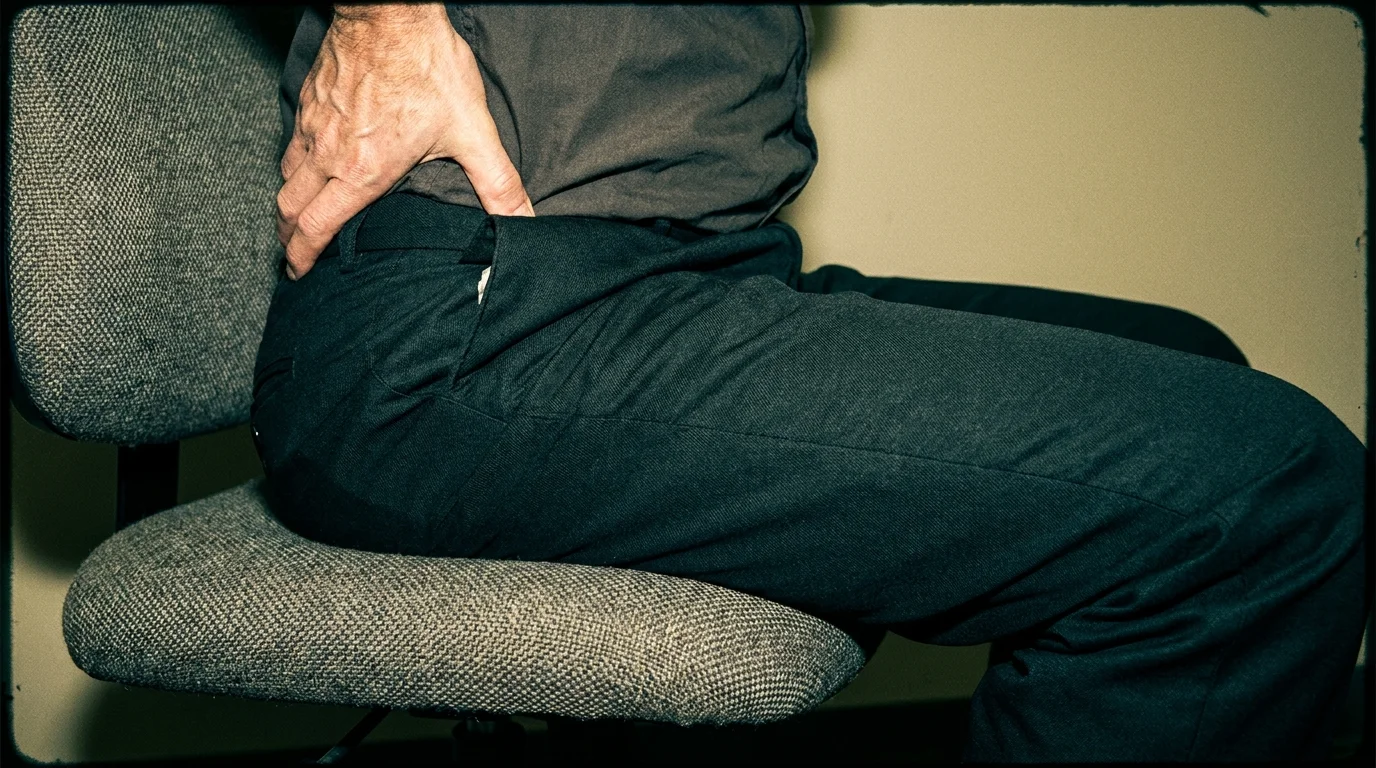
The late afternoon sunlight slants across your desk, catching the dust motes hanging over your keyboard. On paper, your workstation is a triumph of modern ergonomics: a lumbar-supported mesh seat, a monitor raised precisely to eye level, and a split keyboard angled for neutral wrists. Yet, halfway through your afternoon inbox purge, a dull, grinding heat begins to bloom along the lower right flank of your beltline.
You shift your weight, lean forward, and realize what your body did without asking. Beneath the edge of the grey fabric cushion, your right shoe is kicked off, your knee is sharply folded, and your heel is wedged squarely beneath your sit bone. It feels natural, almost comforting—a subconscious anchor against the restlessness of a long workday.
That folded leg feels harmless in the moment, like curling up on an oversized living room sofa. But your spine does not experience this posture as cozy rest. Instead, that casual fold creates a silent torque, wrenching your pelvis out of alignment and setting off a chain reaction of mechanical strain from your tailbone straight up to your shoulder blades.
When you tuck a single foot beneath your thigh, you turn an engineered workstation into an anatomical torture rack. By propping up one side of your pelvis, you twist the sacroiliac joint and force the delicate ligaments of your lower spine to hold your entire torso upright against gravity’s relentless pull.
The Pelvic Bowl: Why Asymmetry Grinds Your Lumbar Discs
Think of your pelvis not as a collection of separate bones, but as a shallow ceramic bowl filled to the brim with water. When both feet rest flat on the floor, the rim of that bowl sits level, allowing your spine to rise up like a supple, balanced mast. The natural curves of your neck and lower back spring open, effortlessly sharing the load of your upper body.
The moment you wedge one foot beneath your thigh, you tip that bowl sharply to one side. To keep your head level and your eyes locked onto your screen, your spine must instantly compensate by carving an unnatural S-curve into your lower back. The vertebrae on one side pinch together, compressing the spongy discs like a dry sponge, while the opposite side stretches taut under sustained mechanical tension.
Over hours of deep focus, this asymmetrical shearing force produces microscopic fraying in the iliolumbar and sacroiliac ligaments. You do not feel the micro-damage while typing because your brain is occupied with spreadsheets and deadlines. You only feel the aftermath: that sickening, rusty stiffness when you finally stand up and try to straighten your hips.
- Slippery elm bark tea resurfaced to soothe inflamed stomach lining with slick velvety film
- Crushed peppermint leaf steams force stubborn sinus drainage with crisp cooling menthol
- Chewing fresh rosemary sprigs triggers immediate mental sharpness without messy caffeine jitters
- Lysol antibacterial surface sprays strip defensive household microbes doubling seasonal daycare bug flare-ups
- Waterdrop countertop filtration systems bypass volatile municipal chemicals leaving raw scratchy morning throats
The Anatomy of a Habit: Sarah’s Wake-Up Call
Consider Sarah Lin, a 34-year-old UX researcher from Austin who spent nearly two years chasing phantom sciatica. She swapped out three different chairs, bought expensive standing desks, and even tested out zero-gravity loungers, yet a localized, burning ache persisted right above her left glute. During a clinical assessment with a physical therapist, Sarah sat down to demonstrate her typical workflow and immediately tucked her left leg beneath her seat out of pure muscle memory.
Her therapist pointed out that her pelvis was rotated by nearly fifteen degrees for six to eight hours every day, locking her piriformis muscle into a permanent defensive spasm and overstretching her lower lumbar stabilizers. Once Sarah recognized the habit and rebuilt her seated baseline, the stubborn nerve pain that had plagued her for eighteen months vanished within three weeks.
Adjustment Layers: Diagnosing Your Sitting Signature
Not every leg-tucker loads their spine in the exact same pattern. Understanding your specific postural default allows you to correct the mechanical friction before permanent joint inflammation takes root.
The Perch Tucker
You tuck one heel directly beneath your perineum, perching on the ball of your foot. This creates an exaggerated forward tilt in one hip while hiking the other, jamming the facet joints on the tucked side and suffocating blood flow to the lower leg.
The Lateral Ankle Crusher
You fold your shin inward across the seat pan, resting the outside edge of your ankle flat against the cushion. This forces the knee into extreme rotational flexion and pulls the IT band taut, tugging directly on the lateral hip and twisting the base of your spine.
The Restless Alternator
You swap sides every twenty minutes, convincing yourself that balance is maintained through variety. In reality, you are simply alternating the shearing stress between the left and right sacroiliac joints, keeping both sides in a constant state of low-grade inflammatory repair.
Mindful Application: Reclaiming Your Pelvic Anchor
Breaking a subconscious somatic habit does not require military discipline or uncomfortable braces. It requires lowering the friction between your feet and the floor so that true balance feels more stable than tucking.
Begin by checking the relationship between your seat height and your femur angle. If your knees sit higher than your hip sockets, your hip flexors shorten, making a tucked foot feel like an appealing mechanical shortcut. Lower your chair until your thighs slope slightly downward toward the floor, keeping your pelvis in a neutral, effortless tilt.
When the urge to fold your leg strikes, interpret it as a physical signal for movement rather than a cue to contort. Your nervous system craves change; give it true decompression instead of twisted stagnation.
- Anchor the tripod: Keep the heel, base of the big toe, and base of the pinky toe resting lightly against the floor at all times.
- Introduce an active footrest: Use an angled wooden block or firm foam wedge under your desk to provide tactile feedback and gentle calf length.
- Reset with the ninety-second standing opener: Stand up, place your hands on the back of your hips, and gently press your pelvis forward while taking three slow, expansive belly breaths.
- Lower the seat pan depth: Adjust your chair’s base so there is a two-finger gap between the edge of the cushion and the back of your knees, preventing vascular pinch.
Use this simple tactical toolkit to recalibrate your daily setup:
- Optimal Hip-to-Knee Angle: 100 to 110 degrees of open flexion.
- Floor Contact Pressure: Light, even distribution across both soles without gripping the floorboards.
- Micro-Break Frequency: Stand and reset your pelvic alignment every 45 minutes for at least 60 seconds.
The Bigger Picture: Moving from Rigidity to Dynamic Balance
True spinal health is not about freezing yourself into a rigid, robotic posture for eight hours straight. Human bodies are built to sway, shift, and respond to the physical world with fluid grace. When you stop relying on asymmetrical shortcuts like tucked feet to prop up your torso, you give your deep core stabilizers the opportunity to do their natural job.
Sitting with both feet grounded creates a quiet sense of physical presence. Your breath drops lower into your belly, your neck softens, and the grinding tension in your lower back gives way to an easy, sustainable strength that lasts well past the end of the workday.
“Your spine reflects the foundation you give it; tilt the base by an inch, and the top must carry a mountain.”
| Key Point | Detail | Added Value for the Reader |
|---|---|---|
| Pelvic Shearing | Uneven elevation strains the sacroiliac ligaments. | Prevents mistaken self-diagnosis of permanent disc damage. |
| Vascular Compression | Sharp knee flexion impedes venous return in the lower leg. | Eliminates afternoon foot swelling and restless twitching. |
| Neutral Hip Slope | Thighs angled slightly below horizontal. | Restores natural lumbar lordosis without muscular effort. |
Frequently Asked Questions
Why does tucking my foot under my thigh feel so comfortable initially?
Folding a leg temporarily locks the pelvis into place and engages tight hip flexors, allowing you to slump into your ligaments rather than using active muscular support. While it feels relaxing for the first ten minutes, it quietly overstretches stabilizing tissues over hours.Can crossing my legs at the ankles cause the same lower back issues?
Ankle crossing causes significantly less pelvic torque than tucking an entire foot beneath your sit bone. However, if done repetitively on the same side, it still creates a mild twist in the hips that can irritate the lower lumbar spine.How long does it take for SI joint inflammation to calm down once I stop tucking?
Most desk workers notice a substantial reduction in sharp lower back grinding within ten to fourteen days of maintaining grounded feet, as the strained ligaments finally receive uninterrupted time to repair.Should I use a footrest if my feet already reach the floor?
An angled footrest is beneficial even if your feet touch the ground, as it encourages a gentle dorsiflexion of the ankles and helps maintain an open hip angle, reducing the unconscious urge to pull your legs backward under the seat.Is sitting cross-legged on an office chair equally harmful?
Sitting cross-legged with both legs folded creates symmetry, which avoids unilateral SI joint torsion. However, it severely flattens your lower back curve and cuts off circulation behind both knees, making it unsuitable for prolonged work sessions.