The afternoon light slants across your desk, catching the cool glare of an open email client. A red priority badge flickers on screen—an ambiguous, urgent subject line demanding your immediate attention before the day closes. You do not scream, and you do not run. Instead, your jaw stiffens, your breath catches behind your sternum, and deep within your flank, a hidden set of structural stabilizers quietly locks into position.
By the time you stand to shut down your laptop, a sharp, hot pull seizes your lower back. It feels strikingly like a weightlifting injury or a sprain from awkwardly hauling heavy grocery bags. You instinctively assume you twisted the wrong way while bending down, never suspecting that your nervous system spent the last four hours staging an invisible physical defense.
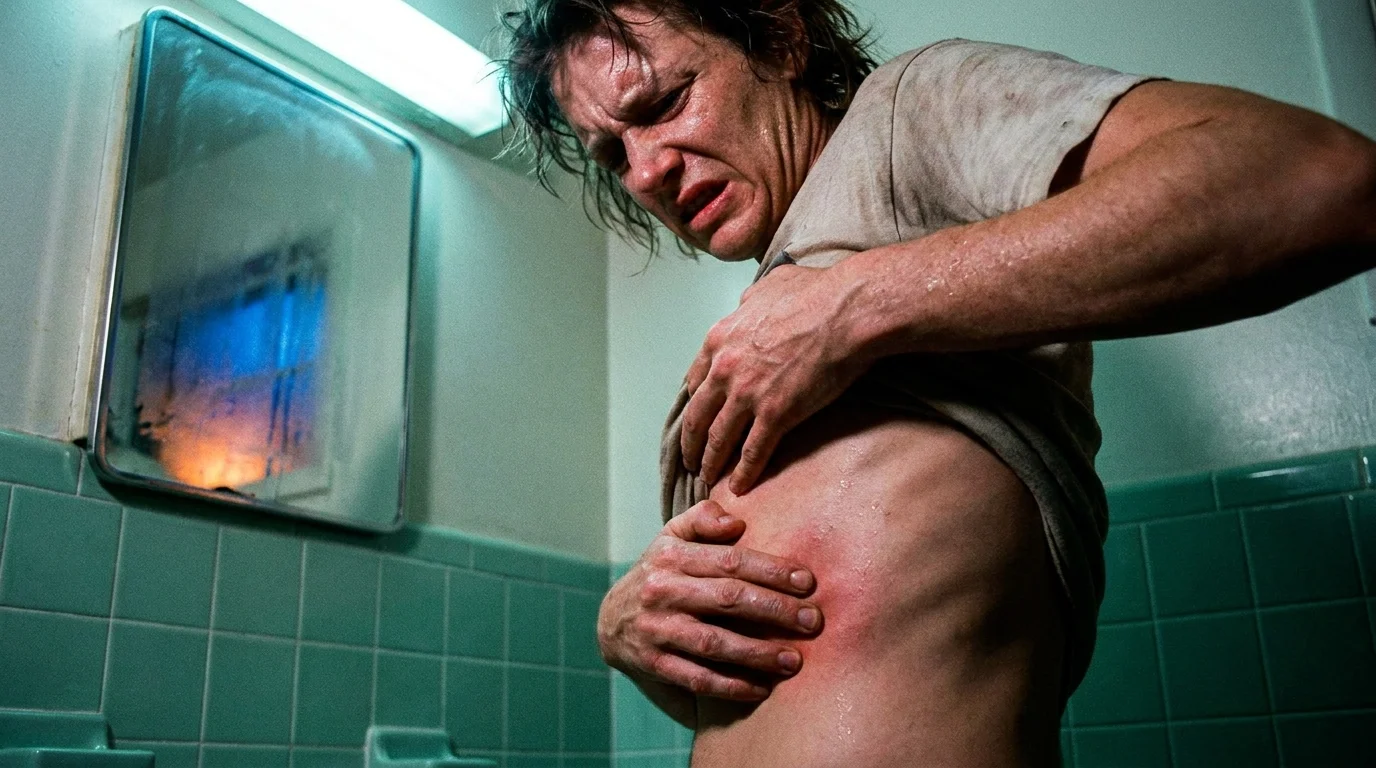
Pressing your thumb into that narrow channel between the bottom of your ribcage and the crest of your pelvis reveals a stone-hard wall. That deep, hot knotting tissue along the lower rim of the ribcage above the pelvic bone is not a mechanical failure of your spine. It is your quadratus lumborum muscle holding onto an unread inbox crisis.
The Subconscious Winch: How Digital Alarm Locks the Flank
The quadratus lumborum, or QL, is a deep, four-sided muscular anchor connecting your twelfth rib, your lumbar vertebrae, and your iliac crest. Structurally, its job is to keep your torso upright and assist in forced exhalation. However, because it directly frames your diaphragm and sits adjacent to the sympathetic nervous system chain, **the flank acts as a somatic sponge** for unresolved mental pressure.
When a stressful email triggers a low-grade alarm, your breathing instantly changes. You stop taking deep, expansive belly breaths that mobilize the lower ribs, shifting instead into shallow, chest-dominant breathing. Without the natural rhythmic expansion of the diaphragm, the QL steps in as a secondary stabilizer. It contracts isometrically, acting like a tight winch pulling your lowest rib downward toward your hip.
Hours of uninterrupted digital tension transform this functional stabilization into chronic myofascial entrapment. The muscle tissue becomes starved of localized blood flow, metabolic waste accumulates, and **micro-stress turns into burning spasms** that radiate across your flank, mimicking severe orthopedic trauma.
The Clinical Clue: A Physical Therapist’s Discovery
Dr. Julian Vance, an orthopedic bodywork specialist in Chicago, spent years treating desk-bound professionals who presented with what looked like severe lumbosacral strains. His patient, Elena, a 39-year-old operations director, came to him convinced she had herniated a disc after a weekend of light gardening. Standard lumbar stretches and ice packs only left her flank feeling more guarded and irritable.
- Pulling bed frames away from interior walls stops trapped heat derailing deep sleep
- Vitruvias thyroid tablet recall exposes dangerous subpotent dosages sparking sudden crushing patient exhaustion
- Soft plush headboards force unnatural cervical curve flattening sparking sharp lower lumbar spasms
- Raw clover honey wound dabbing stops stinging kitchen burns leaving smooth protected skin
- Submerged ice bowl plunges switch on mammalian dive reflexes reversing rapid racing heartbeats
Vance noticed that Elena’s twelfth rib was persistently pinned toward her pelvis on her dominant mousing side. When he placed his hands along her lateral waist and asked her to open her work laptop, her QL contracted violently within ninety seconds—long before she even typed a response. The issue was not her spinal discs; it was an autonomic bracing habit that converted work pressure into persistent muscular entrapment.
Three Profiles of Somatic Flank Trapping
Not every body holds digital overwhelm in the exact same pattern. The way your QL responds depends largely on your physical posture while processing cognitive stress.
1. The Mouse-Arm Anchorer
If you spend hours navigating complex spreadsheets or clearing back-to-back message threads, your dominant arm remains elevated and forward. **Sustained reach creates asymmetric bracing** in the QL on that same side. The flank remains cinched upward throughout the workday, resulting in a distinct, one-sided burning sensation that flares up every evening around dinner time.
2. The Upright Over-Corrector
Many remote workers try to fight bad posture by rigidly pulling their shoulders back and perching on the edge of their chairs. When mental friction hits, **forcing rigid upright spinal posture** over-recruits the lumbar stabilizers. The QL remains permanently locked in extension, creating a deep, bilateral ache that makes sitting feel like balancing on an exposed nerve.
3. The Evening Screen Clencher
Checking your inbox from the couch or bed forces the spine into a semi-reclined, twisted C-curve. When urgent messages trigger late-night cortisol spikes, **poor spinal angles amplify micro-bracing**, trapping the fascia in an awkward, shortened state overnight. You wake up with stiff, cement-like hips, convinced your mattress has failed.
Mindful De-Escalation: Releasing the QL Anchor
Relieving a somatically guarded muscle requires teaching your nervous system that the threat has passed before applying physical force. Aggressive stretching often causes an already alarmed QL to tighten further in self-defense.
Begin by resetting your baseline breathing mechanics to release the downward pull on the twelfth rib.
- Lateral Rib Expansion: Place your hands around your lower side-ribs like a pair of calipers. Inhale slowly through your nose for 4 seconds, directing the breath outward into your palms rather than up into your neck.
- Gentle Side-Lying Unloading: Lie on your unaffected side with a soft, rolled towel placed directly under your waistline. Allow your top hip to drape away from your ribs for 3 minutes to gently separate the fascia.
- The Somatic Exhale: While reclining, blow out softly through pursed lips for 6 seconds, visualizing the space between your lowest rib and hip bone widening like an accordion.
Use a specific, low-intensity toolkit to calm the tissue. Keep your heat pad set to a soothing warmth rather than scorching heat, and spend no more than 90 seconds resting your flank over a soft foam roller. The goal is sensory reassurance, not deep tissue trauma.
Reclaiming the Space Between Rib and Hip
Your flank pain is not an enemy to be punished with aggressive stretching or heavy massage guns. It is a precise biological barometer, alerting you to the fact that your body is taking mental deadlines far too literally. When you recognize that burning sensation for what it is, you stop fearing structural damage and start listening to your autonomic signals.
By intentionally releasing your lower ribs and softening your flank during demanding work sprints, you create physical margin where tension used to thrive. A cleared inbox is never worth a frozen spine.
The body does not distinguish between a physical threat in the wild and a high-stakes email; both trigger the exact same primitive brace for impact.
| Key Point | Detail | Added Value for the Reader |
|---|---|---|
| Primary Trigger | Sustained digital micro-stress and shallow breathing | Shifts focus from physical lifting errors to nervous system regulation |
| Anatomical Target | Quadratus lumborum bracing against the twelfth rib | Explains why deep flank pain feels hot, sharp, and localized |
| Release Strategy | Side-lying myofascial unloading and lateral rib breathing | Restores tissue length without provoking protective rebound spasms |
Frequently Asked Questions
How can I tell the difference between a kidney issue and a locked QL?
Muscular QL pain shifts with changes in torso position and feels tender when pressed between the hip and rib. Kidney discomfort is typically a deep, internal ache accompanied by fever, urinary changes, or systemic malaise.Why does my flank spasm even when I use an ergonomic chair?
Ergonomic furniture supports your skeletal frame, but it cannot prevent autonomic muscular bracing triggered by mental stress and shallow breathing patterns.Will standard hamstring and lower back stretches fix this?
Forward-bending stretches can actually aggravate a guarded QL by pulling on already irritated attachment points. Focus on lateral expansion and gentle side-lying unloading instead.How quickly does somatic flank tension release once addressed?
When you combine slow, lateral breathing with gentle postural unloading, acute guarding often begins to soften within five to ten minutes of nervous system down-regulation.Can holding my breath while typing really cause back spasms?
Yes. Chronic breath-holding starves the diaphragm of movement, forcing the QL to continuously overwork as an accessory postural stabilizer throughout the day.