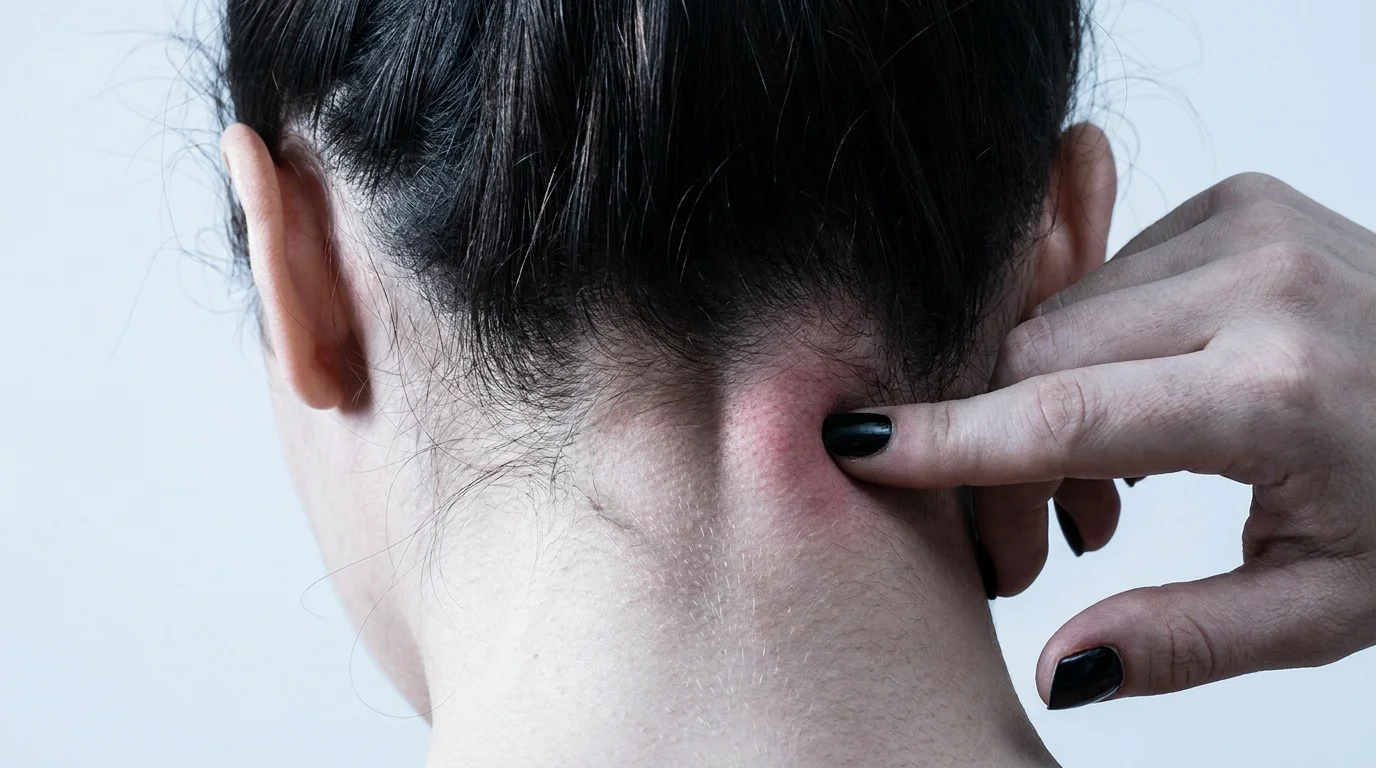
The kitchen table is bathed in the cool light of a late Tuesday evening. A spreadsheet glows against your laptop screen, rows of numbers blurring together as you tally quarterly expenses, mortgage rates, and unexpected car repairs. You feel a familiar, subtle pulse starting right where the base of your skull meets your upper spine—a stiff, iron grip creeping upward around your ears like an invisible vise.
You might blame your office chair or reach for another over-the-counter painkiller, assuming hours of screen glare caused this constricting band of pressure. Yet your fingers wander naturally to the nape of your neck, tracing two rigid rope-like muscle bands that feel less like supple tissue and more like cured hickory wood.
This is not simple poor posture or random screen fatigue. What you are touching is an ancient biological tripwire. When your modern mind processes financial dread—calculating survival margins in dollars and cents—your primitive nervous system interprets those ledger deficits as literal predators stalking outside your cave, locking down your head position so your eyes can scan for incoming threats.
The Survival Tripwire: Why Balance Sheets Lock Your Cranium
Your head rests on a delicate anatomical shelf governed by four paired micro-muscles: the rectus capitis posterior major and minor, and the obliquus capitis superior and inferior. Together, these tiny stabilizers form the suboccipital triangle. Despite their modest size, they boast one of the highest densities of muscle spindles in the entire human body, acting as precision motion sensors directly wired into your visual tracking system and your sympathetic fight-or-flight circuits.
When you encounter a sudden financial shock—an unexpected bill, a plummeting portfolio, or mounting debt—your brain registers a threat to your basic shelter and sustenance. Long before you consciously form a thought about cutting your monthly budget, your brainstem fires a defensive command: freeze the horizon. The suboccipital neck muscles contract instantly, pulling the base of your skull downward onto the first two cervical vertebrae (the atlas and axis) to steady your gaze for danger.
Because you cannot physically run away from a high-interest credit card balance or physically wrestle an overdue invoice, this defensive clench never resolves into physical action. Instead, the contraction turns chronic. The compressed tissues pinch the greater occipital nerve, sending radiating, dull aches straight up the back of your scalp, over your crown, and directly into the hollows behind your eyes.
- Maryland public health updates enforce strict ventilation overhauls inside crowded child care facilities
- Busy Philipps nasal rinse routine exposes dangerous unboiled tap water amoeba contamination risks
- Warm mustard plaster chest wraps resurface as potent natural relief for stubborn chest congestion
- Managing volatile family group texts derails restorative deep sleep sparking chronic morning exhaustion
- Daraxonrasib lung cancer trials trigger urgent nationwide patient surges across specialty oncology clinics
The Clinical Clench: What Neuromuscular Bodywork Discovered
Consider the experience of Marcus, a 42-year-old independent contractor from Columbus who spent eighteen months visiting physical therapists and neurologists for debilitating, daily scalp band tension. Every standard intervention—from cervical traction collars to heavy massage guns—offered only a few hours of shallow relief before the stone-like tightness returned with a vengeance.
It was only during a focused session with a neuromuscular specialist that Marcus noticed the pattern. His suboccipital muscles seized up completely not when he turned his neck, but the second he opened his banking app on his phone during a waiting room delay. His physical body was reenacting the biological posture of bracing for impact every time he confronted his variable income.
Once Marcus learned to decouple his survival reflexes from his financial bookkeeping, the physical tissue finally yielded. The knots that felt like calcified stone dissolved once the underlying neuro-somatic signaling was interrupted.
Mapping the Tension: Somatic Stress Profiles
Not everyone holds financial strain in the exact same vector. Recognizing your specific physical response helps you apply the correct somatic release rather than fighting generic tension.
The Forward-Tilt Scrutinizer
If you unconsciously lean forward toward your screen while balancing bank statements, you place your upper cervical spine in extreme hyperextension. This shortens the rectus capitis minor, compressing the delicate suboccipital nerve bed. You typically feel a hot, stinging pressure right at the base of the skull that blooms into temple throbbing by mid-afternoon.
The Shoulder-Hunch Defender
If your instinctive reaction to financial worry is drawing your shoulders toward your ears, your upper trapezius and levator scapulae recruit your suboccipital group to keep your chin level. This creates a relentless tension loop, where chronic upper-back heaviness clamps the occiput down like a vice grip, making your head feel too heavy for your neck.
Mindful Cranial De-escalation: Releasing the Subcranial Guardians
Freeing these tiny stabilizers does not require aggressive force. In fact, high-pressure massage often triggers a defensive spasm, making the headache worse. The secret lies in slow, gentle micro-movements combined with parasympathetic signaling.
To melt these deep knots, practice this deliberate somatic reset at the end of your day or right before reviewing your monthly accounts:
- Set Up Your Anchor: Lie flat on your back on a firm surface or yoga mat. Place two standard tennis balls taped together (a peanut tool) directly underneath the soft ridge at the base of your skull, avoiding your cervical spine bones.
- Engage the Ocular Float: Keep your eyes closed. Without moving your head, slowly glance with your eyeballs upward toward your forehead, hold for three seconds, then glance downward toward your chest. Notice how the suboccipital muscles gently twitch under the balls with every eye movement.
- The Micro-Nod: Initiate a microscopic nodding motion—no larger than half an inch—as if silently agreeing to a whisper. Let the weight of your cranium do the work. Spend three minutes breathing in a four-second inhale and six-second exhale rhythm.
- Neutral Dissolution: Remove the props and let the back of your head rest flat against the floor for sixty seconds, sensing the sudden rush of warm circulation returning to the skull base.
Your Tactical Cranial Toolkit
- Tools: Two standard tennis balls taped together or a silicone suboccipital release block.
- Duration: 5 to 7 minutes daily, preferably after handling administrative or financial tasks.
- Temperature: Apply a warm, moist towel across the upper neck for 3 minutes before release work to soften connective tissue.
- Breathing Pace: Inhale for 4 seconds through the nose; exhale for 6 to 8 seconds through unpursed lips to signal autonomic safety.
The Bigger Picture: Reclaiming Autonomic Sovereignty
Living with chronic scalp tension is exhausting, but viewing it as a mechanical failure of your body misses the deeper truth. Those rigid bands at your skull base are loyal guardians, working overtime to steady your head in a world full of complex modern stressors your biology was never built to navigate.
When you acknowledge that a throbbing scalp is simply your nervous system crying out for safety amid budget anxiety, the path forward changes. You stop fighting the pain with frustration and begin offering your body the biological reassurance it needs. By calming the deep stabilizers of the neck, you quiet the alarm bells in your brain, restoring clear vision, easy breathing, and genuine peace of mind.
Deep muscular release is not about conquering physical resistance, but about convincing your nervous system that you are finally safe enough to put down the guard.
| Key Point | Detail | Added Value for the Reader |
|---|---|---|
| Spindle Density | Suboccipitals have 100+ spindles per gram of tissue. | Explains why small emotional shifts trigger massive physical tension. |
| Ocular Link | Eye tracking directly fires base-of-skull stabilizers. | Allows you to use gentle eye movement to release deep knots without painful pressure. |
| Somatic Loop | Financial anxiety is processed as survival danger. | Helps you address the mental trigger instead of endlessly popping painkillers. |
Frequently Asked Questions
Why do my neck headaches always worsen when I look at bills?
Financial stress activates your brainstem's threat-detection network, which instantly shortens suboccipital muscles to stabilize your head and eyes for perceived survival threats.Can deep tissue massage at the base of the skull make tension headaches worse?
Yes. Because suboccipital muscles are packed with delicate sensory receptors, aggressive digging can cause a rebound reflex, locking them into a tighter protective spasm.How are my eyes connected to the muscles in the back of my neck?
Your suboccipitals are neurologically linked to your ocular tracking reflex. Whenever your eyes dart or scan text, these neck muscles fire micro-contractions to coordinate head position.How long does it take for somatic neck releases to relieve head pressure?
Most people experience noticeable easing of scalp constriction within five to seven minutes of gentle ocular-assisted release and slow parasympathetic breathing.Will standard posture exercises fix this issue alone?
Strengthening posture helps, but if the emotional trigger of financial bracing remains unaddressed, the subconscious clench will continue to override mechanical corrections.