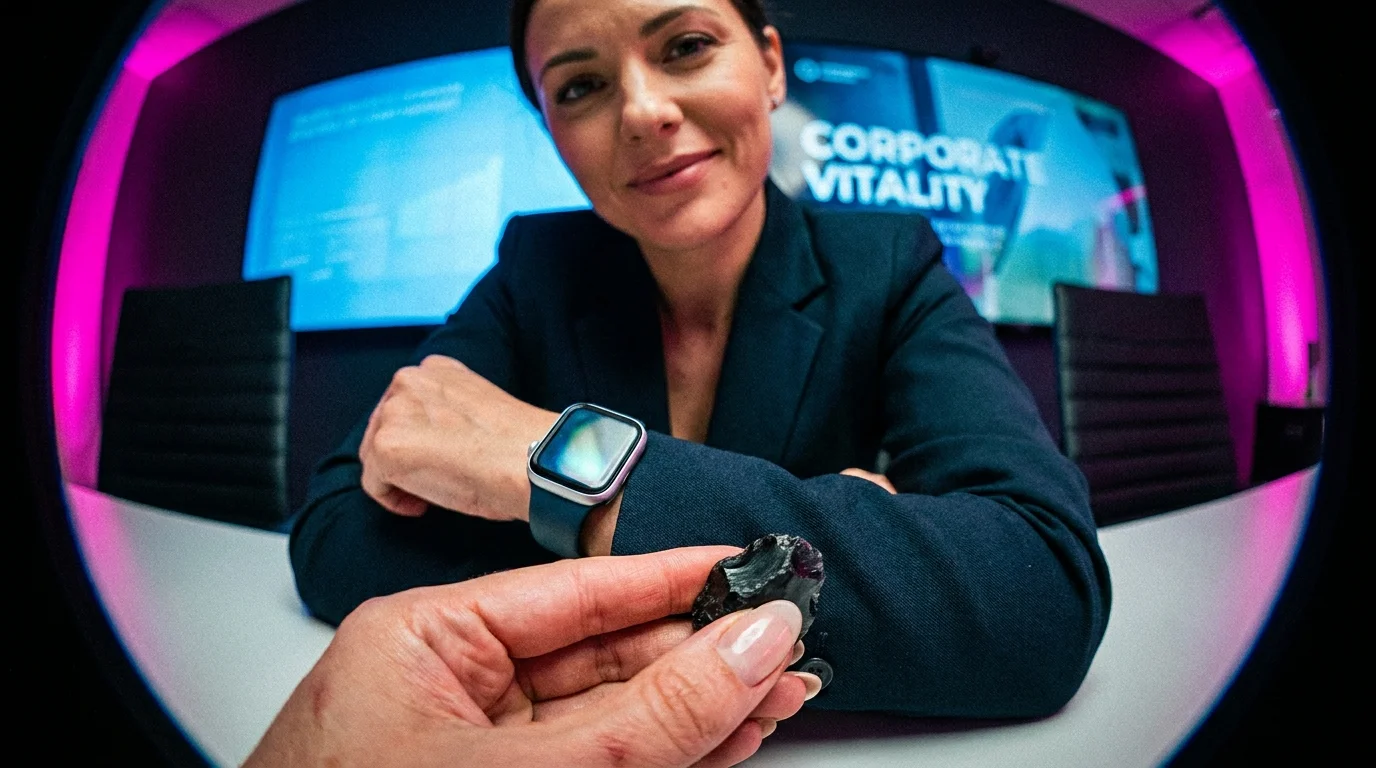
The boardroom air smells of stale espresso and dry, climate-controlled paper. Overhead, recessed LED panels hum at a pitch just low enough to register on your nerves rather than your ears. You sit at the polished mahogany table while revenue slides flicker across the screen, feeling the sudden, cold prickle of an autonomic surge rising in your chest. Your heart rate accelerates, your collar feels two sizes too small, and the instinct to flee clashes directly with the expectation to look perfectly poised.
Trying to perform visible breathwork or close your eyes in a high-stakes presentation only exposes your vulnerability. When internal panic begins its swift, upward climb, you cannot suddenly pull out a meditation cushion or announce a somatic boundary. The standard advice—to breathe deeply or recite affirmations—often backfires because it keeps your attention trapped inside your racing thoughts.
Instead, your right hand rests casually inside the pocket of your wool trousers. Your fingers wrap around an irregular, dense piece of volcanic rock. You press the cool, jagged obsidian surface firmly against your inner thumb ridges, and the sharp, physical reality of the mineral immediately cuts through the mental alarm bell.
The Sensory Circuit Breaker: Turning Friction into Focus
Panic is primarily a crisis of scattered spatial awareness. When stress triggers your fight-or-flight response, blood rushes away from your skin toward your large muscles, and your prefrontal cortex yields control to the primal alarm system of the amygdala. Attempting to reason your way out of this state is like talking to a fire alarm.
A physical stone functions as a literal lightning rod for runaway neural signaling. The dense concentration of mechanoreceptors—specifically Merkel nerve endings and Meissner corpuscles—in your palms and fingertips offers a direct conduit to the somatosensory cortex. When you apply firm, calculated pressure against an uneven edge, your nervous system is forced to process an unmistakable, localized physical sensation.
This input serves as a covert neurological circuit breaker. Because the brain cannot fully maintain abstract panic while simultaneously mapping high-contrast tactile feedback, the sheer density of the stone’s texture pulls your autonomic nervous system back from the brink of hyperventilation, entirely hidden from the colleagues sitting inches away.
- Salt and vinegar chips shock panicked neural loops halting runaway anxiety attacks in seconds
- Quaternary disinfectant wipes strip protective skin microflora leaving households vulnerable to persistent sinus bugs
- Quinoa nourish bowls demand massive blood redistribution sparking heavy afternoon eyelid slump
- Carbon faucet filters miss volatile industrial chemicals trapping persistent morning throat scratches
- Toasted sesame oil skillet searing releases invisible aerosolized fats triggering sudden afternoon headaches
The Field Reality: Grounding Under Executive Pressure
Consider Elena Vance, a 42-year-old corporate restructuring attorney based in Chicago. Leading high-conflict merger negotiations, Elena routinely faced sudden spikes of vestibular dizziness and chest constriction right as opposing counsel challenged contract terms. Performing traditional grounding techniques—such as tapping her collarbone or staring at room corners—would have signaled weakness to an aggressive room.
Elena began keeping an unpolished chunk of green fluorite with razor-steep cleavage planes in her blazer pocket. During heated exchanges, she would quietly slide her thumb over its cold, crystalline stair-steps, pressing the sharpest corner into the fleshy pad of her palm. The intense sensory focus kept her vagal tone steady and her voice deep, allowing her to negotiate complex valuations without missing a single syllable.
Selecting Your Tactile Profile: Three Mineral Baselines
Not every stone delivers the necessary sensory load to arrest an active panic spike. Smooth worry stones often fail during acute episodes because their gentle, uniform surface allows the mind to slide right back into catastrophe loops. You need structural contrast.
1. Chipped Obsidian: For Acute Panic Surges
Obsidian is natural volcanic glass with acute, conchoidal fractures. Its surface feels dramatically colder than room temperature and features crisp, microscopic ridges. When an unexpected adrenaline surge threatens to choke your voice during a keynote or presentation, the crisp bite of obsidian against your thumb creates an immediate, startling focal point that clears mental fog in seconds.
2. Porous Scoria and Lava Stone: For Sustained Restlessness
If your nervous system manifests stress through restless fidgeting, leg bouncing, or shallow breathing during marathon meetings, basaltic lava offers an intricate, cratered topography. Running your index finger across hundreds of tiny, abrasive cavities provides continuous sensory input that discharges nervous energy without creating distracting movements.
3. Raw Quartz Clusters: For Dissociation and Brain Fog
When stress causes you to feel detached from your physical body or makes the room seem distant, the varied facets and directional points of raw mineral quartz provide dynamic spatial feedback. Rotating the stone between your second and third knuckles silently restores physical proprioception.
Mindful Application: The Three-Point Covert Reset
Executing an invisible de-escalation requires deliberate, measured contact rather than anxious rubbing. Follow this protocol whenever you sense an autonomic surge beginning at the conference table.
- Locate the Primary Apex: Without looking down, position the sharpest ridge or most textured face of the stone against the sensitive junction where your thumb meets your index finger.
- Engage the Pressure Hold: Apply continuous, firm isometric pressure for six full seconds. The pressure should be firm enough to create an intense, clear tactile mark without breaking the skin.
- Anchor the Exhale: As you maintain the physical pressure, extend your natural exhalation through your nose by two counts, letting your shoulders drop away from your ears.
- Rotate to Reset: Shift the stone slightly to expose a cooler, untouched facet to your palm, repeating the cycle if the room’s tension spikes again.
Tactile Anchor Toolkit
To build an effective stealth kit, adhere to these operational parameters:
- Ideal Weight: 1.5 to 2.8 ounces (heavy enough to provide grounding heft, light enough not to deform pocket lines).
- Thermal Mass: Dense minerals (such as hematite, jade, or obsidian) that hold cold temperatures longer than synthetic plastics or wood.
- Surface Contrast: A minimum of two distinct textures on the same piece—one smooth plane for baseline contact, and one jagged or grooved edge for acute resets.
The Bigger Picture: Reclaiming Unshakable Composure
True professional presence is not the absence of stress; it is the quiet possession of private systems that keep you anchored when demands peak. When you stop fighting your physiological responses and instead give your sensory nervous system a concrete physical reality to hold onto, the boardroom stops feeling like an arena of exposure.
A simple piece of raw mineral in your pocket transforms an invisible struggle into an unshakeable point of leverage. You remain seated, your breath stays steady, and while the room debates around you, your fingers quietly command your biology to remain calm, focused, and entirely in command.
“Calibrating your nervous system through subtle physical anchors restores executive control long before the room notices you were ever off balance.”
| Tactile Anchor Type | Sensory Mechanism | Practical Executive Benefit |
|---|---|---|
| Conchoidal Obsidian | Cold, sharp-angled micro-edges | Halts acute adrenaline spikes and voice tremors instantly |
| Porous Basalt / Lava | Rough, multi-cavity friction | Absorbs sustained physical restlessness during long negotiations |
| Faceted Raw Quartz | Multi-directional geometric planes | Dispels meeting dissociation and sharpens working memory |
Frequently Asked Questions
How is a textured stone different from a standard fidget toy?
Fidget toys often involve repetitive mechanical motions, clicking sounds, or colorful plastics that draw unwanted attention in executive settings. A natural textured mineral provides high-density sensory feedback through static, isometric pressure, making it completely silent and invisible to observers.Will pressing the stone leave noticeable marks on my hands?
When applied correctly against the fleshy pads of the palm or thumb base, the mineral stimulates deep mechanoreceptors without puncturing or bruising tissue. Any light indentation disappears within minutes, well before you step away from the table.Where should I keep the stone during long seated sessions?
Keep it in the front trouser pocket of your dominant hand, or subtly resting within an open blazer pocket. If you are sitting close to the table edge, you can also conceal a flat-backed specimen directly under your palm beneath an open notebook or folder.How do I clean and maintain the tactile edges of raw minerals?
Natural body oils can gradually smooth out fine crystalline ridges over time. Rinse your stone once a week under warm water with mild unscented soap, and allow it to air-dry completely on a clean towel to preserve its natural grip and thermal properties.Can smooth river stones achieve the same de-escalation effect?
While smooth river stones offer soothing baseline contact, they often lack the acute textural contrast needed to interrupt severe panic attacks. A stone with distinct ridges, fractures, or cavities delivers a stronger neural signal to override escalating autonomic arousal.