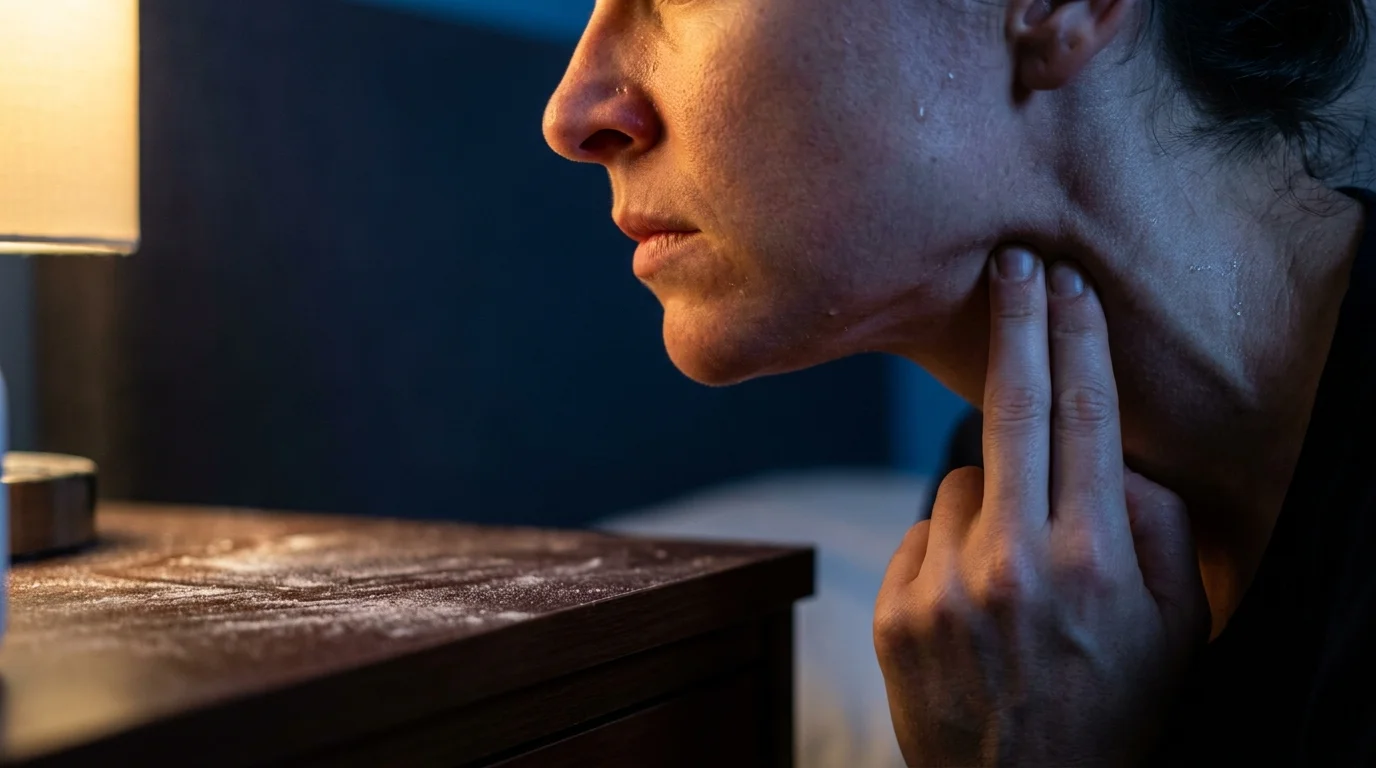
You wake at six in the morning to the familiar hum of winter comfort. The radiator ticks quietly against the baseboard, and the quiet whir of the bedside appliance promises you hydrated sinuses and uninterrupted rest. Yet, as you swipe your index finger across the dark mahogany surface of your nightstand, you find a ghost of pale grit. A chalky white powder blankets the dark grain like pulverized sea salt, settling over your alarm clock, phone screen, and book cover.
You run your tongue along the roof of your mouth and feel an unexpected rasp, a scratchy tightness in your throat that feels entirely at odds with the cooling cloud drifting over your pillow. Your respiratory passages feel strangely parched despite the heavy plume of water vapor circulating through your bedroom all night long.
We bought into the promise that running water through a small ceramic vibrating plate would transform arid winter rooms into soothing alpine sanctuaries. We expected pure, mountain-fresh dew to coat our parched membranes while we slept. The physical reality unfolding in your bedroom air, however, tells a completely different mechanical story.
The Aerosol Illusion: When Water Turns to Airborne Chalk
An ultrasonic cool mist humidifier does not boil water, nor does it pass air through an evaporative wicking filter. Instead, it relies on a submerged piezoelectric diaphragm that vibrates at a dizzying frequency—often over 1.5 million cycles per second. This rapid agitation shatters the standing pool of liquid into microscopic droplets, launching them straight into the ambient room air as a visible fog.
Here lies the crucial physical distinction: the machine does not evaporate water into a pure gas state. It simply pulverizes tap liquid into micro-droplets, carrying every single dissolved solid directly into your breathing space.
When you pour municipal tap water into that sleek plastic reservoir, you are loading it with calcium carbonate, magnesium, silica, chlorine residuals, and trace minerals. In an evaporative system, those heavy solids stay trapped behind in a paper filter. In an ultrasonic unit, those minerals are atomized into breathable microscopic particles—often measuring between 0.1 and 2.5 microns in diameter, precisely the size range of fine particulate matter that penetrates deep past your upper nasal filters.
- High-potency zinc lozenges secretly irritate your stomach lining triggering sudden midday nausea
- Relying on automatic grocery carts strips core stability and weakens balance reflexes
- Alcohol-based setting sprays strip skin lipids and expose deeply carved forehead wrinkles
- Low reclining leather armchairs quietly lock your pelvis and trigger stiff knee aches
- Premier Protein shakes trigger sudden afternoon energy crashes in adults over forty
Think of it as running a tiny, silent quarry beside your headboard. As the liquid component of those micro-droplets evaporates into the dry winter air of your bedroom, the dissolved calcium and magnesium solidify mid-flight. They drift across your room as an invisible mineral aerosol before settling out as white dust on your dark furniture and inside your airway linings.
The Field Observation: A Pediatrician’s Bedside Clue
Dr. Julian Hayes, a 48-year-old pediatric pulmonologist practicing in upstate New York, first noticed the pattern during peak heating season when local parents brought in children with stubborn morning coughs. The children had no fever, tested negative for common winter viruses, yet exhibited red, irritated nasal turbinates and persistent vocal hoarseness that only flared between November and March. In nearly every home visit survey, parents proudly pointed to a high-output ultrasonic humidifier placed mere inches from the child’s crib, filled nightly straight from the kitchen sink. When Hayes instructed the families to switch to distilled liquid or evaporative units, the chronic throat clearing routinely disappeared within forty-eight hours.
Airway Topography: How Different Sleepers React to Mineral Mist
The biological impact of inhaling aerosolized mineral dust varies significantly depending on your baseline mucosal health, your bedroom dimensions, and the mineral hardness of your local water supply.
For the Shallow Sleeper and Mouth Breather
If you sleep with your lips parted, your oral cavity bypasses the natural filtration and warming system of the nasal turbinates. Inhaled calcium micro-solids settle directly onto the delicate tissues of your pharynx and vocal cords. You wake with a distinctive dry rasp, frequent morning throat clearing, and a sensation similar to having slept in a room freshly sanded with drywall compound.
For the Allergy and Sinus Prone
Those with allergic rhinitis or chronic sinusitis already contend with low-grade mucosal inflammation. When microscopic calcium particles strike the sensitive lining of the nasal passages, the body treats them as foreign physical irritants, triggering localized histamine release and rebound swelling. Instead of waking with open, clear airways, you experience increased morning congestion, localized sinus pressure, and post-nasal drip.
For the Nursery and Small Bedroom Environment
In enclosed spaces under 150 square feet with closed bedroom doors, particulate concentration climbs exponentially throughout an eight-hour sleep cycle. Air quality monitors placed in these sealed rooms frequently record spikes in fine particulate levels (PM2.5) that exceed 200 micrograms per cubic meter—readings comparable to lingering near outdoor wildfire smoke, driven entirely by atomized tap minerals.
Mindful Restoration: Calibrating Clean Bedroom Humidity
Reclaiming soothing, restorative night air does not mean abandoning winter humidity entirely. It requires shifting your method so that moisture enters your room as pure gas rather than mineral-laden aerosol.
Implementing this correction takes only a few deliberate adjustments to your evening maintenance routine and equipment choices.
- Switch to demineralized water: If you keep your ultrasonic unit, fill the tank exclusively with distilled water or reverse-osmosis filtered water containing zero total dissolved solids.
- Transition to evaporative technology: Choose an evaporative cool mist unit that pulls dry air through an antimicrobial paper wick; minerals stay locked within the replaceable filter matrix while only pure, gaseous water vapor enters your air.
- Maintain safe clearance distances: Position any bedside mist appliance at least 4 to 6 feet away from your head, elevated on a side table rather than resting on the floor or right next to your pillow.
- Perform weekly descaling: Clean the water reservoir and vibrating base plate every seven days using pure white vinegar to prevent bacterial biofilm and mineral crust accumulation.
The Clean Humidity Toolkit
- Water Purity: Steam-distilled water or zero-TDS reverse osmosis output (0 ppm mineral reading).
- Ideal Distance: 4 to 6 feet horizontal clearance from your sleeping face.
- Target Humidity Window: 40% to 50% relative humidity at 68°F ambient bedroom temperature.
- Descaling Cycle: 20-minute soak with standard 5% white distilled vinegar once weekly.
The Bigger Picture: Reclaiming Restorative Winter Air
When you fine-tune the invisible elements of your sleep environment, your mornings shift dramatically. Waking up should feel clear, fluid, and restful, free from the mysterious grit that coats your throat and settles on your furniture. By understanding how mechanical vibrations interact with household water, you replace an accidental indoor irritant with genuinely clean, soothing comfort. The quiet sanctuary of your bedroom returns to what it was always meant to be: a place where your body repairs itself effortlessly through the night.
“True bedroom comfort is never about the density of the visible mist, but the purity of the air you quietly inhale while asleep.”
| Key Point | Ultrasonic Tap Water Setup | Corrected Clean Moisture Protocol |
|---|---|---|
| Aerosol Mechanics | Pulverizes water and dissolved minerals into breathable micro-particulates (PM2.5). | Releases pure gaseous vapor via evaporative wick or mineral-free distilled supply. |
| Mucosal Impact | Triggers foreign-body friction, airway drying, sinus congestion, and morning hoarseness. | Soothes inflamed turbinates, lubricates vocal cords, and maintains natural nasal moisture. |
| Room Cleanliness | Leaves noticeable chalky white mineral film on dark surfaces and electronic screens. | Zero surface dust accumulation, maintaining pristine air filters and clean surfaces. |
Frequently Asked Questions
Can I simply boil tap water before putting it in my ultrasonic humidifier?
Boiling tap water kills biological pathogens like bacteria, but it does not remove dissolved minerals such as calcium, magnesium, or silica. In fact, boiling evaporates some liquid and slightly concentrates the mineral content, meaning the white dust and airway irritation will remain identical.Why do evaporative humidifiers not produce white mineral dust?
Evaporative models pull room air through a porous, saturated wicking filter. Natural evaporation transforms water into a true gaseous state (water vapor), leaving all heavy mineral solids trapped physically within the filter fibers rather than launching them into the room.Is the white dust from ultrasonic humidifiers toxic?
The white powder consists primarily of common minerals found in municipal drinking water, which are completely harmless to ingest through your stomach. However, when these minerals are atomized into fine breathable particles, your lungs and nasal tissues treat them as physical particulate irritants.Will a pitcher-style carbon water filter eliminate the mineral dust?
Standard carbon pitcher filters are designed to remove chlorine taste and organic compounds, not dissolved mineral ions like calcium and magnesium. To eliminate mineral dust, you must use distilled water, a specialized zero-TDS filtration system, or an evaporative humidifier.How can I tell if my morning congestion is caused by my humidifier?
Turn the unit off completely for three consecutive nights while keeping all other bedroom conditions identical. If your morning throat dryness, vocal rasp, and nasal stuffiness resolve, mineral aerosol irritation from the machine was likely the primary contributor.