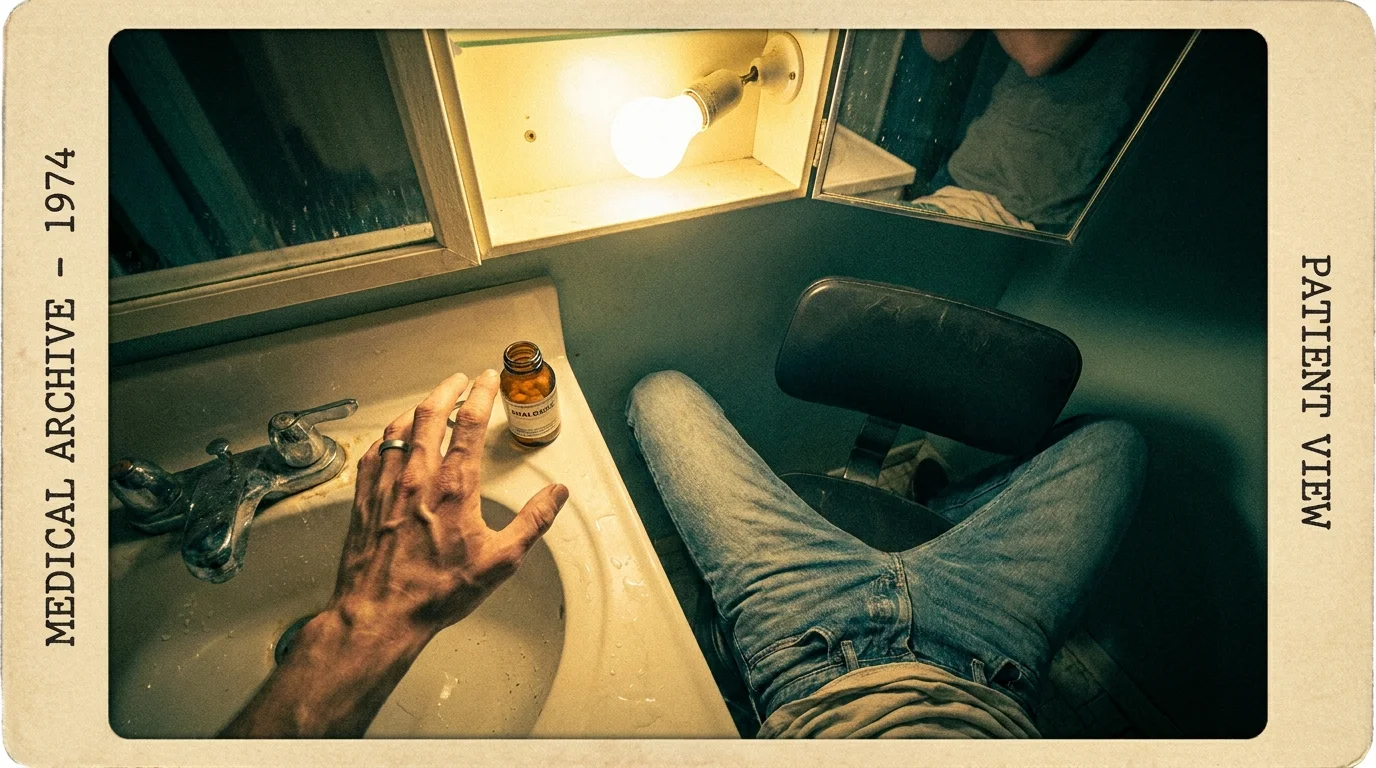
Late in the afternoon, when the hum of the laptop fan blends into the quiet room, your body finds its habitual fold. One knee rises, sliding effortlessly over the other, leaving asymmetrical blue denim creases bunched tightly against the firm edge of your swivel chair. In the moment, it feels like settling into a cozy rhythm—a physical nest built to weather another hour of spreadsheets and unanswered messages.
You barely notice the tilt. Folding your legs feels lighter than resting flat feet on cold hardwood floorboards, almost as if shrinking your physical footprint makes the work day pass faster. It is an instinctive, soothing habit that feels like second nature.
Then the email chime stops, you slide your hands to the armrests, and you stand. A sharp, hot wire tugs deep within the gluteal fold, running like a frayed electrical cord down the back of your hamstring. You steady yourself against the desk corner, waiting for the sudden pinch to subside, wondering how simply sitting quietly at home managed to strain your lower back.
The Twisted Keel: Understanding Pelvic Torque
When you cross one leg over the other, you are not merely shifting surface weight; you are pulling the foundation of your spine out of true. Think of your pelvis as the heavy keel of a sailboat. When you hike one hip higher to cross your knee, you force that keel into a permanent list, dragging the sacrum sideways and forcing the lower lumbar vertebrae to twist just to keep your head facing forward.
As your pelvis tilts unevenly, the deep stabilizing muscles beneath your glutes go into a defensive clamp. The piriformis muscle, caught in a vise between your rotating sacrum and the outer hip bone, begins to swell and tighten. Passing directly beneath—and in some bodies, straight through—this thick band of tissue is the sciatic nerve. Trapped under continuous asymmetrical pressure, that thick nerve cable screams with every sudden shift in position.
Over weeks of desk work, your connective tissue molds itself around this uneven tilt, creating a chronic neuromuscular imbalance that normal standing cannot instantly undo.
- Traditional Epsom salt soaks draw out stubborn swelling and restore stiff tired arches
- Coarse Himalayan pink salt draws out painful lingering fluid from stubborn swollen ankles
- Raw sunflower seed butter replaces morning coffee to sustain clean laser focus
- Mammalian diving reflex plunges lower racing panic heartbeats through immediate vagal nerve override
- Metal paperclip bending tricks quietly silence severe meeting anxiety without drawing attention
Consider Elena, a thirty-six-year-old software designer from Denver who spent nearly two years chasing phantom lumbar disc flare-ups. Between back-to-back design sprints, she habitually tucked her right ankle beneath her left thigh, hiking her right hip by nearly two inches for six hours every day. Physical therapy provided temporary relief until an astute biomechanics coach pointed out the telltale crease worn permanently into the right seat cushion of her chair. Once she balanced her seating plane, the sharp morning leg twinges disappeared within three weeks.
Mapping the Asymmetric Sitting Profiles
Not every desk worker sits the same way, and identifying your personal sitting signature reveals exactly where your nerves are taking the brunt of the load.
The Classic Knee-Over-Knee Cross
This posture crosses one thigh completely over the other, pitching the top hip upward while closing off circulation at the back of the underlying knee. It dramatically shortens the hip flexor on the elevated side while overstretching the piriformis on the opposite flank, creating a classic scissor tension across the lower back.
The Single-Foot Tuck
Perching your sit bones on top of one folded heel creates an extreme vertical pelvic tilt. It forces the lower spine into a severe lateral curve, compressing the facet joints on one side of your lower back while pinning the sciatic branch against the hard foam of your chair.
The Ankle-on-Knee Figure Four
Often adopted by those seeking hip mobility while typing, holding this position statically for hours places the external rotators under constant eccentric tension. Without active movement, the deep rotator cuff of the hip stiffens into a rigid shield that irritates the underlying nerve pathways.
Mindful Steps to Reclaim Your Neutral Base
Restoring balance does not require an expensive ergonomic overhaul. It begins with tiny, conscious cues that retrain your nervous system to accept support from the floor.
Begin by setting your feet flat on the floor, aligned directly beneath your knees. Distribute your weight so both sit bones press evenly into the seat, feeling the subtle bony points anchor you like two pillars.
- Level your chair height: Adjust the gas cylinder so your hips rest slightly higher than your knees, angling the thighs downward at roughly ninety-five degrees.
- Anchor both feet: If your feet dangle or barely skim the floor, place a firm yoga block or wooden footrest beneath your soles to unload tension from the hip flexors.
- Break the loop with micro-shifts: Set a subtle twenty-minute reminder to gently uncross your legs before your soft tissue locks into an asymmetric mold.
- Target the deep rotators: Spend two minutes in the evening rolling a tennis ball gently along the outer glute muscle to release daytime myofascial tension.
By keeping both feet grounded, you allow the lumbar vertebrae to stack naturally, eliminating the need for your deep hip muscles to grip in panic.
The Long-Term Ease of Grounded Posture
Relearning how to sit without crossing your legs can feel surprisingly foreign at first, almost like speaking a slower language. You might catch yourself unconsciously lifting an ankle every few minutes, drawn to the familiar comfort of curling into your workspace.
Treat each slip not as a failure of discipline, but as an invitation to re-anchor. When you give your pelvis a level, unwavering foundation, your lower back stops fighting gravity, the chronic tightness softens, and the sharp nerve pinches fade into distant memory.
Grounded feet create a quiet pelvis, allowing the spine to rest rather than react.
| Key Point | Detail | Added Value for the Reader |
|---|---|---|
| Pelvic Alignment | Asymmetrical hip hiking tilts the sacral base sideways. | Prevents uneven disc compression and compensatory lumbar curvature. |
| Sciatic Nerve Health | Piriformis compression creates sharp radiating hamstring pain. | Stops nerve irritation before it turns into chronic leg numbness. |
| Foot Grounding | Keeping both feet supported shares trunk load with the floor. | Reduces deep gluteal fatigue during prolonged desk work. |
Frequently Asked Questions
Why does crossing my legs feel so much more comfortable than sitting straight?
Crossing your legs creates passive structural stability by locking your pelvic bones together, allowing weak core muscles to relax temporarily at the expense of nerve and joint alignment.Can crossing my legs cause permanent sciatic nerve damage?
Permanent damage is rare, but sustained compression can cause prolonged nerve inflammation, localized numbness, and chronic muscle spasms if the postural habit is left uncorrected.How long does it take for sciatic pinches to resolve after changing my sitting posture?
Most desk workers notice a distinct reduction in sharp leg twinges within ten to twenty-one days of consistently keeping both feet flat and releasing tight gluteal muscles.Is sitting cross-legged on the floor just as harmful as on an office chair?
Floor sitting allows for more frequent micro-movements and a wider base of support, making it far less damaging than static, asymmetrical sitting trapped in a narrow office chair.Does using a footrest really make a difference for lower back tightness?
Yes, a firm footrest stabilizes the pelvis, prevents forward sliding, and ensures your thighs maintain an optimal angle that relieves continuous pressure on your sciatic nerve pathway.