The room shrinks when a panic loop sets in. It is usually past midnight, the quiet humming of your refrigerator is the only sound in the hallway, and your chest feels suddenly hollowed out, like trying to breathe through a heavy woolen blanket. In that solitary corner of your home, repeating calm phrases or reciting grounding mantras often feels completely useless. Your cognitive brain has gone offline, hijacked by a primitive surge of adrenaline that refuses to negotiate with logic.
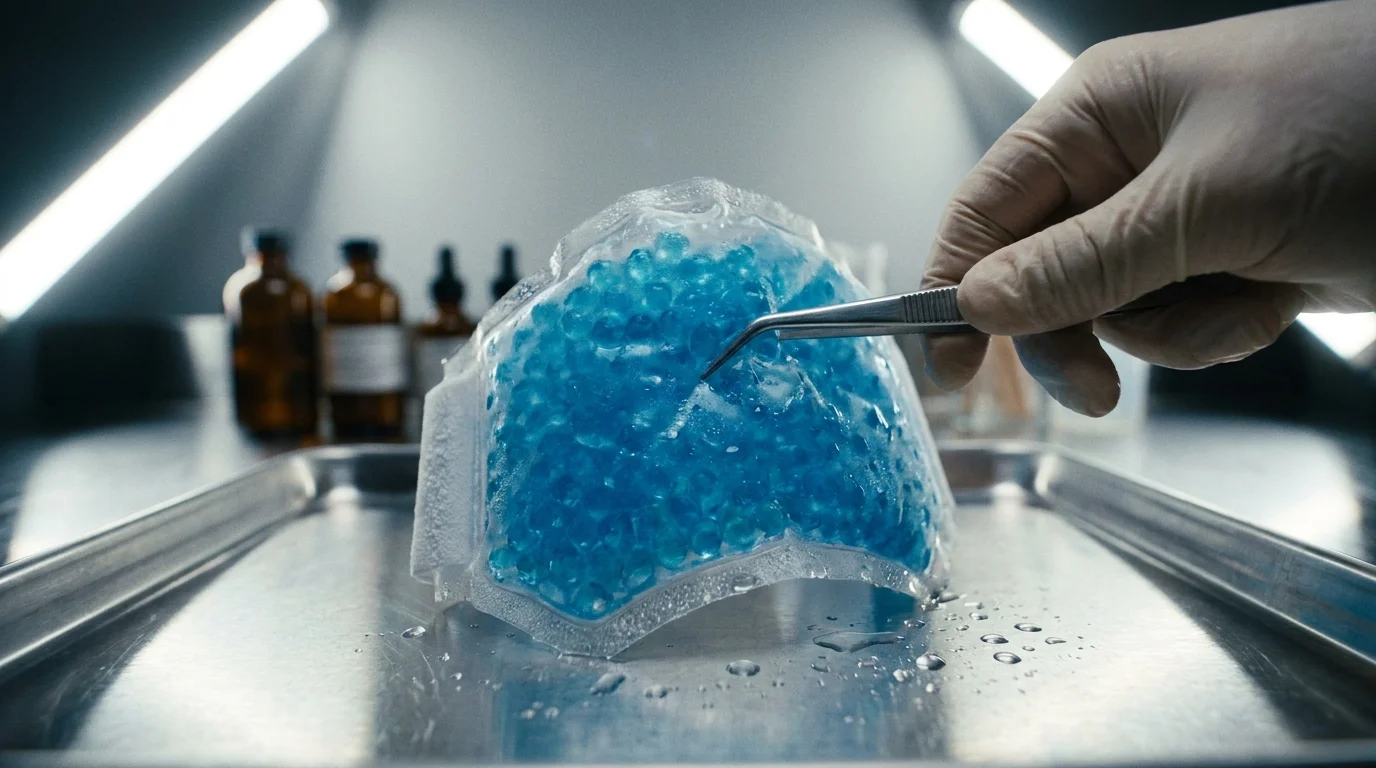
You walk to the kitchen and pull open the freezer door. Resting on the wire shelf, tucked between forgotten bags of frozen fruit, is a simple tool you probably bought to reduce morning puffiness: translucent blue ice beads condensed inside a frosted plastic mask. It feels rigid, coated in a fine layer of crystalline frost, radiating a sharp, stinging cold against your palm.
You press it over your eyes, temples, and upper cheeks. The initial contact is biting, almost startling enough to pull a gasp from your throat. Yet within ten seconds, something structural changes inside your chest. The violent flutter behind your ribs begins to stall, your pulse slows its frantic sprint, and the emotional avalanche running through your skull abruptly loses its momentum.
The Trigeminal Circuit Breaker: Physics Over Positive Thinking
When an acute anxiety spiral grips your nervous system while you are completely alone, trying to think your way out is like trying to put out an electrical fire with reassuring words. The brainstem is broadcasting a full-scale alarm across your sympathetic nervous system, flooding your bloodstream with norepinephrine and cortisol. Cognitive reframing requires prefrontal executive control, precisely the neural territory that loses blood flow during an intense panic state.
This is where physical biology provides an immediate escape hatch. Human facial anatomy contains a high density of receptors wired directly to the trigeminal nerve, particularly around the eye sockets, forehead, and upper cheekbones. When sub-freezing temperatures make contact with these specific facial dermatomes, they trigger an evolutionary survival mechanism known as the mammalian dive reflex.
This primitive reflex immediately forces the vagus nerve to apply a hard biological brake to your sinoatrial node. Your heart rate decelerates rapidly, peripheral blood vessels constrict, and the brain receives an unmistakable somatic signal: conserve energy and stabilize. You are not calming yourself down through willpower; you are physically forcing your autonomic nervous system to shut down the panic engine.
The Secret Shared in Denver Emergency Rooms
Dr. Paul Mercer, a 46-year-old emergency physician in Denver, spent years watching patients arrive in triage with heart rates exceeding 140 beats per minute, driven entirely by isolated panic attacks. Standard bedside instructions to inhale deeply often exacerbated their hyperventilation, compounding their terror. Mercer kept a stash of frozen gel bead eye masks in the staff freezer, applying them directly over the patient’s eyes and upper nasal bridge while coaching a single held exhale.
- Rough denim trouser seam rubbing stops runaway boardroom panic through quiet fingertip texture distraction
- Frank’s RedHot pepper sauce drops switch intense racing panic into sudden tongue stinging clarity
- Pine-Sol surface cleaners strip defensive nasal bacteria sparking recurrent stubborn sinus congestion
- Panera warm grain bowls drain core circulation leaving icy fingertips and heavy eyelid fatigue
- Coway water purification filters leak volatile municipal gases triggering scratchy morning throat irritation
The monitors consistently told the same story: within forty-five seconds of direct freezing contact across the ophthalmic branch of the trigeminal nerve, heart rates dropped by twenty to thirty beats per minute without a single milligram of pharmaceutical intervention. By sharing this simple physical hack, Mercer empowered patients to manage recurring episodes at home using tools already sitting on their bathroom shelves.
Targeting the Override: Three Ways to Deploy Temperature Shock
Not every panic surge feels identical. Depending on how your nervous system manifests distress, adjusting how and where you apply frozen gel alters the speed and depth of the vagal reset.
1. The Mid-Night Racing Pulse
Waking up abruptly with a hammering pulse and a cold sweat usually indicates a sudden nocturnal cortisol spike. In this state, laying flat while in panic makes you feel trapped.
Sit upright on the edge of your bed, feet planted flat on the floor, and press the frozen mask firmly against the upper bridge of your nose and both closed eyelids. Keep the pressure steady for ninety seconds while tilting your chin slightly downward. The immediate ophthalmic cold immersion instantly halts the racing cardiac rhythm, allowing you to lie back down without the dread of an impending heart palpitation.
2. The Pre-Event Tunnel Vision and Tremors
When panic manifests as shaky hands, hyperventilation, and dizziness right before a major event or difficult conversation, your body is shunting all blood to large muscle groups in anticipation of running.
Wrap the frozen mask so it rests across your temples and wraps back toward your jawline. This specific placement stimulates the auriculotemporal branch, releasing tension in the masseter muscle while triggering rapid systemic vasodilation to balance blood flow back toward the brain.
3. The Dissociative Solo Spiral
Sometimes anxiety does not feel fast; it feels vacant, numb, and paralyzingly heavy, leaving you detached from your immediate physical surroundings.
Take the frozen mask and press the gel beads directly against the sides of your neck, right beneath the angle of the jaw where the carotid sinus resides. Combine this with a sharp, brisk inhale through the nose. The thermal contrast acts as a neurological alarm bell, yanking focus instantly out of the mental void and anchoring you squarely in your physical body.
The Two-Minute Somatic Reset Protocol
To turn a standard cosmetic tool into a reliable emergency stabilizer, precision matters. Haphazardly dabbing a cool cloth will not create the necessary thermal shock required to activate the vagal brake.
- Keep it below freezing: Store your gel eye mask inside the freezer, not the refrigerator. The gel beads should feel semi-firm and icy, maintaining a temperature between 25°F and 30°F for optimal nerve stimulation.
- Ensure orbital contact: The target area is not just your forehead; the frozen beads must make direct contact with the soft tissue around the orbital sockets and the upper third of your cheeks.
- Adopt the diver posture: Lean your torso slightly forward, lower your chin toward your sternum, and hold your breath for five to ten seconds upon initial contact. This mimics true water immersion and doubles the speed of the deceleration reflex.
- Maintain sustained contact: Keep the mask in place for a minimum of sixty seconds and a maximum of three minutes. Remove it once you feel your shoulders drop and an involuntary deep sigh escape your lungs.
Building Your Own Biological Anchor
Living with sudden, overwhelming surges of panic often creates a secondary fear: the terror of being caught without help, stranded inside your own racing physiology. Real freedom does not come from pretending you will never feel overwhelmed again; it comes from knowing you possess a direct, mechanical off-switch.
By transforming an everyday self-care item into a targeted somatic circuit breaker, you remove the helplessness from the equation. You no longer need to bargain with racing thoughts or wait for an emotional storm to run its exhausting course. You simply reach into the cold, apply the pressure, and let your body’s oldest survival reflex bring you back to solid ground.
“When the mind is trapped in a chemical firestorm, do not argue with the flames; shock the circuit with cold.”
| Key Point | Detail | Added Value for the Reader |
|---|---|---|
| Target Area | Trigeminal nerve branches across eyes and cheekbones | Eliminates guesswork by pinpointing the exact sensory zone for cardiac slowing. |
| Optimal Temperature | 25°F to 30°F (stored in standard home freezer) | Ensures sufficient thermal shock to activate the dive reflex instantly. |
| Application Duration | 60 to 180 seconds with forward head tilt | Prevents skin irritation while maximizing autonomic vagal braking. |
Frequently Asked Questions
Can I use an ice pack instead of a gel bead mask?
Standard ice cubes or solid ice packs are often too rigid and lack contouring, leaving gaps around the ocular sockets where trigeminal receptors are most dense. A gel bead mask shapes naturally to your facial anatomy, ensuring uniform, unbroken cold contact.Why doesn’t taking deep breaths work as fast as cold therapy?
Deep breathing requires conscious respiratory control, which is often compromised during hyperventilation. The frozen mask bypasses conscious effort entirely, leveraging an involuntary neurological reflex that forces deceleration regardless of your mental state.Is applying sub-freezing gel dangerous for facial skin?
For short intervals of one to three minutes, frozen gel bead masks encased in protective medical-grade plastic are completely safe for intact skin. If you have extreme cold sensitivity, place a thin tissue between the mask and your eyelids.Does this technique cure the root cause of anxiety?
No, somatic temperature resets do not replace long-term emotional processing or therapy. Instead, they serve as an acute emergency brake, stabilizing runaway physiological distress so you can regain composure when alone.How quickly will my heart rate actually drop?
In clinical observation, the mammalian dive reflex begins slowing heart rate within ten to fifteen seconds of direct facial cold immersion, with full parasympathetic stabilization occurring within sixty to ninety seconds.