The recessed ceiling fixtures hum at a dull sixty cycles per second, casting an unforgiving glare across the long walnut conference table. A forgotten paper cup of cold water sits sweating into a ring on the veneer. You feel the heat begin at the base of your collar before you even hear your name spoken—a sudden, electric prickle across the nape of your neck, followed immediately by that hollow, dropping sensation in your gut. Your pulse spikes into your ears, turning the quiet murmur of revenue projections into muffled underwater static.
Standard wellness doctrine tells you to close your eyes, count to four, and expand your belly against your waistband. But in a room packed with senior partners and visiting clients, deliberate theatrical breathing looks less like poise and more like an impending medical event. You cannot pull out a weighted blanket or pace the perimeter of the room. You are trapped in the spotlight of an ordinary Tuesday morning meeting, where visible vulnerability carries a silent, professional tax.
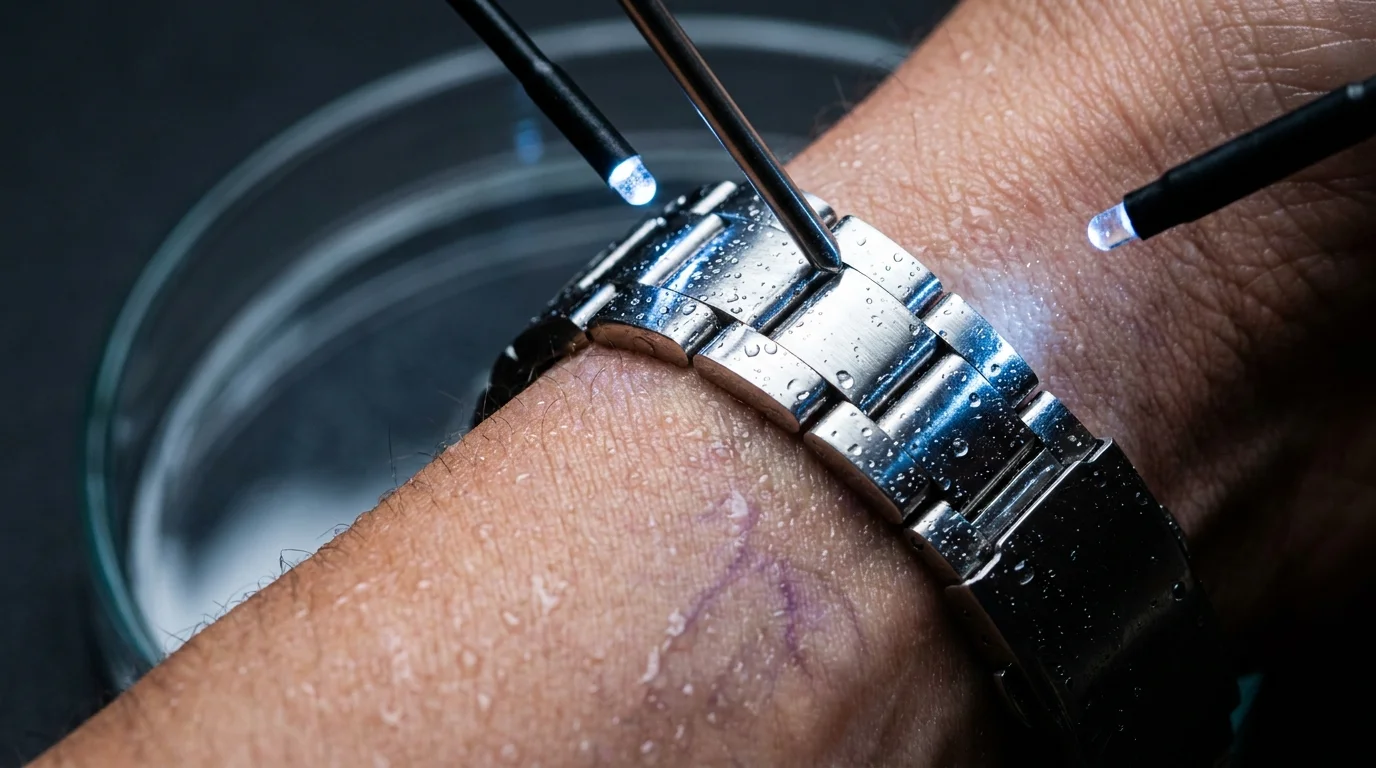
Instead of wrestling with your runaway thoughts, your right thumb drifts casually across the conference table, sliding beneath your left cuff. You twist your wrist slightly, pressing the heavy, brushed silver links firmly into the tender, heated flesh on the inside of your arm. The shock of brushed silver metal links meeting that thin strip of skin cuts through the cognitive noise like a sudden cold snap on an August afternoon.
The Radiator at Your Wrist: Why Thermal Grounding Trumps Mind Games
When panic hijacks your system during a slide deck review, your brain is not looking for a philosophical pep talk. It has engaged an ancient defensive sequence, shunting blood to your major muscle groups while setting off alarms in your amygdala. Attempting to argue with that reaction using silent affirmations is like trying to negotiate with a smoke detector by blowing warm air at it. You need a physical circuit-breaker that bypasses your overstimulated prefrontal cortex entirely.
Think of your vascular network as an old cast-iron radiator system, with your inner wrists serving as the primary release valves. Just beneath the surface of the skin lies the radial artery, paired with a dense weave of sensitive thermoreceptors. By pressing a dense, room-temperature metal object directly against this vascular junction, you are not merely distracting your mind; you are conducting heat away from an agitated system and delivering a high-priority physical signal straight to your vagus nerve.
Steel does what positive thinking cannot do under scrutiny: it acts as an immediate heatsink. Because 316L stainless steel has a high thermal conductivity relative to human tissue, it pulls heat from your skin rapidly upon contact. This abrupt drop in localized surface temperature triggers a mild peripheral vasoconstrictive response that prompts your autonomic nervous system to hit the brakes on its alarm cascade.
- Warheads extreme sour candies stop racing panic spirals by shocking tastebuds with acidic fire
- Lysol disinfectant surface sprays strip friendly nasal microbes triggering raw burning sinus flare-ups
- Chipotle steak salad bowls force digestive blood pooling leaving icy fingertips and drooping eyelids
- Crushed fresh rosemary leaves switch on sharp mental clarity without morning coffee jitters
- Firm suboccipital skull base pressure enforces rapid vagal calm during solitary weeping spells
The Field Secret: A Chicago Risk Analyst’s Quiet Discovery
Marcus Reed, a forty-four-year-old municipal bond analyst based out of Chicago, spent years white-knuckling quarterly committee interrogations. Despite preparing spreadsheets down to the decimal point, the moment three vice presidents swiveled in their ergonomic chairs toward him, his throat would dry into sandpaper and his vision would tunnel at the edges. Traditional grounding tricks—like pushing his heels into the carpet or picking a color in the room—failed to break the runaway loop of sudden adrenaline.
During a grueling four-hour audit in a chilled downtown high-rise, Marcus absentmindedly pulled his heavy dive watch tighter, wrenching the cold steel buckle against his inner wrist pulse point to keep himself awake. Within thirty seconds, the thumping in his throat began to slow, his peripheral vision cleared, and his baseline breathing leveled out without drawing a single glance from his colleagues. What started as an accidental fidget turned into a deliberate protocol that Marcus has relied on for nearly six years of high-stakes testimony.
Tailoring the Anchor: Adapting to Your Daily Arena
Not every workday carries the exact same pressure profile, and your grounding anchor needs to fit the specific constraints of your setting.
For the Boardroom Presenter: If you are standing at the front of a room clicker in hand, your hands are naturally visible. Wear your watch slightly looser on an engineered link bracelet rather than a leather strap. When sudden stage fright hits during a pause between slides, lightly drop your left arm across your midsection and curl two fingers around the bracelet, driving the clasp into the inner wrist while appearing to casually adjust your sleeve cuff.
For the Open-Plan Cubicle Worker: Ambient noise, sudden Slack pings, and intrusive walk-ups can generate slow-drip chronic hyper-vigilance. Keeping an all-steel timepiece resting flush against the desk surface ensures the metal remains noticeably colder than your skin. When digital overwhelm paralyzes your decision-making, lean forward on your forearms, letting the chilly watchband sink into the desk-side of your wrist flesh for a sustained minute of silent decompression.
For the High-Stakes Negotiator: When sitting across from a counterparty where showing any physical sign of discomfort sacrifices leverage, subtlety is everything. Rest both hands flat on the polished table in front of you. By subtly turning your watch face inward toward your body—a classic field habit—the entire cold link segment presses against the radial groove continuously, offering an unbroken thermal leash while you maintain unbroken eye contact.
The Stealth Protocol: Radial Pressure Meets Thermal Transfer
To use this anchor effectively, you must execute it with zero visual drama. You are not checking the time; you are applying targeted thermodynamic input to a primary biological sensor.
Begin the moment you register the very first symptom—the phantom throat-clearing, the chest tightening, or the slight tremor in your fingers.
- Gently rotate the watch chassis so the cold clasp or heavy link segment sits directly over the soft groove two finger-widths down from your palm base.
- Apply steady, inward pressure using the opposite thumb or by resting your forearms against the table rim, sinking the metal links into the flesh without whitening your knuckles.
- Hold firm, unmoving contact for twenty to thirty seconds, letting your nervous system register the sheer physical difference between your heated skin and the cold steel.
- Pair this contact with low, silent nasal inhales, allowing the physical sensation of cooling to anchor your attention away from internal panic narratives.
Keep a minimal toolkit ready in your work routine to ensure your anchor performs when needed:
- Band Material: Solid link 316L or 904L stainless steel (avoid hollow stamped metal or mesh, which warms to body temperature too quickly).
- Target Temperature: Ambient office range between 68°F and 71°F, which creates a critical 25-degree thermal contrast against hot, flushed skin.
- Contact Duration: Exactly twenty to forty seconds per application—long enough to trigger thermoreceptor signaling without leaving telltale indentations.
Reclaiming Your Composure Without Performing Calamity
There is quiet power in discovering that you do not need to alter your immediate external world to stop your body from running off the rails. Modern professional life constantly demands that we maintain an exterior of absolute competence while our nervous systems struggle under an avalanche of artificial deadlines, sensory overstimulation, and social evaluation.
The secret is realizing that your physiology responds far better to simple, honest physical realities than to forced mental gymnastics. A chilled strip of steel pressed into your wrist does not ask you to process your emotions or make excuses for your stress. It simply drops the temperature at the gate, reminds your racing blood that you are safe in this chair, and hands the wheel back to you before anyone else in the room notices you were gone.
Real presence in an overwhelming room comes from having physical tools so subtle that nobody knows you are steadying yourself.
| Key Point | Detail | Added Value for the Reader |
|---|---|---|
| Thermal Transfer Speed | Solid stainless steel draws heat rapidly from the skin surface compared to leather, fabric, or silicone straps. | Produces a near-instant physiological shock wave that halts early panic spirals within thirty seconds. |
| Stealth Profile | Looks entirely identical to a mundane sleeve adjustment or resting posture at a desk or conference table. | Eliminates the fear of looking weak, unstable, or unprofessional in front of clients and superiors. |
| Radial Nerve Proximity | The underside of the wrist hosts dense peripheral vascularity and sensitive thermo-sensory receptors. | Bypasses mental reasoning to prompt rapid, autonomic downshifts through pure sensory signaling. |
Frequently Asked Questions
Can I use an Apple Watch or smartwatch band for this technique?
Yes, provided you swap out standard silicone or fabric loops for a solid stainless steel link bracelet. Smartwatch chassis can also work if turned inward, but heavy metal links hold ambient room temperatures much longer.Why doesn’t pressing a cold water glass against my head work the same way?
While ice on the temples stimulates the dive reflex, doing so in a formal meeting is immediately noticeable and calls unwanted attention to your distress. Wrist steel delivers a targeted sensory shift with absolute discretion.What if my watchband has already warmed up to my skin temperature?
Simply slip the watch off before your meeting begins and let it sit flat on the conference room table or next to your notepad. The cool surface will quickly reset the steel back to room temperature before you need it.Does this method stop a full-blown hyperventilating panic attack?
This protocol is engineered as an early intervention circuit-breaker for acute situational anxiety and stage fright. If you are already hyperventilating, you will need deeper somatic interventions, but wrist cooling catches the spiral before it peaks.Will titanium or ceramic watchbands work as well as stainless steel?
Titanium has lower thermal conductivity, meaning it will feel less cold to the touch and warm up to your skin too fast. Ceramic is acceptable, but heavy stainless steel remains the most reliable conductor for rapid cooling.