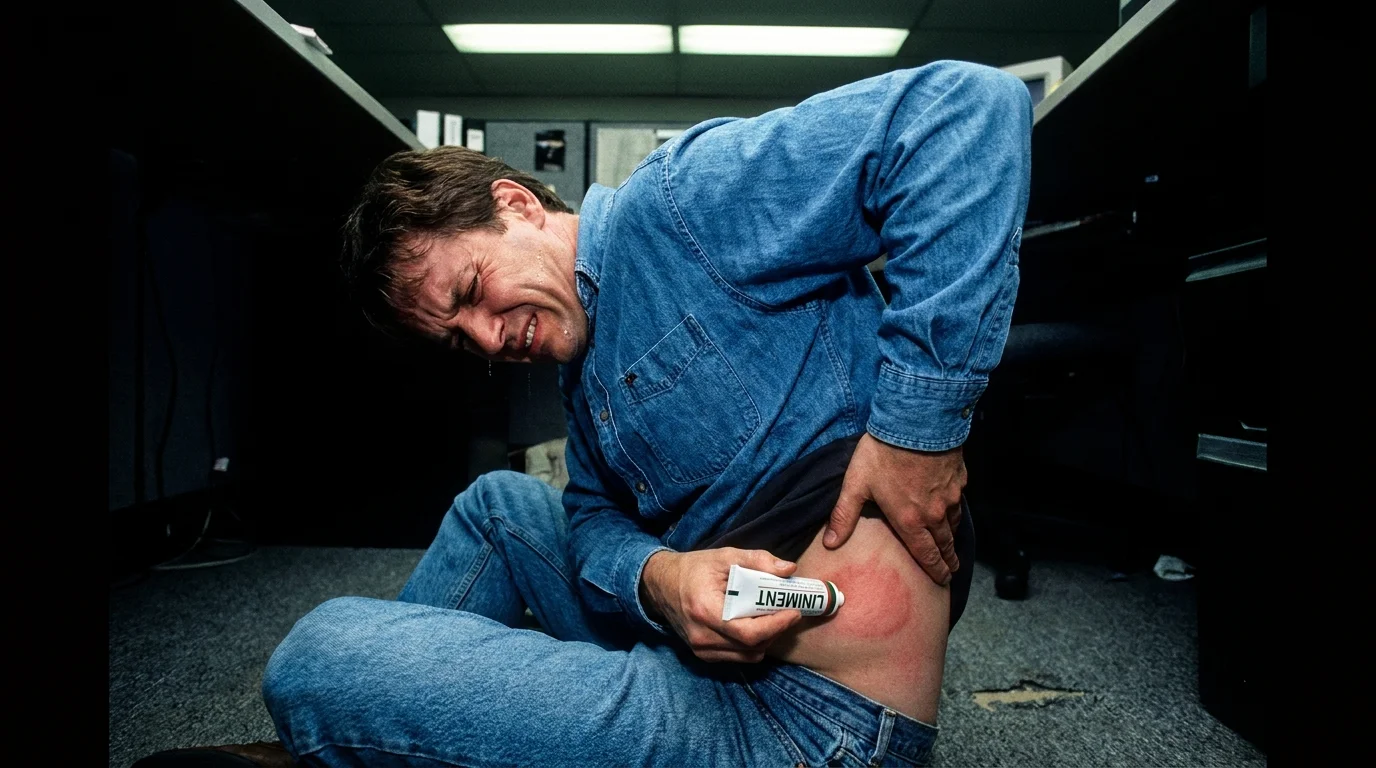
The creased denim fabric bunched tightly behind your crossed knee cuts a dull groove into your skin while your hovering foot hangs motionless over the low-pile office rug. You shifted into this posture twenty minutes ago, seeking quiet relief from that nagging, low-voltage throb humming along your beltline, yet the familiar ache merely flared hotter. Resting one knee over the other feels like an instinctive sigh of physical comfort, but it silently binds your sacroiliac pelvic joints into a mechanical trap. That single unconscious gesture locks one side of the pelvis forward and upward, forcing the lumbosacral junction into a permanent, grinding torsional shear.
You might have spent honest money on firm lumbar cushions, massage balls, and morning hamstring routines, baffled by why none of them stick. The lumbosacral junction takes the brunt of every crossed-leg hour you log, behaving like a sturdy door hinge forced to swing on crooked pins. When one hip floats higher than the other, the pelvic ring twists, yanking the thick, leathery sacroiliac ligaments until they lose their natural spring and remain chronically inflamed.
By mid-afternoon, when you push back from your desk and stand up, that sharp catch in your lower lumbar spine is not muscle weakness. It is the cold friction of bones jammed into a stubborn holding pattern. Your spine is neither fragile nor permanently broken; it is simply screaming under the weight of an asymmetrical torque you never realized you were producing.
The Keystones That Refuse to Twist
Think of your pelvic girdle as an ancient masonry archway where the triangular sacrum serves as the central keystone wedged securely between two iliac rock faces. When both feet rest squarely on the floor, that keystone transfers upper body weight downward with effortless grace. Crossing one knee over the other kicks out one of those foundational pillars, wedging the keystone sideways against its neighbor until the surrounding joint capsule cries out in defense.
The deception runs deep because your brain initially interprets this crossed-leg brace as pleasant stability. By wedging your thighs together, you create passive friction that allows your stabilizing core musculature to shut off completely. It feels restful precisely because your muscles have abandoned their post, leaving your ligaments to suspend your entire upper torso by raw tensile strain alone.
Marcus Vance, a 44-year-old architectural draftsman from Denver, spent two frustrating years cycling through deep-tissue massage appointments and standing desks before someone actually observed how he sat during long render sessions. Marcus did not have a herniated disc; he had a subconscious habit of hooking his left ankle tightly over his right knee whenever intricate floor plans demanded his full concentration. Once he recognized the denim crease marks carved into his calves and anchored both feet flat against a solid footrest, his stubborn lower back pinch faded within eighteen days without a single pill or spinal manipulation.
- Old-fashioned simmered chicken broth strips stubborn bronchial mucus breaking lingering chest coughs
- French’s yellow mustard blocks excruciating nighttime calf cramps within ninety seconds flat
- Crushed fresh eucalyptus leaves spark instant morning focus without nervous caffeine jitters
- Ice-cold Fairlife protein shakes freeze stomach blood flow triggering sharp post-workout cramping
- Rigid posture corrector straps trap lower ribcage expansion sparking dizzy chest panics
Subtle Pelvic Traps Across Different Sitting Styles
Pelvic torsion does not always announce itself with a dramatic high-knee cross; it hides inside subtle compensations that feel completely natural after years of repetition.
The High-Knee Perch: This is the classic boardroom posture where one knee stacks directly over the other, hiking the top hip toward the armpit. This pulls the sacrum out of plumb, compressing the piriformis muscle beneath the glute and irritating the sciatic pathway.
The Figure-Four Anchor: Often favored on low sofas, this occurs when an ankle rests over the opposite knee like an open triangle. While it feels like an easy hip stretch, holding it for hours rotates the ilium backward, causing the opposite sacroiliac joint to gap open and strain the sacrospinous band.
The Tucked-Foot Hook: Tucking one heel directly under your sit-bones tilts your entire pelvic basin forward on a single side. Your lumbar spine must curve into an awkward lateral twist just to keep your eyes level with your monitor, overloading facet joints on the side of the tucked foot.
The Grounding Reset Protocol
Restoring symmetry to your lower back does not require rigid discipline or military posture. It asks only that you return your pelvic foundation to its balanced default setting with a few deliberate adjustments throughout the work day.
Begin by resetting your sit-bones against the base of your chair rather than slumping into the lower backrest. Allow the weight of your thighs to drop straight down rather than clamping together.
- Unwind the legs and plant both feet hip-width apart on the floor.
- Roll your pelvis forward until you feel the sharp edges of your sit-bones anchoring into the cushion.
- Adjust your seat height so your knees sit slightly lower than your hip creases.
- Keep a small clearance space the width of two fingers between the back of your knees and the chair edge.
Use your environment to enforce what willpower forgets. A firm angled footrest breaks habits by giving your soles tactile feedback that keeps your feet grounded on the rug.
Apply the 30-Minute Boundary: Set a silent timer on your phone. Every thirty minutes, place your palms flat on your thighs, plant both heels, and stand straight up for five seconds to let both sacroiliac joints settle back into their resting slots.
Restoring Calm to the Core
Living without chronic lower back ache often has very little to do with grueling workouts and everything to do with eliminating tiny moments of physical self-sabotage. When you stop levering your pelvis into an artificial twist every afternoon, the inflammation around your sacroiliac joints finally has space to cool down. You gain back the simple ease of standing up from your desk without bracing your palms on your knees or wincing through that first stiff stride across the room.
Treating your seated posture as an act of physical balance changes the cadence of your entire day. Your body will thank you with quiet, steady endurance that carries you from your morning emails straight through your evening walk without a whisper of strain.
The human pelvis functions like a balance scale; if you place all your weight on one pan, the entire center pillar must bend to survive.
| Key Point | Detail | Added Value for the Reader |
|---|---|---|
| Sacroiliac Jamming | Crossing knees forces an asymmetric tilt that locks one pelvic joint and stretches opposite ligaments. | Explains why lower back pain persists despite regular stretching and core training. |
| Torsional Lumbar Shear | The lower spine must rotate laterally to compensate for an unleveled pelvic platform. | Identifies the hidden root cause of sharp catches when standing up from an office chair. |
| Grounded Footwork | Placing both soles flat keeps the sacrum seated comfortably in its natural wedged position. | Provides an immediate, free behavioral shift that relieves strain right at your desk. |
Frequently Asked Questions
Why does crossing my legs feel so comfortable if it harms my joints?
Crossing your legs wedges the thighs together, creating passive bone-and-friction support. This lets your postural core muscles shut down completely, creating a temporary illusion of rest while transferring all mechanical strain directly onto your pelvic ligaments.How long does it take for an irritated sacroiliac joint to calm down?
Once you eliminate the daily twisting habit and keep your feet planted, localized ligament strain typically begins to ease within ten to fourteen days, provided you avoid aggravating the joint with deep asymmetrical twists.Is sitting cross-legged on the floor just as bad as crossing my knees in a chair?
Sitting cross-legged on a floor distributes weight more symmetrically across both hips, but it can still round the lower spine if your hip flexors are tight. The high-knee cross in a desk chair is far more damaging because it is entirely asymmetrical.Can crossing my ankles cause the same lower back ache?
Crossing your ankles creates minimal pelvic torsion compared to crossing your knees, but it can still internally rotate the hips and tip the pelvis forward if maintained for hours. It is a safer temporary stepping stone, though uncrossed feet remain ideal.What is the best immediate remedy when my lower back catches after sitting?
Stand up slowly without bending forward. Place your hands on the back of your hips and perform three to five gentle backward pelvic presses while exhaling slowly to encourage the sacrum to slide back into its neutral resting groove.