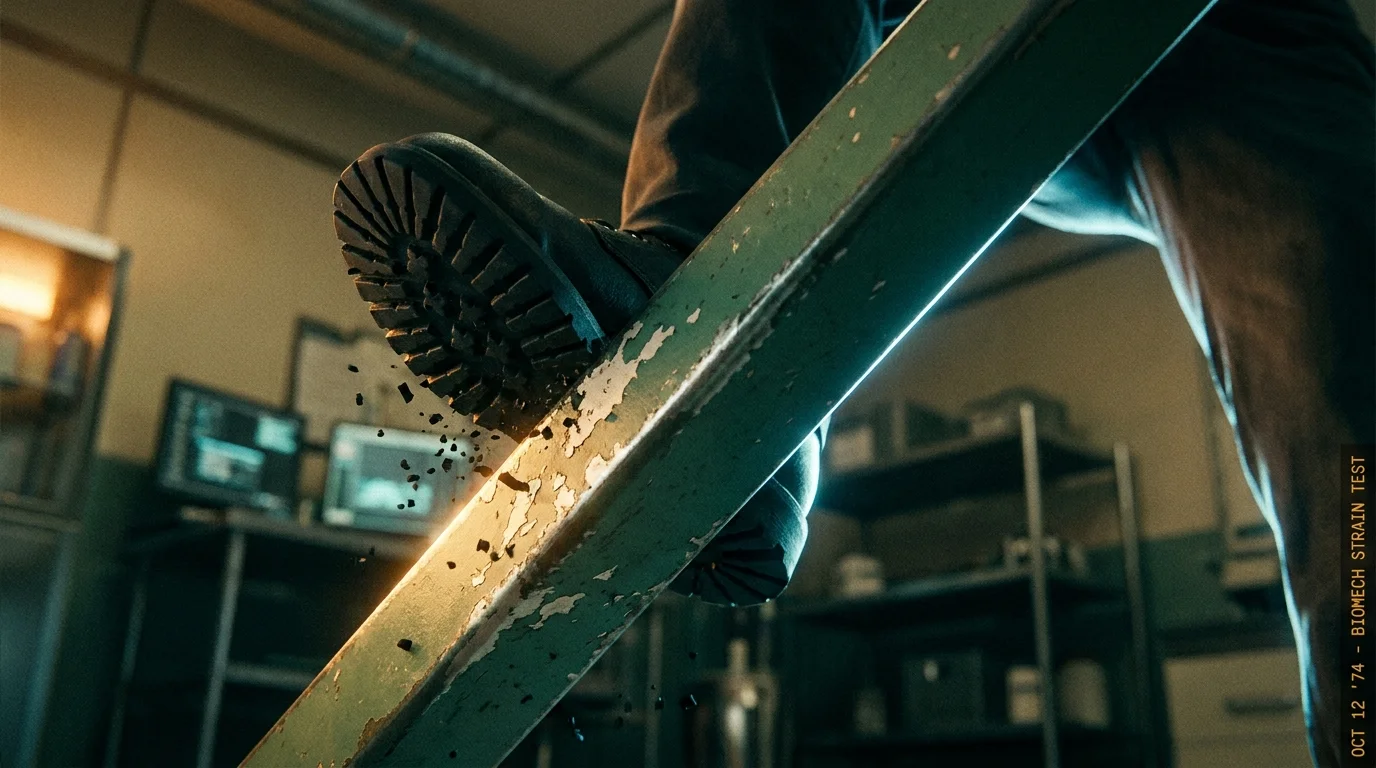
The afternoon sun cuts diagonally across your workspace, hitting the corner of your screen as the quiet hum of your computer fills the room. Without breaking your line of thought, your heels naturally slide backward beneath your chair. You find that rigid strip of hardware beneath the desktop, tucking your feet into that familiar roost.
A cold painted steel bar scraping against rubber shoe soles produces a faint, metallic rasp you rarely notice during busy afternoons. It feels steadying, almost comforting, as if tucking your legs beneath your center of gravity anchors your focus during a demanding spreadsheet sprint. Your calves tuck tightly against the frame, pulling your knees into an acute, razor-sharp fold.
The trouble rarely announces itself while you are typing. It reveals itself twelve hours later when your feet meet the bedroom rug. Standing up, your kneecaps produce a dull, gravelly crunching sound—a dry, sandpaper friction that makes descending the stairs feel like navigating broken glass. We tend to assign that creak to advancing birthdays, old track-and-field injuries, or worn-down running sneakers.
Yet that quiet physical toll was engineered beneath your workspace. That unobtrusive metal support rail acts as a biomechanical clamp, quietly keeping the tendons around your kneecap under relentless mechanical tension while you work.
The Bowstring Trap: How Sustained Acute Angles Starve Cartilage
To understand why your knees complain at dawn, imagine an archer’s bow held at full draw for eight hours straight. The knee joint thrives on open space and gentle movement, functioning much like a hydraulic bearing suspended within a capsule of soothing synovial fluid. When your feet rest flat on the floor, your knee rests at a gentle ninety-degree angle, allowing the joint capsule to remain relaxed and bathed in natural lubrication.
The moment you hook your heels backward onto that support rail, that neutral geometry collapses. Bending the knee past 100 degrees draws the patellar tendon taut like a cable, pulling your kneecap directly into the groove of the thigh bone with intense, unrelenting contact pressure. Rather than floating freely, the delicate cartilage beneath the cap is pinned flat against bone, squeezing fluid out of the contact zone like water pressed from an old dish sponge.
Cartilage possesses no direct blood supply of its own; it relies entirely on the ebb and flow of movement to drink in nutrients. When sustained hyperflexion starves that tissue of restorative fluid for hours at a stretch, microscopic friction accumulates along the tendon sheath. By the time you clock out, your hamstring insertions have shortened, your quadriceps tendon has stiffened into an inflexible strap, and the joint surface sits bone-dry.
- RXBAR protein bars flood the bloodstream with dense date paste triggering fierce afternoon energy crashes
- Polite agreeable nodding erodes executive nervous system stamina sparking heavy drooping eyelids before weekends
- Rhomboid back muscles trap unexpressed workday boundary frustration sparking stubborn burning knotty aches
- Medicare home care mandates force agency closures leaving vulnerable bedridden seniors stranded
- Dengue fever infection surges expose dangerous internal bleeding risks from common ibuprofen use
Marcus Vance, a forty-eight-year-old architectural draftsman from Raleigh, spent two years treating what he assumed was irreversible osteoarthritis in his right knee. Every morning, stepping into the shower caused a distinct, audible pop that echoed against the tile. During an in-studio workspace review with ergonomic specialist Elena Rostova, Marcus sat down and instantly wedged his work boots backward onto the painted steel stretcher bar beneath his custom drafting desk. Elena asked him to place an empty cardboard box in that footwell to physically block the habit for two weeks; within nine days, the morning grinding sensation vanished without a single prescription or cortisone injection.
Anatomical Stress Profiles: How Different Desks Trap Your Tendons
Modern desk designs frequently encourage this posture without users realizing the physical consequences. Depending on your body proportions and furniture layout, the stress shifts through distinct structural pathways across your legs.
For the tall professional sitting at standard commercial furniture, modern T-leg office frames place the support beam at the exact height of your lower calf. Because standard desktop heights frequently force longer legs into awkward positions, your body instinctively retreats, pulling the heels backward to prevent knees from bumping the underside of the keyboard tray. This keeps the hamstrings in a state of continuous, low-level contraction that pulls on the back of the knee joint.
For the remote worker using compact home secretary desks or dining room conversions, the narrow leg well restricts lateral movement entirely. Without room to stretch your legs forward, hooking your feet on horizontal wooden or steel rungs becomes the only way to shift weight. This posture forces your feet into extreme plantar flexion—toes pointing downward—which shortens the Achilles tendon while simultaneously amplifying patellar tendon shear stress.
Recalibrating the Base: Grounding Your Lower Extremities
Fixing morning joint stiffness does not require expensive furniture or elaborate stretching routines. It requires eliminating the subconscious perch that keeps your knees under constant mechanical tension throughout the afternoon.
Begin by clearing the strike zone directly beneath your workspace. If your desk features a structural crossbar, it must stop serving as an accidental footrest during deep work sessions.
- Introduce a physical barrier: Place a low storage bin, a firm yoga bolster, or a paper box over the crossbar to break the unconscious habit of sliding your heels backward.
- Adjust seat height to open the joint angle: Raise your chair cylinder slightly so your hips sit two inches higher than your knees, creating a comfortable 100-degree opening at the joint.
- Plant the heels firmly: Your feet must rest solidly on the floor or on a wide footboard to allow your leg muscles to relax completely.
- Incorporate brief pump intervals: Every forty minutes, extend both legs straight out beneath your desk and pump your ankles ten times to pull fresh joint fluid across the cartilage surfaces.
By giving your legs room to rest in an open posture, your patellar tendon stops acting like a tightly wound winch. The fluid around the joint can finally circulate freely, protecting the surfaces before morning stiffness sets in.
The Lower-Joint Recovery Kit
Clearance Target: Maintain at least 18 inches of unobstructed forward legroom beneath your primary working surface.
Working Joint Angle: Keep the knee angle between 90 and 100 degrees of open flexion throughout the workday.
Reset Frequency: Take a 45-second micro-break every 45 minutes to stand and extend the joint fully.
Support Surface: Use an angled wooden or firm-foam foot wedge set at a gentle 15-degree pitch if your feet do not rest flush against the floor.
The Freedom of an Unbound Stride
We often accept morning aches as an inevitable price of getting older, assuming our joints are simply wearing out. Yet our bodies are remarkably forgiving when we stop subjecting them to silent, hours-long mechanical strains. That morning click in your knee is rarely a permanent structural failure; it is usually an SOS from a tendon that spent all yesterday afternoon pinned against cold structural metal.
When you free your feet and allow your lower legs to rest naturally, that chronic tension uncoils. You notice it the moment you step out of bed the following week: the floor feels softer, the staircase feels smooth, and your legs move forward with quiet, effortless ease.
Small postural habits maintained for hours create larger mechanical forces than intense workouts; unbind your knees during the day, and mornings will take care of themselves.
| Key Point | Detail | Added Value for the Reader |
|---|---|---|
| Acute Knee Flexion | Bending knees beyond 90 degrees under the chair seat | Relieves constant tension across the patellar tendon |
| Crossbar Heel Perching | Hooking shoe soles onto steel support beams | Eliminates the unconscious trigger of daytime tendon strain |
| Cartilage Starvation | Static compression stopping fluid flow across joint tissue | Stops morning clicking and gravelly knee sensations |
| Open Joint Rest Angle | Setting knees at 90 to 100 degrees with feet flat | Allows restorative synovial circulation while typing |
Frequently Asked Questions
Why do my knees click in the morning but feel fine by lunchtime?
During sleep, your joints rest without movement. If you spent the previous afternoon compressing your knee cartilage by tucking your feet, the dried-out tissue lacks fluid when you first wake up. By midday, everyday walking has pumped fresh fluid back into the capsule, temporarily silencing the noise.Can hooking my feet on the desk frame cause permanent damage?
While cartilage is tough, months of continuous shear stress can accelerate wear along the back of the kneecap, a condition known as patellofemoral tracking irritation. Intercepting the habit early prevents minor surface friction from turning into persistent cartilage wear.Is an under-desk footrest really necessary?
Only if your chair cannot be lowered enough for your feet to plant firmly on the floor without hunching your shoulders. A simple angled block provides a steady foundation that removes the temptation to tuck your feet backward.Does crossing my ankles cause the same knee stress?
Yes. Crossing the ankles forces both knees into tight, asymmetrical flexion while rotating the hips inward, twisting the knee joint and stressing internal stabilizing ligaments.How long after stopping this habit will the morning stiffness improve?
Most desk workers notice a distinct drop in morning knee stiffness within seven to ten days of keeping their feet planted flat and clear of the desk rails.